
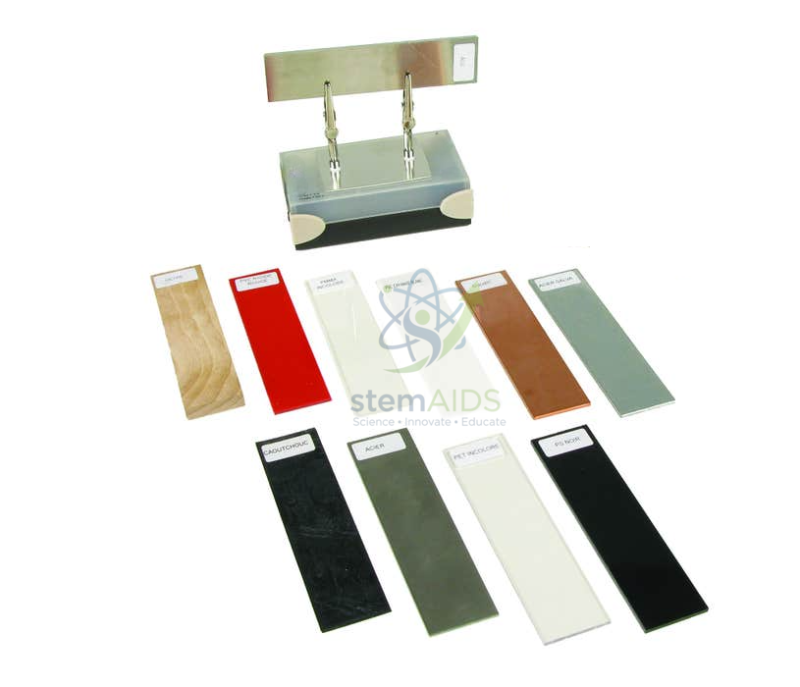
Quick Answer: The Electrical Conductivity Pack is a set of flat sample strips in different materials together with a holder that grips each strip between two contacts, so it can be placed in a simple circuit and tested. Students use the electrical conductivity pack to sort conductors from insulators and to compare how readily different materials carry current.
Conductors, Insulators and In Between
Metals conduct well because some of their electrons are free to drift through the material when a voltage is applied. In insulators such as wood, most plastics and ceramics, the electrons are tightly bound and almost no current flows. Some materials sit between the two: carbon in the form of graphite conducts, though less well than a metal, which surprises students who expect only metals to conduct.
The product photograph shows a holder with two upright contact posts and a clamping bar, and around it a set of strips of contrasting appearance, including wood-coloured, red, white, copper-coloured, grey and black samples. Because the strips are the same shape and size, any difference in the reading comes from the material itself.
Testing a Strip
The simplest test puts a cell, a lamp or LED and the holder in series. A strip that lights the lamp brightly is a good conductor; one that leaves it dark is an insulator. To rank the conductors, replace the lamp with an ammeter, or measure resistance directly with an ohmmeter, and compare the values.
Resistance depends on length, cross-section and material, R = ρL/A. With length and section fixed by the identical strips, a lower resistance means a lower resistivity, so the ranking is a ranking of materials.
Specifications
| Product | Electrical conductivity pack |
| Holder | Two contact posts with clamping bar |
| Samples | Flat strips of equal shape in different materials |
| Test circuit | Cell with lamp, LED, ammeter or ohmmeter |
| Material list of the strips | Confirm at enquiry |
Activities With the Pack
- Sorting the sample strips into conductors and insulators with a lamp circuit
- Ranking the conductors by current or resistance
- Showing that carbon-based material conducts, unlike other non-metals
- Discussing why cables use copper cores with plastic insulation
Care & Handling
- Clean metal strips gently with fine abrasive paper if they tarnish, since oxide layers add resistance
- Tighten the clamping bar firmly but without bending the strips
- Keep the strips together in their pack so the set stays complete
- Use only low-voltage cells or supplies for the tests
Why Choose LabEquip
As one of the simplest electricity experiment kits for schools, the pack suits primary and lower-secondary classes as well as revision lessons later on. LabEquip supplies it with the Study of Ohm’s Law module among its physics equipment; the strip materials can be confirmed through the contact page.
Frequently Asked Questions
How do students test whether a strip conducts?
Clamp the strip in the holder and connect it in series with a cell and a lamp or LED. If the lamp lights, the strip conducts; if it stays dark, the strip is an insulator.
Why are all the samples the same shape?
Resistance depends on length and cross-section as well as material. Identical strips make it a fair test, so differences in the readings come from the materials alone.
Why might a metal strip give a poor reading?
A tarnish or oxide layer on the surface, or a loose clamp, adds resistance at the contacts. Clean the contact areas and tighten the holder, then test again.
Can a lamp show the difference between two good conductors?
Usually not. Both will light the lamp fully, because the lamp’s own resistance is much larger than theirs. An ammeter or an ohmmeter is needed to rank good conductors.
What is the difference between conductance and resistance?
Conductance is the reciprocal of resistance. A material with high conductance has low resistance, and conductance is measured in siemens while resistance is measured in ohms.
Is the pack suitable for primary classes?
Yes. With a single cell and a bulb, younger pupils can sort materials safely. Older students can extend the same pack to quantitative resistance measurements.
Last Updated: October 2026






Reviews
There are no reviews yet.