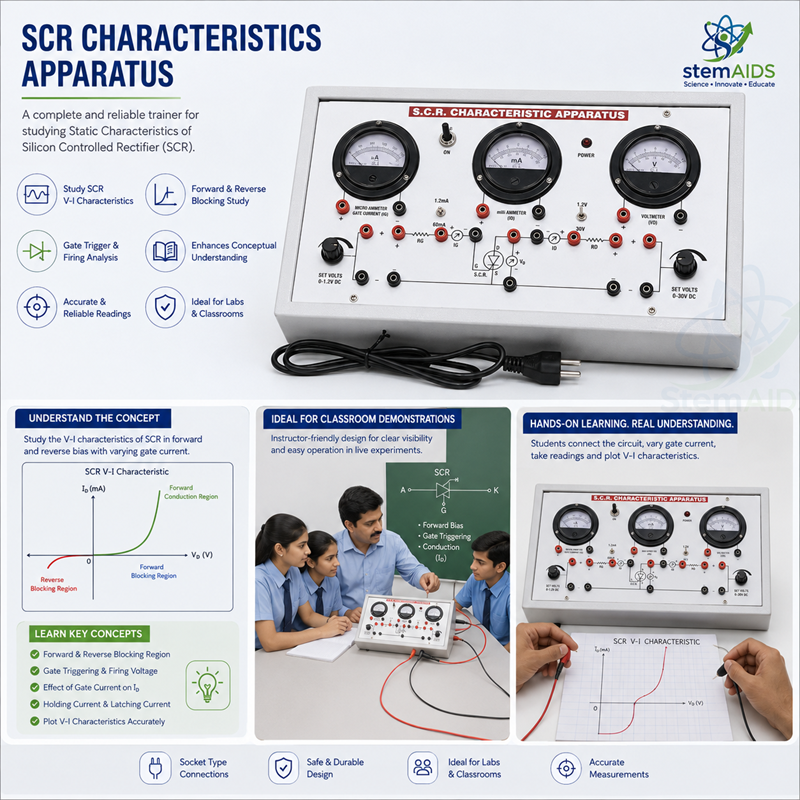
Quick Answer: The SCR Characteristics Apparatus is an electronics lab unit used to study a Silicon Controlled Rectifier (SCR/thyristor) — plotting its V-I characteristic curve and demonstrating how a gate trigger current switches the device from a blocking (off) state into a conducting (on) state.
An SCR is a four-layer semiconductor device widely used in power electronics for rectification and switching applications. This apparatus provides a panel-mounted SCR with Anode, Cathode, and Gate terminals brought out for external wiring, letting students apply a small gate current to trigger conduction and then record anode voltage/current readings to plot the forward and reverse characteristic curve.
It is used in undergraduate electrical/electronics engineering labs, diploma and polytechnic courses, wherever the syllabus covers thyristor/SCR characteristics as part of a power electronics or industrial electronics module.
Key Features
- Panel-mounted SCR with labelled Anode (A), Cathode (K), and Gate (G) terminals
- Demonstrates gate-triggered switching from blocking state to conducting state
- Supports plotting of the forward V-I characteristic curve of the SCR
- Compact bench-top layout for use with an external DC supply and standard meters
- Useful for lab sessions covering thyristors and power electronics switching devices
Specifications
| Product Type | SCR Characteristics Apparatus |
| Application | Plotting the V-I characteristic curve of a Silicon Controlled Rectifier (SCR/thyristor) |
| Terminals | Anode (A), Cathode (K), Gate (G) |
| Mounting | Panel-mounted with terminal posts for external wiring |
| SCR Device Included | Not specified for this listing — confirm with our sales team |
| Power Supply Required | External regulated DC supply (not included unless stated on the listing) — confirm with our sales team |
| Brand | LabEquip |
Safety Note
Apply gate current only within the safe triggering range for the mounted SCR, and keep anode current within its rated limit to avoid damaging the device. Observe correct terminal polarity for Anode, Cathode, and Gate connections, use a current-limited DC supply, and disconnect power before changing any wiring. Once triggered, an SCR continues conducting until anode current is interrupted — factor this into how the circuit is powered down. Recommended for supervised use in a teaching lab setting.
Why Choose LabEquip
Explore related boards and modules from our Electrical and Electronics range to build out a complete semiconductor devices lab:
Frequently Asked Questions
What does the SCR Characteristics Apparatus demonstrate?
It demonstrates the V-I characteristic curve of a Silicon Controlled Rectifier (SCR), including how a small gate trigger current switches the device from a blocking state to a conducting state.
What terminals does the apparatus provide?
It provides access to the Anode (A), Cathode (K), and Gate (G) terminals of the mounted SCR for connection to an external DC supply and meters.
How is the SCR triggered into conduction?
A small current applied to the gate terminal triggers the SCR into conduction; once triggered, it continues conducting until the anode current is reduced below the holding current.
Is the SCR device included with the apparatus?
This is not specified for the current listing. Please confirm exactly what is included with our sales team before ordering.
What topic area does this apparatus support?
It supports lab work on thyristors and power electronics switching devices, typically covered in a power electronics or industrial electronics course.
Who is this apparatus intended for?
It is intended for undergraduate electrical/electronics engineering students, diploma and polytechnic learners, and technical training institutes covering SCR/thyristor characteristics.
Last Updated: September 2026