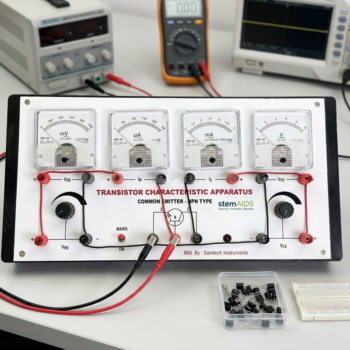
Quick Answer: The Electronic Leclanche Cell is an electronic demonstration unit that represents the classic Leclanché primary cell in physics and electrochemistry teaching. It gives classes a repeatable low-voltage DC source for cell experiments without preparing a wet chemical cell for every session.
The Leclanché Cell and Its Electronic Equivalent
The Leclanché cell, devised by Georges Leclanché in the 1860s, uses a zinc rod as the negative electrode and a carbon rod surrounded by manganese dioxide as the positive electrode, standing in ammonium chloride solution, often with the carbon and manganese dioxide packed in a porous pot. It gives an EMF of about 1.5 V and is the ancestor of the ordinary zinc-carbon dry cell.
In the laboratory, the wet cell is demanding. The zinc is consumed, the electrolyte must be made up and replaced, and under continuous current the cell polarises: hydrogen collects at the carbon faster than the manganese dioxide can remove it, so the voltage sags. That is why the Leclanché cell was traditionally used for intermittent loads such as electric bells. The electronic version avoids the chemistry and gives a repeatable output lesson after lesson.
Its most familiar use is in the senior physics potentiometer practical that compares the EMFs of two primary cells, usually a Leclanché and a Daniell cell. Each cell is balanced against the potentiometer wire, and the ratio of their EMFs equals the ratio of the balancing lengths, E1/E2 = l1/l2. For this experiment it is usually paired with LabEquip’s electronic Daniell cell, rated 1.08 V.
Specifications
| Apparatus | Electronic equivalent of a Leclanché cell (demonstration unit) |
| Represents | Leclanché zinc-carbon primary cell, classic EMF about 1.5 V |
| Output | Low-voltage DC, repeatable between sessions |
| Main practical | Comparing EMFs of two primary cells with a potentiometer |
| Output voltage and terminals | Confirm at enquiry |
| Use | Supervised school and college physics labs |
Safety and Care
- Use the cell under teacher supervision and make connections with any switches open.
- Observe polarity when connecting voltmeters, galvanometers and potentiometer circuits.
- Never short-circuit the output terminals, and keep the unit away from water and damp benches.
- Stop using the cell if a lead, terminal or casing is damaged.
Why Choose LabEquip
Physics departments setting up the EMF comparison practical usually buy this unit together with the electronic Daniell cell, and schools that still want students to assemble a wet cell can use the Leclanche Cell Pots from the same Electrical and Electronics range. Send quantities for each lab through the contact page, noting whether you need the Daniell unit too.
Frequently Asked Questions
What is an electronic Leclanche cell?
It is an electronic demonstration unit that stands in for the traditional wet Leclanché cell, giving a repeatable low-voltage DC output for cell and circuit experiments without zinc rods, porous pots or ammonium chloride solution.
What was inside a traditional Leclanché cell?
A zinc rod as the negative electrode, a carbon rod packed with manganese dioxide as the positive electrode, and ammonium chloride solution as the electrolyte. The manganese dioxide acted as a depolariser.
Why use an electronic version instead of a wet Leclanché cell?
A wet cell needs fresh electrolyte, consumes its zinc and polarises under continuous current, so readings drift. The electronic unit avoids chemical preparation and gives a repeatable output, which keeps potentiometer readings consistent between groups.
Which practical uses a Leclanché cell alongside a Daniell cell?
The potentiometer experiment to compare the EMFs of two primary cells. Students find the balancing length for each cell and use E1/E2 = l1/l2 to compare them.
What output voltage does the unit give?
A traditional Leclanché cell gives about 1.5 V. The output of this electronic unit is confirmed at enquiry, so mention the experiment you will use it for.
What safety precautions apply?
Use it under supervision, connect it with correct polarity, never short the terminals, keep it dry and stop using it if any lead or casing is damaged.
Last Updated: October 2026