
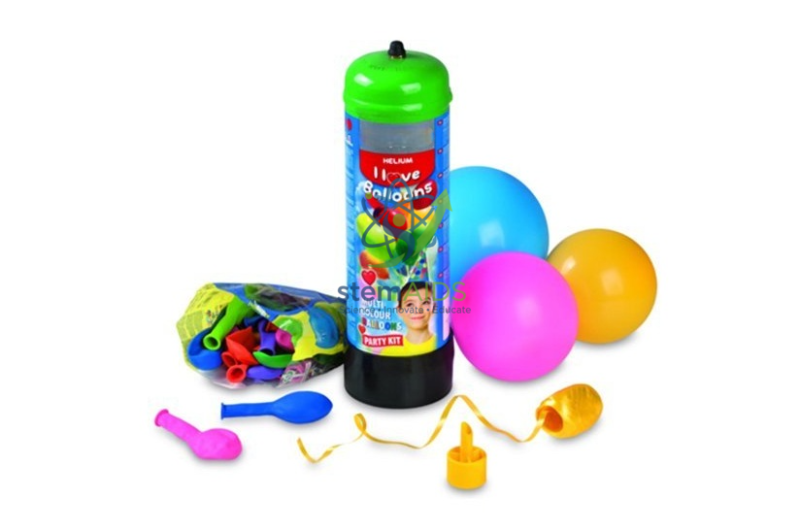
Quick Answer: Compressed Helium 2.2 L is a canister of helium gas, 2.2 L being the canister size given in its name, shown in the product photograph with a pack of balloons. Compressed helium fills balloons that float in air, making buoyancy and the density of gases visible in a physics lesson.
Why a Helium Balloon Rises
Archimedes’ principle applies to gases as well as liquids: a balloon in air feels an upthrust equal to the weight of the air it pushes aside. Helium has a molar mass of 4 g/mol against about 29 g/mol for air, so at the same temperature and pressure it is roughly one seventh as dense. A litre of air weighs about 1.2 g and a litre of helium about 0.17 g, so each litre of helium released into a balloon gives close to 1 g of lift before the balloon’s own weight is subtracted.
Students can test this directly. Hang paper clips from a filled balloon until it just hovers, measure the balloon’s diameter to estimate its volume, and compare the measured lift with the calculation. The agreement is usually close, and the gap opens a discussion of the rubber’s weight and the slightly raised pressure inside the balloon.
Diffusion and the Speed of Sound
A helium balloon goes soft within a day or so while an air-filled one lasts far longer, because small helium atoms pass through rubber much faster than nitrogen and oxygen molecules. Graham’s law gives a first comparison: rates of effusion vary inversely with the square root of molar mass, so helium escapes through a small hole about 2.7 times faster than air.
Sound travels almost three times faster in helium than in air. Blowing a small whistle or organ pipe with helium from the canister instead of breath raises its pitch, because the resonant frequency depends on the speed of sound in the gas inside. This shows the effect safely, without anyone breathing the gas.
Specifications
| Product | Compressed helium canister |
| Size, from title | 2.2 L |
| Shown in photograph | Canister with balloons, ribbon and clips |
| Gas | Helium, an inert gas lighter than air |
| Number of balloons and canister pressure | Confirm at enquiry |
Lessons for the Helium Canister
- Measuring balloon lift and comparing it with an Archimedes’ principle calculation
- Comparing how quickly helium and air balloons deflate, linked to Graham’s law
- Raising the pitch of a whistle or pipe sounded with helium
- Discussing gas density, from weather balloons to airships
Care & Handling
- Never inhale helium from the canister or from a balloon
- Store the canister upright, away from heat and direct sun, and never puncture it
- Close the nozzle fully after use and keep the canister and balloons away from young children
- Follow the canister label for disposal, and never attempt to refill it
Why Choose LabEquip
Physics teachers and science clubs buy compressed helium for the buoyancy lesson students remember, where a calculation is tested against a balloon that floats. LabEquip can supply it with other physics lab equipment; contact LabEquip about quantities for a class.
Frequently Asked Questions
How much can one litre of helium lift?
About 1 g at room conditions. Air has a density of roughly 1.2 g per litre and helium about 0.17 g per litre, so the difference, a little over 1 g per litre, is the lift before the balloon’s own weight.
Why do helium balloons deflate faster than air balloons?
Helium atoms are much smaller and lighter than the nitrogen and oxygen molecules in air, so they pass through rubber more quickly. A helium balloon can go soft within a day, while an air balloon lasts far longer.
Is it safe to breathe helium to change the voice?
No. Breathing helium displaces oxygen in the lungs and can cause fainting or worse. Show the effect of helium on sound with a whistle or pipe sounded with helium instead.
Why does a whistle sound higher with helium?
The note of a whistle or pipe depends on the speed of sound in the gas inside it. Sound travels almost three times faster in helium than in air, so the resonant frequency, and the pitch, rises.
Is helium flammable?
No. Helium is an inert noble gas and does not burn, which is why it replaced hydrogen in airships. The canister is still a pressurised container and must be kept away from heat.
What should be done with the empty canister?
Follow the disposal instructions on the canister label. Never puncture, burn or try to refill a pressurised canister, even when it seems empty.
Last Updated: October 2026






Reviews
There are no reviews yet.