
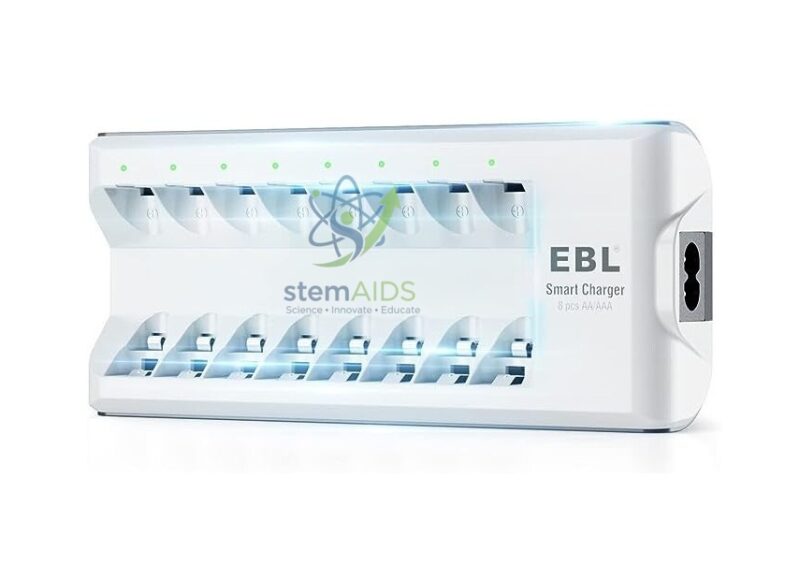
Quick Answer: This battery charger is a multi-bay charger for cylindrical rechargeable cells, shown in the product photograph as a white unit with a row of charging bays. A battery charger keeps the rechargeable cells used in multimeters, stopwatches, data loggers and cell-powered circuits ready for the next practical, instead of relying on single-use cells.
What Charging Does
A rechargeable cell stores energy in reversible chemical reactions. Discharging lets the reaction run and drive a current; charging pushes current the other way and reverses the reaction, restoring the chemicals to their charged state. A battery charger supplies that current in a controlled way and stops or reduces it when the cell is full, because overcharging heats the cell and shortens its life.
Cell capacity is given in milliamp-hours. A cell rated at 2000 mAh could in principle supply 200 mA for 10 hours. Charging it at 500 mA would take at least four hours, and in practice somewhat longer, because charging is never perfectly efficient.
Uses in the Department
- Keeping a department’s rechargeable cells charged between lessons
- Measuring cell capacity by logging discharge through a resistor
- Comparing the capacity of new and older cells
- Discussing reversible reactions and energy storage in rechargeable cells
A Capacity Measurement Practical
Charge a cell fully, then discharge it through a known resistor while logging the voltage every few minutes. The current at each moment is V ÷ R, and the area under the current-time graph is the charge delivered, which can be compared with the capacity printed on the cell. Multiplying by the average voltage gives the energy stored.
Comparing a new cell with an older one shows how capacity falls with age, and repeating with two different resistors shows that a cell delivers less of its rated capacity at higher currents.
Specifications
| Product | Battery charger for rechargeable cells |
| Shown in photograph | White multi-bay charger with a row of cell bays |
| Use | Recharging cells for meters, timers, data loggers and circuits |
| Charges | Rechargeable cells only, never single-use cells |
| Cell sizes, chemistry and number of bays | Confirm at enquiry |
Care & Handling
- Charge only the rechargeable cell types the charger is made for; never insert single-use alkaline or lithium primary cells
- Charge on a hard, non-flammable surface away from paper and heat
- Remove cells once charged and unplug the charger when it is not in use
- Stop using any cell that is swollen, leaking or unusually hot
Why Choose LabEquip
Departments that switch their meters and timers to rechargeable cells buy a charger so a full set is always ready. For devices that take coin cells, keep spare lithium 3V button cells, which are normally single-use; contact LabEquip with the cell sizes your charger must take, or browse more physics lab equipment.
Frequently Asked Questions
Can single-use alkaline cells be charged?
No. Charging cells not designed for it can cause leakage, heating or bursting. Charge only cells marked as rechargeable and of a type the charger supports.
How long does charging take?
Roughly the cell capacity divided by the charging current, plus extra because charging is not perfectly efficient. A larger capacity or a lower charging current takes longer.
What does mAh mean?
Milliamp-hours, a measure of the charge a cell can deliver. A 2000 mAh cell could ideally supply 2000 mA for one hour or 200 mA for ten hours.
Why do rechargeable cells give a lower voltage than alkaline cells?
The common rechargeable chemistry for these sizes, nickel-metal hydride, gives about 1.2 V per cell against about 1.5 V for alkaline. Many devices designed for alkaline cells run well on 1.2 V cells.
How can students measure how much charge a cell holds?
Discharge a fully charged cell through a known resistor, logging voltage over time. Current is voltage divided by resistance, and the area under the current-time graph gives the charge delivered.
Which cell sizes does the charger take?
The photograph shows several bays for cylindrical cells. The sizes, chemistry and number of bays can be confirmed at enquiry so the charger matches your equipment.
Last Updated: October 2026




Reviews
There are no reviews yet.