
Quick Answer: The stand-alone direct current joulemeter is a self-contained energy meter for DC circuits: it is wired between a source and a load and displays the electrical energy delivered, together with readings such as voltage, current and power. Physics classes use a DC joulemeter to measure energy input in efficiency, heating and motor experiments.
What a Joulemeter Adds to Separate Meters
Electrical energy is E = V × I × t. With a separate voltmeter, ammeter and stopwatch, students must read all three and multiply, and the answer is only right if voltage and current stayed steady. A DC joulemeter does that sum continuously and adds the result up, so the total is correct even when the current drifts, as it does when a heater warms, a motor slows under load or a capacitor charges.
The word stand-alone matters here: the meter works on its own with its built-in display, without a data logger or computer. That makes it quick to set up on any bench and easy to read from where students stand.
Wiring the Meter Into a Circuit
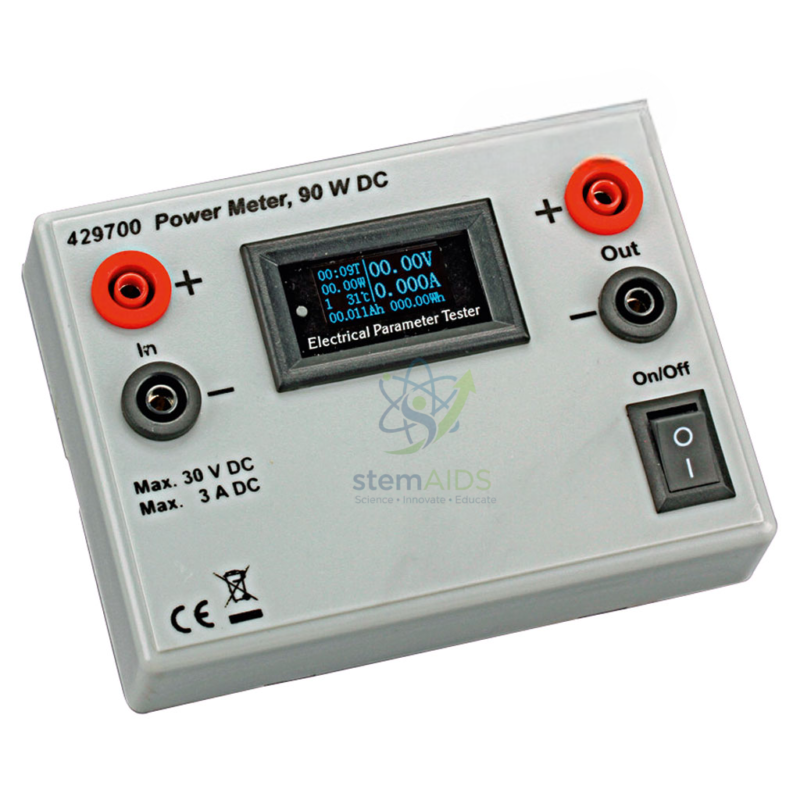
The front panel in the product photograph shows a pair of input sockets and a pair of output sockets with polarity marks, a digital display and an on/off switch. The source connects to the input side and the load to the output side, so all of the energy reaching the load passes through the meter. Reset or note the starting reading before each run.
A joulemeter itself uses a little energy to run its electronics and measuring circuit, so for very small loads its own consumption should be kept in mind. The panel also carries the maximum voltage and current the meter accepts; the circuit must stay within those markings.
Experiments Using a DC Joulemeter
- Measuring the energy supplied to an immersion heater in a metal block to find specific heat capacity
- Finding the electrical input when a motor lifts a load, for an efficiency calculation
- Recording the energy taken by a capacitor during charging and comparing it with ½CV²
- Comparing the energy two small lamps use over the same time
Specifications
| Instrument | Stand-alone joulemeter (energy meter) for direct current circuits |
| Display | Digital, showing electrical quantities including energy |
| Connections | Input and output terminal pairs marked for polarity |
| Operation | Self-contained, no computer or data logger required |
| Current type | Direct current only, as the product name states |
Care & Handling
- Check polarity before switching on: source positive to the input positive socket
- Keep voltage and current within the limits printed on the front panel
- Switch the joulemeter off after use so its display electronics are not left running
- Never connect the meter to mains or to any alternating supply
Why Choose LabEquip
Schools and colleges buy a DC joulemeter mainly for specific heat capacity and efficiency practicals, where it removes the most error-prone arithmetic. LabEquip supplies it alongside the energy and efficiency models and other physics equipment; bench quantities for a class set can be arranged through the contact page.
Frequently Asked Questions
What is the difference between a joulemeter and a wattmeter?
A wattmeter shows power, the rate at which energy is being transferred, in watts or joules per second. A joulemeter adds that power up over time and shows the total energy in joules. One watt flowing for ten seconds gives ten joules.
Can the joulemeter be used with an AC supply?
No. It is a direct current instrument, as its name says, and should only be connected to DC sources such as a laboratory DC supply, cells or a DC generator. AC energy measurements need a meter designed for alternating current.
How is specific heat capacity found with a DC joulemeter?
Put an immersion heater in a drilled metal block, wire it through the joulemeter, and record the energy supplied and the temperature rise. Specific heat capacity is the energy divided by the product of the mass and the temperature rise. Insulating the block reduces heat losses.
Why does the energy reading keep rising when the current is steady?
Energy accumulates with time. A steady current at a steady voltage means steady power, so the joule reading climbs at a constant rate. The slope of a graph of energy against time equals the power.
Which way round should the source and load be connected?
The source goes to the input terminals and the load to the output terminals, matching the positive and negative marks. Reversing them may give no reading or an incorrect one, so check the markings before switching on.
What limits should be checked before connecting a circuit?
Read the maximum voltage and maximum current printed on the meter’s front panel and make sure the supply and load stay within both. Exceeding them can damage the measuring circuit or the display.
Last Updated: October 2026




Reviews
There are no reviews yet.