
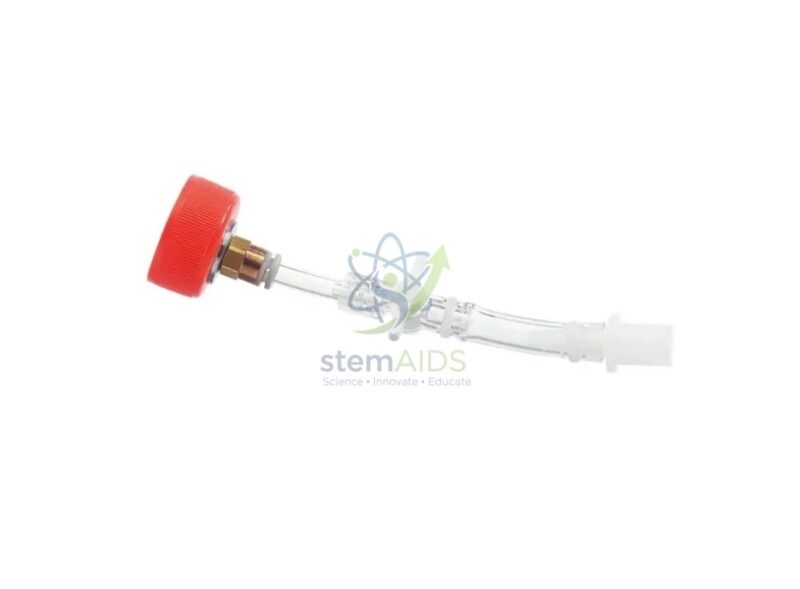
Quick Answer: The soda bottle adapter cap is a red screw cap fitted with an outlet nozzle and a short tube with a connector, as pictured, that replaces the lid of a plastic drinks bottle. With the soda bottle adapter cap in place, the bottle becomes a simple reaction vessel whose gas can be led away to a syringe, a balloon or a water trough.
Why Use a Drinks Bottle as a Reaction Vessel
Plastic fizzy-drink bottles are designed to hold carbonated drinks under pressure, they are clear enough to watch a reaction, and every school can collect them easily. What a bottle lacks is a safe gas outlet. This adapter cap provides it: the reaction mixture goes into the bottle, the cap is screwed on, and the gas leaves only through the nozzle and the tubing attached to it.
Because the bottle is large compared with a test tube, slow reactions that release gas over many minutes, such as yeast fermenting a sugar solution, can run in it for a whole lesson, while the gas is collected and measured further down the line.
A Typical Set-Up
Place the reactants in the bottle, for example vinegar with a measured amount of sodium hydrogen carbonate, or dilute hydrogen peroxide with a little yeast as a catalyst. Screw the cap on promptly, with the tubing already connected to a graduated syringe or led under an inverted vessel in a water trough. The volume of gas collected over time can then be recorded and plotted.
Specifications
| Product | Adapter cap for plastic drinks bottles |
| Shown in photograph | Red screw cap with metal nozzle, short tube and connector |
| Function | Seals the bottle and routes the gas produced to an outlet tube |
| Used with | Plastic drinks bottle, delivery tubing, gas syringe or water trough |
| Thread | For the common screw neck of plastic soft-drink bottles; check the fit on your bottles at enquiry |
Uses in Class
- Producing carbon dioxide from vinegar and sodium hydrogen carbonate and collecting it
- Measuring the oxygen released when yeast breaks down hydrogen peroxide
- Following alcoholic fermentation by collecting the carbon dioxide yeast produces
- Comparing how temperature or concentration changes the volume of gas released per minute
Care & Handling
- Never close the outlet while a gas-producing reaction is running in the bottle, so pressure cannot build up
- Use only small amounts of reactants and keep the bottle upright
- Rinse the cap and nozzle after use and let them dry before storage
- Replace the bottle if it is creased, scratched deeply or has been heated
Why Choose LabEquip
Teachers choose this cap because it makes gas experiments possible with bottles the school already has. LabEquip supplies it with the 60 mL graduated syringe for measuring gas volume and the wider physics lab equipment range, and you can contact LabEquip to confirm the thread suits your bottles.
Frequently Asked Questions
Which bottles does the cap fit?
It is intended for the screw neck used on plastic soft-drink bottles. Bottle necks vary between brands and countries, so try it on the bottles your school collects before running a class practical.
Is it safe to seal a bottle in which gas is being produced?
Only if the outlet stays open. The cap is safe because the gas escapes through the nozzle and tubing. Never block the outlet or tighten a plain lid on a reacting mixture.
What can the gas be collected in?
Connect the outlet to a graduated syringe to read the volume, lead the tubing under an inverted vessel in a water trough, or fit a balloon to show the gas qualitatively.
Can the bottle be heated?
No. Plastic drinks bottles soften with heat. Use reactions that work at room temperature or with warm, not hot, water around the bottle.
Why does the first gas collected contain air?
The empty part of the bottle is full of air, and the gas produced pushes that air out first. For testing a pure gas, let the first portion escape before collecting.
How is the cap cleaned?
Rinse it with warm water, flush water through the nozzle and tubing, and leave it to dry. Avoid solvents, which can damage the plastic and the seal.
Last Updated: October 2026




Reviews
There are no reviews yet.