
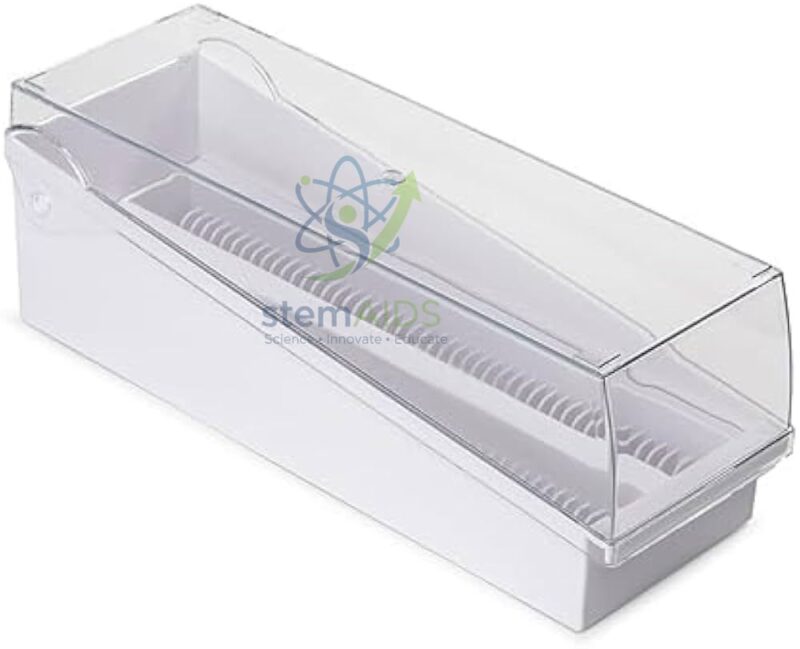
Quick Answer: The Slide Storage Rack, Plastic is a plastic rack that holds microscope slides on edge in a row of slots, filing them like cards so a working collection can be browsed, removed and put back quickly. A plastic slide storage rack suits reference and teaching slides that are used week after week.
Filing Slides for Everyday Use
A slide collection in daily use is handled differently from an archive. In a histopathology teaching lab or a college zoology department, a demonstrator may pull a dozen slides for a morning practical and return them the same afternoon. A storage rack keeps the whole run in view: slides stand on edge in order with their labels visible, and a finger can walk along the row to find a specimen without unpacking anything.
Plastic suits this job. It does not rust or splinter, it is light enough to lift onto a bench with the slides in place, and it wipes clean. Racks of this style are often made to stack or come with a clear cover to keep dust off; this listing does not state the capacity or whether a cover is included, so check both before ordering.
For long-term archiving, or for carrying slides between rooms, a closed plastic slide box is safer, because it latches and can be moved without slides tipping out. Many departments use both: a rack for the current term’s teaching set and boxes for the rest of the collection.
Specifications
| Item | Rack for storing microscope slides on edge |
| Material | Plastic |
| Arrangement | Row of slots, slides filed like index cards |
| Suited to | Working collections that are accessed often |
| Capacity and cover | Confirm at enquiry |
Care & Handling
- File only dry, finished slides; soft mountant glues slides to the slot walls.
- Keep the plastic slide storage rack away from xylene and other solvents, which can soften or cloud some plastics.
- Keep it level on a shelf or in a drawer out of direct sunlight, which fades stains and can make plastics brittle.
- Put slides back in their labelled order after each practical, before gaps and mix-ups build up.
Applications
- Holding the current term’s teaching slides beside the demonstration microscope
- Filing pathology or microbiology reference slides by organ or organism
- Sorting student preparations by group before marking
- Keeping slides in order during a long practical examination
Why Choose LabEquip
Histology and pathology teaching labs, college biology departments and hospital training rooms use racks for slides handled week after week. LabEquip supplies this rack from its Microscope & Optics range; list the number of slides you need to file on the contact page.
Frequently Asked Questions
How does a storage rack differ from a slide box?
A rack is built for quick access: slides stand in an open row and can be scanned by label. A slide box closes and latches, so it is better for archiving and carrying. Racks suit the slides in use this term, boxes suit the rest.
Can slides with fresh mountant go straight into the rack?
No. Leave newly mounted slides lying flat on a tray first. On edge, soft mountant lets the cover glass slip and the specimen drift, and any mountant that oozes out glues the slide into its slot.
How should slides be ordered in the rack?
Pick one scheme and keep to it: by syllabus topic, by organ system for histology, or by catalogue number for a reference set. Write the position number on each slide label so returned slides go back to the same place.
Is the plastic rack resistant to cleaning chemicals?
Mild detergent and water are safe for most plastics. Xylene, toluene and acetone attack many plastics, so keep them off the rack and wipe immersion oil from slides before filing them.
Does the rack protect slides from humidity?
Only partly. It keeps slides apart and off the shelf, but fungus can still grow on slides kept in damp air. Keep the rack in a dry room and put a desiccant sachet in the drawer during the monsoon or other damp months.
Can the rack be used for drying slides?
It is designed for storage rather than drying. Slides that have just been washed or stained should drain on a draining tray first and go into the rack only once they are dry.
Last Updated: September 2026







Reviews
There are no reviews yet.