







In Stock
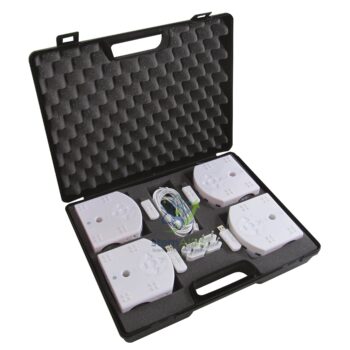
Volume Relationship Set for School Maths Lab
Precision-Matched Base and Height Dimensions: Facilitates the empirical derivation of the V = 1/3 Bh formula, enabling students to analyze the constant geometric ratio between cones/pyramids and their corresponding cylinders/prisms.
Transparent, Graduated Walls: Allows for high-accuracy displacement observation, supporting the Evaluation of Archimedes' Principle and the concept of volumetric invariance across disparate shapes.
₹530.00
Quick Answer: A Volume Relationship Set is a group of hollow geometric solids with matching dimensions that are filled and poured into one another to compare their volumes. The volume relationship set is typically used to show that a cone holds one third of a cylinder with the same base and height, and to explore similar relationships between other solids.
Discovering the One-Third Rule by Pouring
Most students meet V = ⅓πr²h for a cone as a formula to memorise. With a cone and a cylinder that share the same base radius and height, they can find the one-third for themselves: fill the cone with sand or water, pour it into the cylinder and repeat. The cylinder fills after three cones, so the cone’s volume must be a third of the cylinder’s.
The same reasoning applies to a pyramid and a prism with an identical base and height, where three pyramids fill the prism. Sets that include a sphere reach Archimedes’ result: for a cylinder whose height equals the sphere’s diameter, the cone, sphere and cylinder with that radius and height have volumes in the ratio 1 : 2 : 3. The solids included vary between sets, so confirm which relationships a particular set can demonstrate.
Filling also produces useful errors. Pouring rarely gives exactly three cones, because of spillage, grains packing differently and the thickness of the walls, and discussing why a measured result a little under or over three still supports one third is good practice in reasoning from evidence.
Applications
- Deriving the volume of a cone from the volume of a cylinder by pouring
- Showing that a pyramid holds one third of a prism with the same base and height
- Demonstrating the cone, sphere and cylinder ratio of 1 : 2 : 3 where the set includes a sphere
- Comparing measured and predicted ratios to discuss experimental error
Care & Handling
- Use dry fill materials where possible; if water is used, empty and dry every piece of the volume relationship set before storage.
- Pour over a tray to catch spills, and sieve sand or rice back into a labelled container.
- Do not squeeze thin-walled pieces, which can crack or deform and spoil the matched dimensions.
Specifications
| Item | Set of hollow solids for comparing volumes by filling |
| Main relationship | Cone holds one third of a cylinder with equal base radius and height |
| Other relationships (depending on solids included) | Pyramid to prism 1 : 3; cone, sphere and cylinder 1 : 2 : 3 |
| Fill materials | Dry sand, rice, lentils or water |
| Typical level | Upper primary to secondary mensuration |
| Solids included, material and size | Confirm at enquiry |
Why Choose LabEquip
Secondary mensuration teachers choose a matched set because pupils can only find the one-third rule if the base and height really are equal. The Transparent Acrylic figures and the Hollow Cylinder (Transparent) are useful additions, and all sit in the Mathematics School Lab Products range. Ask which solids are in the set on the contact page.
Frequently Asked Questions
Why does a cone hold one third of a cylinder?
A cone narrows steadily to a point, so its cross-sections shrink from the full base to nothing. Adding up those shrinking slices gives exactly one third of the cylinder with the same base and height, which is why the formula is one third of πr²h. The filling experiment shows the result before calculus explains it.
Do the cone and cylinder need to be the same size?
Yes. The one-third relationship holds only when the base radius and the vertical height are equal for both. A cone with a smaller base or a lower height will take more than three pours to fill the cylinder.
What is Archimedes’ ratio for a cone, sphere and cylinder?
Take a sphere of radius r, a cylinder of radius r and height 2r, and a cone with the same base and height as the cylinder. Their volumes are in the ratio 1 : 2 : 3, cone to sphere to cylinder. According to Cicero, the sphere and cylinder figure was marked on Archimedes’ tomb.
Should the solids be filled with water or sand?
Dry sand, rice or small lentils are easier to level off at the brim and less messy in a classroom. Water gives a flat surface and fills every corner but needs a tray and careful drying. Either works if the fill is levelled exactly at the rim each time.
Why don’t the pours give exactly three?
Small errors add up: the fill may not be level, some grains spill, and the wall thickness or a slightly rounded tip changes the inside volume. A result close to three, rather than exactly three, still supports the one-third rule when the sources of error are discussed.
Does the pyramid and prism relationship work like the cone and cylinder?
Yes. A pyramid holds one third of a prism with the same base and height, whatever the shape of the base. The cone is simply the case where the base is a circle.
Last Updated: September 2026
You must be logged in to post a review.
Bestsellers




Reviews
There are no reviews yet.