









In Stock
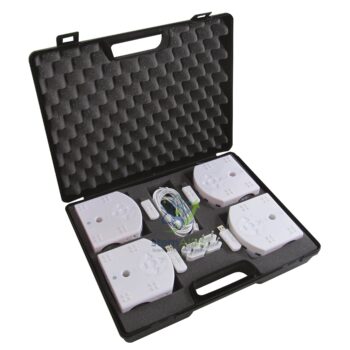
Geometrical Shapes, Moulds for School Maths Lab
Optical-Grade Shatter-Resistant Polycarbonate: Each mould is constructed from high-transparency, impact-resistant polymer featuring removable base lids to facilitate seamless filling and cleaning during repetitive volume-displacement experiments.
Precision-Calibrated Dimensional Set: The comprehensive collection includes hollow prisms, pyramids, and cylinders engineered with consistent 10cm base dimensions, ensuring mathematically accurate results when demonstrating proportional relationships between different geometric solids.
$3.89
Quick Answer: Geometrical Shapes, Moulds are moulds in the shapes of standard solids, commonly pressed full of modelling clay to form cubes, cones, cylinders and similar shapes. Maths classes use geometrical shapes moulds to make solids that students can measure, slice and compare, and to compare volumes by filling.
Making Solids Students Can Cut and Measure
A bought solid can only be looked at and measured. A solid made in a mould can also be cut. When students press modelling clay into a cylinder mould and turn it out, they can slice the clay cylinder parallel to its base and find a circle, or slice it along its axis and find a rectangle. The same test on a clay cone gives a circle, an ellipse or a triangle depending on the angle of the cut, which is a direct introduction to cross-sections and, later, to conic sections.
Moulds also give solids with matching dimensions. Where a cone mould and a cylinder mould share the same base and height, students can fill the cone three times with dry sand and empty it into the cylinder, seeing that the cone holds one third as much. Weighing two solids moulded from the same clay compares their volumes too, because equal volumes of the same material weigh the same.
Younger students use the moulds to name and sort solids, turning a freshly moulded cube over to count its six faces, twelve edges and eight vertices. The shapes in the set, the mould material and whether clay is supplied vary between versions and should be confirmed before ordering.
Specifications
| Item | Moulds in the shapes of standard geometric solids |
| Common use | Forming modelling clay into solids; filling with dry sand to compare volumes |
| Topics | Faces, edges and vertices; cross-sections; volume comparison |
| Used with | Modelling clay, taut thread or thin blade for slicing, dry sand, a balance |
| Shapes in the set, mould material and clay supply | Confirm at enquiry |
Applications
- Moulding clay solids to name, sort and count faces, edges and vertices
- Slicing clay solids to show the cross-sections of cylinders, cones and prisms
- Comparing the volume of a cone with a cylinder of matching base and height by filling
- Comparing volumes of two clay solids by weighing them
- Checking Euler’s formula on moulded prisms and pyramids
Care & Handling
- Dust the inside of each geometrical shapes mould lightly, or line it with cling film, so the clay releases cleanly without tearing.
- Scrape out clay residue with a wooden or plastic tool rather than a metal knife, which can scratch the inner surface.
- Keep the moulds away from heat, which can warp them and change the shape they produce.
- Let an adult handle any slicing with a blade; a taut thread cuts clay safely for younger classes.
Why Choose LabEquip
Teachers building a practical mensuration unit often combine moulded clay solids with ready-made see-through models such as the Hollow Cylinder (Transparent). LabEquip lists both in its Mathematics School Lab Products range; ask about the shapes supplied through the LabEquip contact page.
Frequently Asked Questions
What are shape moulds used for in maths?
They let students make their own solids, usually from modelling clay, and then handle, measure and cut them. That supports lessons on naming solids, counting faces, edges and vertices, cross-sections and volume comparisons that ready-made plastic solids cannot provide.
How do clay solids show cross-sections?
Slice the moulded solid with a taut thread or thin blade and look at the cut face. A cylinder cut parallel to its base shows a circle; cut along its axis it shows a rectangle. A cone can give a circle, an ellipse or a triangle depending on the angle of the cut.
How can the moulds compare volumes?
If a cone mould and a cylinder mould have the same base and height, fill the cone with dry sand and pour it into the cylinder. It takes three fills, which shows that the volume of a cone is one third of the matching cylinder.
How do I stop clay sticking in the moulds?
Dust the inside lightly with talc or cornflour, or line it with cling film, then press the clay in firmly and turn it out by tapping the mould on the table. Slightly firm clay releases better than very soft clay.
Do moulded solids help with Euler’s formula?
Yes. Students count the faces, vertices and edges of clay prisms and pyramids they have made and find that F + V – E equals 2 each time. A cube has 6 faces, 8 vertices and 12 edges, and 6 + 8 – 12 gives 2.
Which classes use these moulds?
Primary classes use them for naming and describing solids. Middle-school classes use them for cross-sections, Euler’s formula and volume comparisons, and older students can relate slices of a cone to the conic sections.
Last Updated: September 2026
You must be logged in to post a review.
Bestsellers




Reviews
There are no reviews yet.