
In Stock
Basic Microchemistry Kit
₹1,035.00
Quick Answer: The Basic Microchemistry Kit is an entry-level microscale chemistry kit for middle school through college-foundation labs, letting students study reaction rates, titration, equilibrium, acids and bases and mole ratios using very small quantities of chemicals.
Description
The Basic Microchemistry Kit from LabEquip introduces students to chemistry practicals using compact, reusable micro-scale apparatus instead of large glassware and high chemical volumes. It supports experiments in microplates, small wells, pipettes, tubes and miniature apparatus, covering mole ratios, catalysts, reaction rates, equilibrium, titration, pH, acids and bases, precipitation and gas formation.
Because each experiment uses only a small quantity of reagent, the kit reduces chemical consumption, waste generation, preparation time and cleanup effort compared with conventional apparatus, making it well suited to individual learners or small groups working through introductory practical chemistry. Components are supplied in a kit box or storage case so a class set can be issued, cleaned and returned quickly between sessions.
Kit Contents & Specifications
| Product type | Educational microscale chemistry experiment kit |
| Learning level | Middle school, senior secondary, high school, college foundation and teacher-training laboratories |
| Common experiment topics | Mole ratios, catalysts, reaction rates, equilibrium, titration, pH, acids and bases, precipitation, gas formation and chemical reactions |
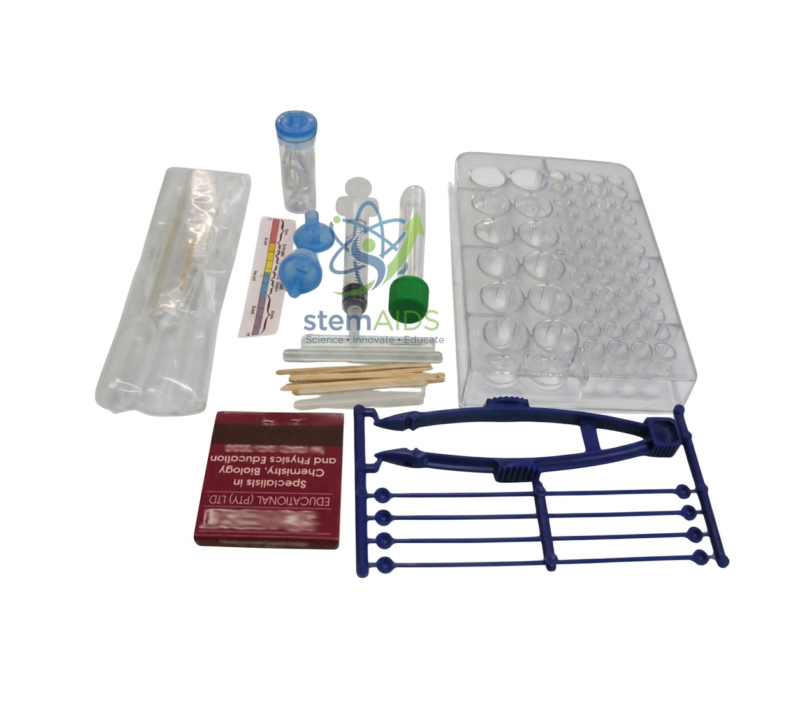
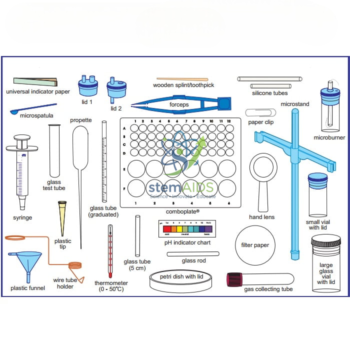
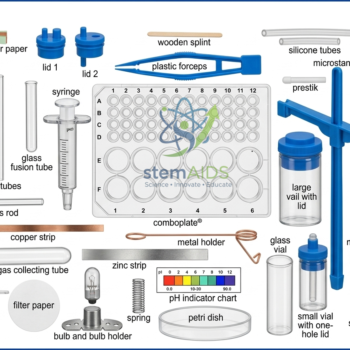
| Typical components | Microplate or comboplate, pipettes, microspatula, syringe, glass stirring rod, thermometer, micro burner or heating accessory, gas lids and small tubes |
| Documentation | Student manual and teacher or instructor guide, depending on supply configuration |
| Reusable components | Most apparatus items are reusable after proper cleaning |
| Chemical requirement | Small quantities of standard laboratory chemicals may be required; chemicals may be included or supplied separately depending on kit version |
| Storage | Kit box or storage case, depending on configuration |
Care & Safety Note
Use the kit only under adult or teacher supervision, with appropriate personal protective equipment for the chemicals in use. Follow the laboratory’s standard operating procedure for handling, dispensing and disposing of chemicals, wash and dry reusable apparatus after each session, and store chemicals separately from cleaned equipment.
Why Choose LabEquip
- Entry-level microscale format reduces chemical consumption and cleanup time for schools and colleges.
- Covers reaction rates, titration, equilibrium and acid-base chemistry in one reusable kit.
- Pairs well with our Advanced Microchemistry Kit for institutions progressing from introductory to advanced microscale practicals.
- Part of our wider LEP Kits range, alongside kits such as our Basic Microelectricity Kit, so institutions can standardise practical science supplies with one supplier.
Frequently Asked Questions
What experiments can be performed with the Basic Microchemistry Kit?
Students can study mole ratios, catalysts, reaction rates, equilibrium, titration, pH, acids and bases, precipitation, gas formation and chemical reactions.
What does the kit include?
A typical configuration includes a microplate or comboplate, pipettes, microspatula, syringe, glass stirring rod, thermometer, a micro burner or heating accessory, gas lids and small tubes.
Who is this kit suitable for?
It is designed for middle school, senior secondary, high school and college-foundation laboratories, as well as teacher-training programmes.
Are chemicals included with the kit?
Chemicals may be included or supplied separately depending on institutional requirement and the kit version ordered.
Are the kit components reusable?
Most apparatus items are reusable after proper cleaning, though some consumables and chemicals are used up during experiments.
What safety precautions apply when using this kit?
Use the kit only under adult or teacher supervision, wear appropriate personal protective equipment, and follow the laboratory’s standard operating procedure for handling and disposing of chemicals.
Last Updated: September 2026
You must be logged in to post a review.
Bestsellers


Reviews
There are no reviews yet.