

Quick Answer: A dropping bottle is a small reagent bottle whose closure releases liquid one drop at a time. It is used to dispense indicators, stains and test reagents at the bench without measuring each portion with a pipette.
Two Common Dispensing Designs
Laboratory catalogues use the name for two different closures. In the first, a glass pipette passes through a cap or stopper and carries a rubber teat; squeezing the teat draws liquid up and releasing it lets drops fall. In the second, a ground-glass dropping stopper has a groove along one side. Turning the stopper lines the groove up with a matching channel in the neck, so tilting the bottle lets drops run out, and a further turn closes it again.
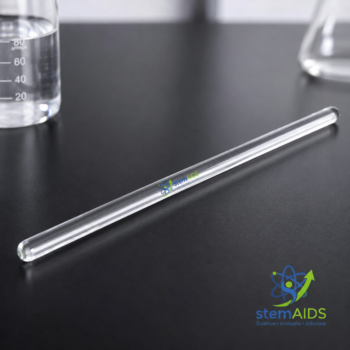
Each suits different reagents. A teat pipette is quick for classroom use and is the safer choice for alkalis, which can cement a ground-glass stopper in place. A ground dropping stopper avoids rubber, which organic solvents swell and iodine or strong oxidising solutions slowly degrade. The product name of this listing does not say which closure it uses, or whether the glass is clear or amber, so state your preference when you enquire. If colourless glass is what you need, the clear glass version is listed separately, and a loose laboratory dropper can replace a lost or perished pipette.
Typical Uses on the Reagent Shelf
- Acid-base indicators such as phenolphthalein and methyl orange, added a few drops at a time before a titration
- Qualitative test reagents: silver nitrate for halides, barium chloride for sulfates, sodium hydroxide for metal-ion precipitates
- Biology food tests, for example iodine solution for starch and biuret reagent for protein
- Stains such as methylene blue when preparing cheek-cell or onion-peel slides
- Microscale chemistry, where a whole experiment runs on a few drops in a spotting tile
Specifications
| Item | Small reagent bottle with a drop-dispensing closure |
| Closure | Not stated in the product name (teat pipette or ground dropping stopper) |
| Glass colour | Not stated (clear or amber) |
| Capacity | Confirm at enquiry |
| Service | Room-temperature storage and dispensing of reagents |
Care & Handling
- Label each bottle with the reagent name, concentration and date of preparation.
- Keep every pipette or stopper with its own bottle: a swapped closure carries one reagent into another, and a ground stopper from a different bottle may not seal.
- Replace rubber teats that turn sticky, hard or cracked.
- Keep the set in a tray on the reagent shelf, out of direct sunlight.
Why Choose LabEquip
Schools and colleges usually order these bottles in sets to stock bench reagent shelves for chemistry and biology practicals. LabEquip lists them in its Lab Glassware category; tell LabEquip the quantity, closure style and colour you need through the contact page.
Frequently Asked Questions
What closures do dropping bottles use?
Two designs are common. One has a glass pipette with a rubber teat that is squeezed to draw up and release drops. The other has a grooved ground-glass stopper; turning it lines the groove up with a channel in the neck, and tilting the bottle then releases drops.
Which reagents need an amber bottle?
Solutions that break down in light, such as silver nitrate, potassium permanganate, hydrogen peroxide and iodine solutions, are usually kept in amber (brown) glass. Most acid-base indicators, salt solutions and dilute acids are stable in clear glass, which shows the level and any contamination.
Can sodium hydroxide solution be kept in a dropping bottle?
Dilute solutions can, but not under a ground-glass stopper, because alkali attacks the glass surfaces in the joint and can seize the stopper. Use a closure with a rubber teat or a plastic cap, and keep it closed, since sodium hydroxide also absorbs carbon dioxide from the air.
How do I avoid contaminating the reagent?
Hold the dropper tip just above the mouth of the test tube rather than inside it, never lay the pipette on the bench, and return it only to its own bottle. Do not pour unused reagent back into the bottle.
How many drops make one millilitre?
There is no fixed number. Drop size changes with the tip diameter, the angle the bottle is held at, and the surface tension and viscosity of the liquid, so drops are not a unit of volume. Use drops for indicators and test reagents, and a pipette or burette when the volume matters.
What should I specify when ordering?
The product name does not give capacity, colour or closure type, so state all three when you enquire. For a bench reagent set, small bottles are typical, with amber glass reserved for light-sensitive solutions and teat closures preferred for alkalis.
Last Updated: September 2026







Reviews
There are no reviews yet.