


In Stock
Welding Helmet
Optical Filtration System: Equipped with a precision-ground filter lens meeting DIN 11/13 specifications, providing constant 99.9% attenuation of infrared (IR) and ultraviolet (UV) radiation to prevent ocular fatigue and photokeratitis.
Thermoplastic Shell Integrity: Fabricated from high-impact, heat-stabilized polypropylene with an ergonomic four-point adjustable suspension system, engineered to deflect molten metal droplets and maintain structural hermeticity under extreme thermal stress.
₹590.00
Quick Answer: The Welding Helmet is a head-worn face screen for electric arc welding: a shaped shell on an adjustable headband, with a dark filter window that protects the eyes and face from arc radiation and spatter while both hands stay on the electrode holder and the work.
Hands-Free Protection at the Arc
The helmet hangs from a headband that pivots at the sides, so the shell can be nodded down over the face before the arc is struck and tipped up afterwards. With both hands free, the welder can guide the electrode holder with one hand and steady it with the other, which is how students learn to hold a consistent arc length and travel speed.
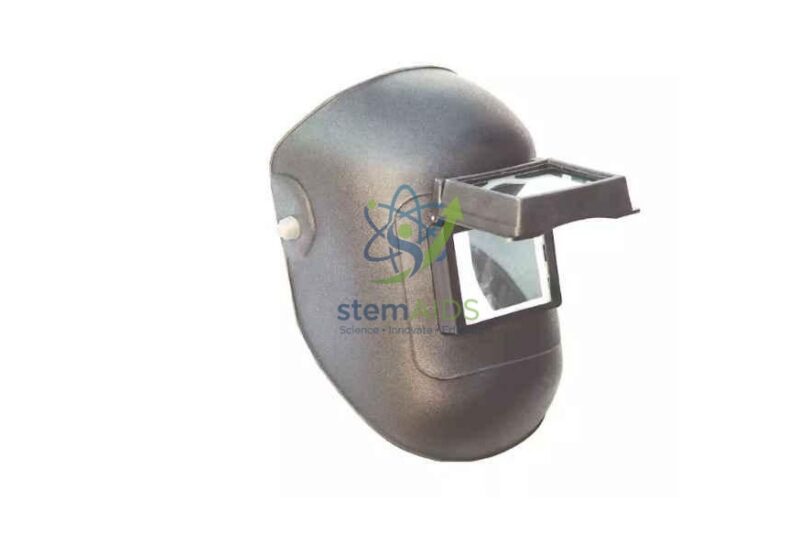
The listing photograph shows a grey helmet with a lift-up front: the dark filter sits in a hinged frame over a clear lens. Raising the frame gives a clear view for chipping slag and checking the bead while the face stays covered, and lowering it restores the filter before the next strike. The pictured design appears to be a fixed-shade (passive) helmet, so the filter must be lowered before striking; auto-darkening helmets, which switch shade electronically, are a different product type.
The shell also covers the ears, neck and throat from radiation and hot spatter, which a hand-held screen protects only partly. For quick tacks and for observers, the Welding Hand-Shield remains useful alongside it.
Welding Tasks It Suits
- Manual metal arc (stick) welding practice in ITI and polytechnic fabrication shops.
- Longer runs on practice plates, joints and frames that need both hands.
- Chipping and inspecting welds between runs with the filter raised and the clear lens down.
- Fabricating benches, stands and frames in college workshops.
Care of the Helmet
- Adjust the headband so the helmet stays up when tipped back and drops cleanly with a nod; a loose band lets it fall at the wrong moment.
- Replace the outer clear cover plate when spatter builds up, and keep a spare filter so a cracked plate is never used.
- Keep the helmet out of direct sun and away from solvents, which can weaken the shell.
- Wash or change the sweatband regularly if the helmet is shared between students.
Specifications
| Type | Head-worn arc welding face shield |
| Front | Lift-up frame holding a dark filter over a clear lens (listing photograph) |
| Headgear | Adjustable headband with side pivots |
| Colour in photograph | Grey |
| Filter shade and shell material | Confirm at enquiry |
Why Choose LabEquip
Fabrication instructors and engineering workshops usually buy welding helmets as class sets, one per welding booth, with spare cover plates. LabEquip lists the helmet in General Lab Products next to the flip up welding goggles used for gas welding, and filter shades or quantities can be discussed through the contact page.
Frequently Asked Questions
How is this welding helmet different from an auto-darkening helmet?
As pictured, this helmet has a fixed dark filter in a lift-up frame, so the welder raises the frame to see and lowers it before striking. An auto-darkening helmet uses an electronic filter that darkens by itself when the arc starts. Fixed-shade helmets are simpler and have no batteries or sensors to fail.
Why do welders lift the front frame instead of the whole helmet?
Raising only the filter frame leaves the clear lens and the shell in front of the face, so chipping slag and wire brushing are done with the eyes still protected. Tipping the whole helmet up exposes the face to flying slag at exactly that moment.
How should the helmet fit?
The headband should sit level, just above the eyebrows at the front, and grip firmly without pressure points. Set the pivot tension so the helmet stays in the raised position and comes down with a firm nod.
Does the helmet protect against ultraviolet burns to the skin?
It shields the face, ears and front of the neck from the arc. Arms and the back of the neck still need covering with flame-resistant clothing, because arc ultraviolet reddens and burns bare skin within minutes.
What is arc eye and how is it prevented?
Arc eye is a painful inflammation of the surface of the eye caused by ultraviolet from the arc, often felt hours later as grittiness and watering. It is prevented by lowering the filter before every strike and by screening booths so people nearby are not exposed. Anyone with symptoms should seek medical advice.
Can students share one helmet between them?
Yes, if the headband is adjusted for each wearer and the sweatband is cleaned or changed between users. Many workshops give each student a replaceable sweatband to keep sharing hygienic.
Last Updated: September 2026
You must be logged in to post a review.
Bestsellers




Reviews
There are no reviews yet.