

In Stock
Touch Discriminator 2-Point
₹540.00
Quick Answer: The 2-point touch discriminator is a plastic, caliper-style instrument with one fixed and one sliding tip, used to find the smallest distance at which two touches on the skin are felt as two separate points. Biology, physiology and psychology classes use it for practicals on the sense of touch.
What the Two-Point Threshold Measures
Touch receptors are not spread evenly through the skin. Where they are packed closely and each sensory neuron serves a small receptive field, as on the fingertips and lips, two points only a few millimetres apart feel distinct. On the back, upper arm or calf the receptive fields are far larger, and two points several centimetres apart can still feel like one. The smallest separation felt as two is the two-point threshold, and measuring it at different sites maps these differences across the body.
The same pattern appears in the brain. In the somatosensory cortex, the fingertips, lips and tongue take up far more area than the trunk, which is why the sensory homunculus is drawn with huge hands and lips.
Running the Practical with the 2-Point Touch Discriminator
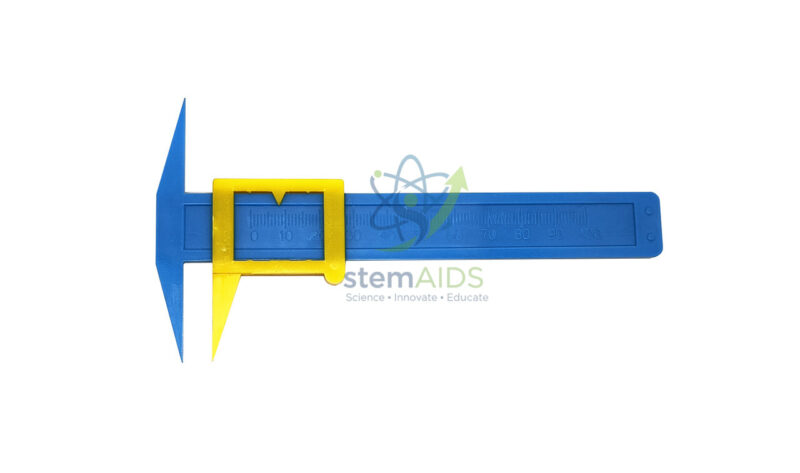
The listing photograph shows a blue plastic bar with a fixed tip at one end and a yellow slider carrying the second tip, with a printed scale along the bar so the separation can be read directly. Students work in pairs with the subject’s eyes closed. The tester touches the skin lightly with one tip or with both, in random order, and the subject answers one or two. Starting with the tips well apart and closing them in steps finds the point where two touches merge into one; approaching from a narrow gap confirms it.
Both tips must land at the same moment and with the same light pressure. Pressing harder, or touching with one tip slightly before the other, gives the subject extra cues and makes the threshold look smaller than it is.
Applications
- Mapping two-point thresholds on several body areas in human biology lessons on sensory receptors
- Psychology practicals on perception, including how expectation and guessing affect results
- Student investigations comparing dominant and non-dominant hands, or fingertips before and after cooling
- Linking touch sensitivity to the sensory homunculus when teaching the nervous system
Specifications
| Item | Two-point touch discriminator (aesthesiometer) |
| Form | Caliper-style bar with a fixed tip and a sliding tip (as pictured) |
| Material | Plastic; blue bar and yellow slider as pictured |
| Scale | Printed along the bar for reading the tip separation |
| Contact | Light touch on intact skin only; not for pressing or pricking |
| Scale range and graduations | Confirm at enquiry |
Care & Handling
- Wipe both tips with an alcohol wipe between subjects and use the instrument only on intact skin.
- Apply light pressure only; the test measures touch, not pain, and a firm press is uncomfortable and spoils the result.
- Keep the slider clean and dry so it moves smoothly, and avoid flexing the bar, which throws the scale reading off.
- Store it flat in a drawer or case so the tips are not bent or snapped.
Why Choose LabEquip
The 2-point touch discriminator is typically ordered in class sets by biology departments teaching the nervous system and by psychology departments running perception practicals. It works well alongside the Human Skin Model on Stand, 3D, which shows the receptors being tested, and other classroom measuring aids appear under General Lab Products. For class quantities, send your requirement through our contact page.
Frequently Asked Questions
What is a typical two-point threshold on the fingertip?
Classroom results for the fingertip are usually only a few millimetres, while the forearm, back and calf often give several centimetres. Values vary with age, skin condition, attention and technique, so compare body areas within the same person rather than against one fixed figure.
Why should single-point touches be mixed into the test?
They reveal whether the subject is genuinely telling two points from one or simply guessing two once they expect it. If a subject reports two when only one tip touched, readings near that distance are unreliable and should be repeated.
Why is the fingertip more sensitive than the back?
The fingertip has a high density of touch receptors, and each sensory neuron there covers a small receptive field. On the back, receptors are sparser and the fields are large, so two nearby touches stimulate the same neuron and are felt as one.
Can a pair of compasses be used instead of a 2-point discriminator?
Compasses have sharp steel points that can prick the skin, turning a touch test into a pain test, and they carry no scale. A purpose-made discriminator with plastic tips and a printed scale is easier to set accurately and safer on skin.
How should the instrument be cleaned between students?
Wipe both tips with an alcohol wipe, or a cloth dampened with 70 percent alcohol, and let them dry before the next subject. Do not test on broken, inflamed or recently injured skin.
Can the lips and face be tested?
The lips and face are among the most sensitive areas, but many schools limit testing to the hands and arms for hygiene and comfort. If the face is tested, use a freshly cleaned instrument and very gentle contact.
Last Updated: September 2026
You must be logged in to post a review.
Bestsellers




Reviews
There are no reviews yet.