








In Stock
Test Urine
Test urine 7-Parameter Simultaneous Detection Engineered with high-affinity reactive pads to detect a broad spectrum of metabolites, including THC, Opiates, Cocaine, and Amphetamines, within a single standardized immunoassay cycle.
High-Sensitivity Threshold Calibrations utilize precision-coated chemical reagents with specific "Cut-off" levels to minimize cross-reactivity, ensuring rapid, visually distinct colorimetric results in under five minutes for high-volume institutional screening.
₹540.00
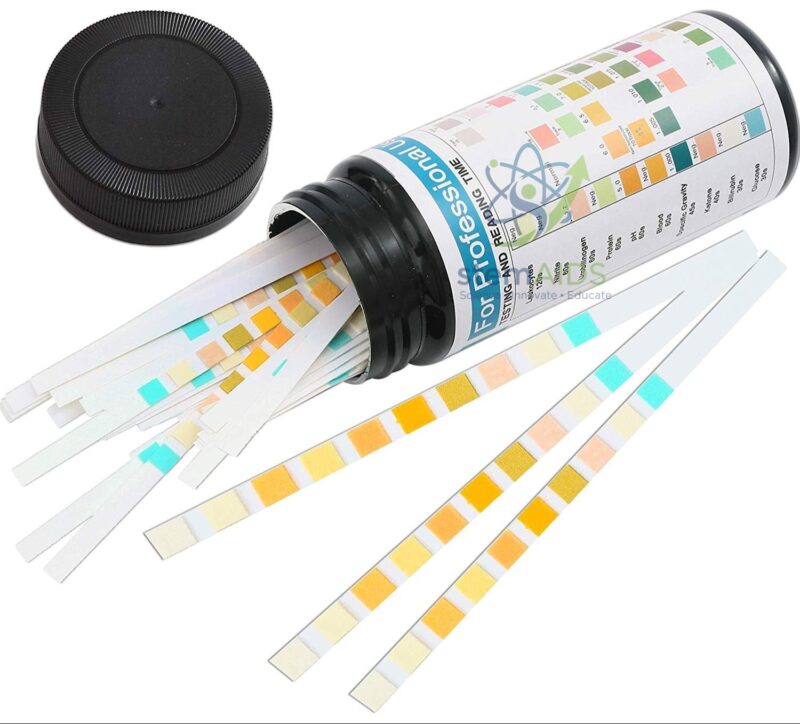
Quick Answer: Test Urine is a tube of urine test strips: plastic strips carrying a row of reagent pads that change colour when dipped in urine, read against the colour chart printed on the container. They are used to teach dipstick urinalysis in biology, nursing and laboratory technician training; they are not a diagnostic device.
Dipstick Urinalysis Explained
Each pad on a reagent strip holds a dried chemical test for one substance or property. Multi-pad strips commonly test for glucose, protein, pH, ketones, blood, bilirubin, urobilinogen, nitrite, leucocytes and specific gravity, although the parameters depend on the particular strip. The pictured tube carries a colour chart with several rows, one per pad, and that chart is where the parameters of this strip should be read.
The chemistry varies by pad. The glucose pad commonly relies on glucose oxidase and peroxidase enzymes producing a coloured dye, the protein pad on an indicator whose colour shifts when protein binds to it, and the pH pad on a mixture of indicators. Because each reaction takes a different time, the chart states when each pad should be read; reading too early or too late gives misleading colours.
In teaching laboratories, strips are usually tested on simulated urine made from water, salts and colouring, with glucose or protein added to create positive samples. That lets students practise the technique and discuss kidney function without handling body fluids. Real samples belong in supervised healthcare training, collected in a proper urine container.
Where the Strips Are Used
- Human biology lessons on kidney function, using simulated urine samples
- Practical training for nursing, paramedical and medical laboratory technician students
- Forensic-science and health-awareness activities comparing normal and abnormal test samples
- Demonstrating enzyme-based tests, such as glucose oxidase, in biochemistry classes
Specifications
| Type | Multi-parameter urine reagent strips |
| Pictured pack | Strips in a capped tube with a colour chart on the label |
| Reading | Visual comparison with the chart at the stated times |
| Intended use here | Teaching and training; not for diagnosis |
| Pad parameters and strips per tube | Confirm at enquiry |
Care & Handling
- Close the cap immediately after taking out a strip; the drying agent in the tube protects the pads from humidity.
- Never touch the pads, and never cut strips or move them to another container.
- Store the tube at room temperature, out of direct sun, and use the strips before the printed expiry date.
- Wear gloves when handling any real urine sample and disinfect surfaces afterwards.
Why Choose LabEquip
Nursing and paramedical colleges, biology departments and laboratory-skills trainers use urine test strips to teach a quick, standard screening technique. LabEquip lists them in the General Lab Products range; share your class size through the contact page when ordering tubes for a practical.
Frequently Asked Questions
How should a strip be dipped and read?
Dip the strip briefly so that all pads are wet, draw its edge along the rim of the container to remove excess liquid, and hold it horizontally so colours do not run between pads. Compare each pad with the chart at the time stated for that pad, in good light.
Can these strips diagnose a medical condition?
No. A strip result is a screening indication. Colours can be affected by diet, medicines, dilute samples and reading errors, so any abnormal result on a real person must be followed up by a qualified clinician and laboratory tests. In teaching use, the strips show the technique only.
What is simulated urine and how is it made?
It is a safe teaching substitute prepared from water, a little salt and yellow food colouring. Adding glucose, egg albumin or a small amount of acid or alkali creates samples that give positive glucose, protein or pH results on the strips.
Why do the pads have different reading times?
Each pad works by a different reaction, and some develop colour within seconds while others take a minute or more. Reading all pads at once gives errors, so the chart lists the time for each one.
Why must the tube be kept tightly closed?
The reagent pads absorb moisture from the air and gradually lose their activity. The cap and drying agent keep them dry, so leaving the tube open through a practical session can spoil the remaining strips.
What else is needed for a urinalysis practical?
Clean sample containers, disposable gloves, paper towels, a timer and a waste bag are the basics. For real samples, add a disinfectant for spills and make sure a hand-washing station is close by.
Last Updated: September 2026
You must be logged in to post a review.
Bestsellers






Reviews
There are no reviews yet.