



In Stock
Suspension Clamp
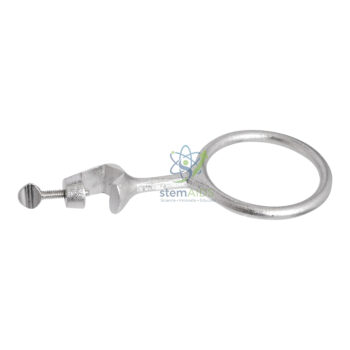
Gallows-Style Design: Features a unique "drop-down" hook or adjustable loop that allows instruments to be suspended directly over the center of a flask or beaker.
Non-Marring Secure Grip: Equipped with a small, precision-adjustable screw or spring-clip mechanism that holds narrow instruments (like glass thermometers) firmly without the risk of crushing.
₹190.00
Quick Answer: The Suspension Clamp is a stand fitting for hanging apparatus from a fixed point rather than gripping it from the side, typically used to suspend a pendulum thread, a spring or a thermometer from a retort stand. The listing has no photograph, so its exact form should be confirmed before ordering.
What a Suspension Clamp Is For
Many physics and chemistry set-ups need something to hang freely: a pendulum bob on a thread, a spring loaded with slotted masses, a spring balance, or a thermometer dangling in a beaker so its bulb does not touch the glass. A suspension clamp provides that fixed hanging point on a stand, so the item swings or stretches from a defined spot instead of from a loop of thread tied round a rod.
For pendulum work the hanging point matters. If the thread is simply tied to a rod, the effective length changes as it wraps and slips, and the period measurements scatter. Gripping the thread firmly between two flat faces fixes the pivot, the same idea as the split cork used in older practical manuals. The length is then measured from the grip to the centre of the bob, as with the pendulum time period apparatus.
Clamps sold under this name are made in more than one form, including jaws that pinch a thread and hooks for springs, and this listing gives no photograph or description beyond its name. Ask for a picture when ordering and say what you plan to hang from it, so the right pattern is supplied.
Applications
- Simple pendulum experiments to find g from the period and length, using bobs such as the six metal pendulum bob set
- Hooke’s law experiments, hanging a spring and adding slotted masses
- Hanging a thermometer in a beaker of water or a cooling liquid so the bulb stays clear of the glass
- Suspending a plumb line to check that a stand rod or column is vertical
Specifications
| Type | Stand fitting for suspending apparatus |
| Typical loads | Pendulum thread, spring, spring balance, thermometer |
| Mounting | On a retort stand, usually through a boss head |
| Listing photograph | None on the listing |
| Form and size | Confirm at enquiry |
Care & Handling
- Mount the clamp so the hanging item falls clear of the stand base and rod.
- Use a heavy or clamped-down stand when a swinging pendulum or bouncing spring is attached.
- Check that the thread is gripped, not cut, by the clamp faces, and replace frayed threads before timing runs.
Why Choose LabEquip
Physics teachers setting up pendulum and spring practicals for a whole class need a hanging point on every stand. LabEquip lists this clamp in General Lab Products; tell us what it will carry through the contact page so the form can be confirmed.
Frequently Asked Questions
What is a suspension clamp used for?
It gives a fixed point on a stand from which apparatus can hang freely, such as a pendulum thread, a spring with masses, a spring balance or a thermometer.
Why not just tie the pendulum thread to the stand rod?
A tied thread can slip and wrap round the rod, so the effective length changes and the pivot moves. Clamping the thread at a fixed point gives a consistent length and more reliable period readings.
How do I measure pendulum length with the clamp?
Measure from the point where the thread leaves the clamp to the centre of the bob. Measuring to the top of the bob instead gives a systematic error in the value of g.
Can it hold a thermometer?
Yes. Hanging a thermometer keeps its bulb in the liquid without touching the walls or base of the beaker, which would give a false reading when the beaker is heated.
What stand should I use with it?
A heavy stand, or one clamped to the bench, because a swinging pendulum or oscillating spring rocks a light base and disturbs the timing. Place the stand so the hanging item clears the base.
How many pendulum lengths should I test?
Use several, from short to as long as the stand height allows, and plot period squared against length. The gradient of the straight line equals 4π²/g.
Last Updated: September 2026
You must be logged in to post a review.
Bestsellers




Reviews
There are no reviews yet.