

In Stock
Plankton Net
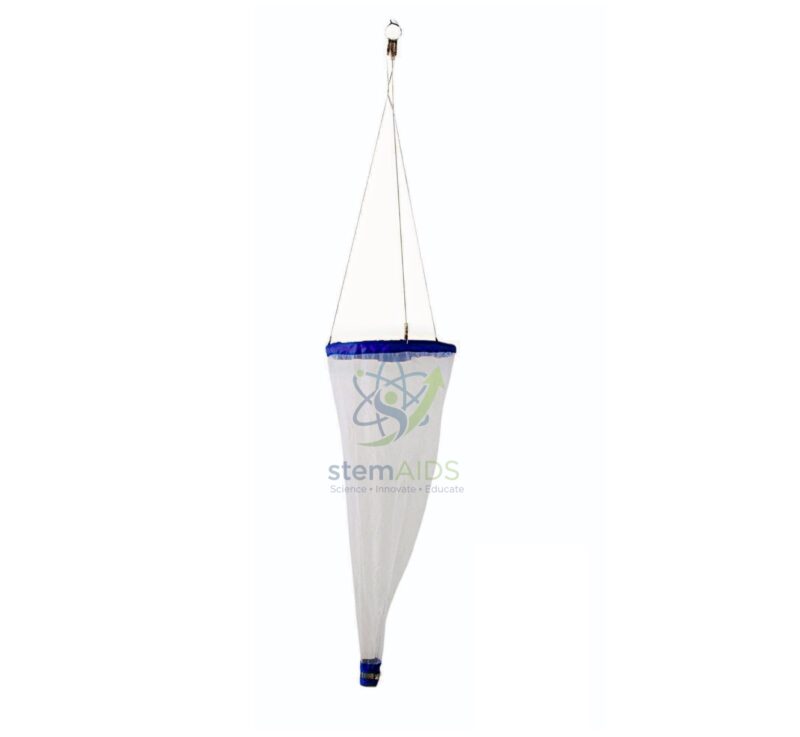
Filet à plancton Engineered with high-tensile polyamide mesh available in standardized micron apertures, providing an optimized filtration-to-mouth area ratio to minimize hydraulic resistance and clogging.
Marine-Grade Structural Assembly Features a reinforced stainless steel ring and a three-point towing bridle, integrated with a removable, graduated cod-end for the non-destructive concentration and extraction of collected samples.
₹750.00
Quick Answer: The Plankton Net is a conical net of fine mesh with a towing bridle at the mouth and a small collecting container at the narrow end, as pictured. Drawn through water, it filters out microscopic algae and tiny animals and concentrates them for study under a microscope.
Concentrating Life from Open Water
Plankton are spread thinly through water, so a jar of pond water may hold only a few visible organisms. The net filters a large volume: water passes through the mesh while organisms larger than the openings are swept down the cone into the container at the tip. After a tow, that small container can hold thousands of individuals.
Mesh size decides the catch. Finer meshes retain phytoplankton such as diatoms and desmids, while coarser meshes let most algae pass and catch zooplankton such as water fleas, copepods and rotifers more efficiently. The mesh aperture of this net is not stated in the title, which is worth confirming if you plan to target a particular group.
The net can be towed horizontally from a boat, pulled slowly through the water from a jetty, or lowered and hauled vertically to sample a water column. Afterwards it is rinsed from the outside so organisms on the mesh wash down into the container, which is then emptied into a labelled jar. Look at live samples within hours; the Aquarium can hold pond water and organisms for short-term observation.
Care & Handling
- Tow slowly; pulling too fast pushes water back out of the mouth and can damage delicate organisms.
- Rinse the net thoroughly in clean fresh water after each use, including after seawater sampling, and dry it in the shade.
- Store the net loosely folded and away from sharp objects that could tear the mesh.
- Work in pairs near water, stay behind railings or on stable ground, and never lean out over deep water.
Specifications
| Type | Conical towing net |
| Mouth | Ring with three-line towing bridle, as pictured |
| Cod end | Small collecting container at the narrow end |
| Sampling | Horizontal tows or vertical hauls |
| Mesh aperture and mouth diameter | Confirm at enquiry |
Applications
- Pond and lake studies comparing plankton at different sites or seasons
- Food-web lessons linking algae, zooplankton and small fish
- Estimating plankton density from the distance towed and the net mouth area
- Marine biology field trips from a pier or boat
Why Choose LabEquip
College limnology courses, marine science programmes and school ecology groups buy a plankton net because it is the standard way to reveal the life hidden in clear water. LabEquip lists it in the General Lab Products range; the Dissolved Oxygen Kit pairs well with it for a fuller water-quality study.
Frequently Asked Questions
What mesh size should a plankton net have?
It depends on the target. Fine meshes of a few tens of micrometres retain small algae, while meshes of around 100 micrometres or more are commonly used for zooplankton. A single school net is a compromise, so note its mesh when comparing results between groups.
How is plankton density worked out from a tow?
Multiply the area of the net mouth by the distance towed to get the volume of water filtered, count organisms in a known fraction of the sample, and scale up. The result is approximate, because some water is pushed aside rather than filtered.
How should samples be kept alive until they are examined?
Keep them in a wide, loosely capped jar, cool and shaded, and look at them within a few hours. Crowded, warm samples lose oxygen quickly and many organisms die.
Can the net be used in the sea?
Yes, plankton nets are used in both fresh and salt water. After sea use, rinse the net, bridle and container in fresh water, since salt crystals left in the mesh weaken the fabric and block openings.
How should plankton samples be preserved?
For later identification, samples are preserved with a fixative chosen according to the laboratory’s protocol, for example Lugol’s iodine for many algae or ethanol for animals. Label each jar with site, date and depth.
Which microscope suits plankton samples?
A stereo microscope suits larger zooplankton such as copepods and water fleas, while a compound microscope is needed for diatoms and other algae. A drop of sample on a cavity slide keeps organisms from being crushed.
Last Updated: September 2026
You must be logged in to post a review.
Bestsellers




Reviews
There are no reviews yet.