



In Stock
Pack of 25 Blue-bot Beebot sequential cards
$24.14
Quick Answer: The pack of 25 Blue-bot Beebot sequential cards is a set of printed command cards showing robot moves, such as forward, back, turns and pause, plus multiplier cards. Pupils lay the Bee-Bot sequence cards out in order to plan a program before entering it on the robot.
Planning a Program on the Table
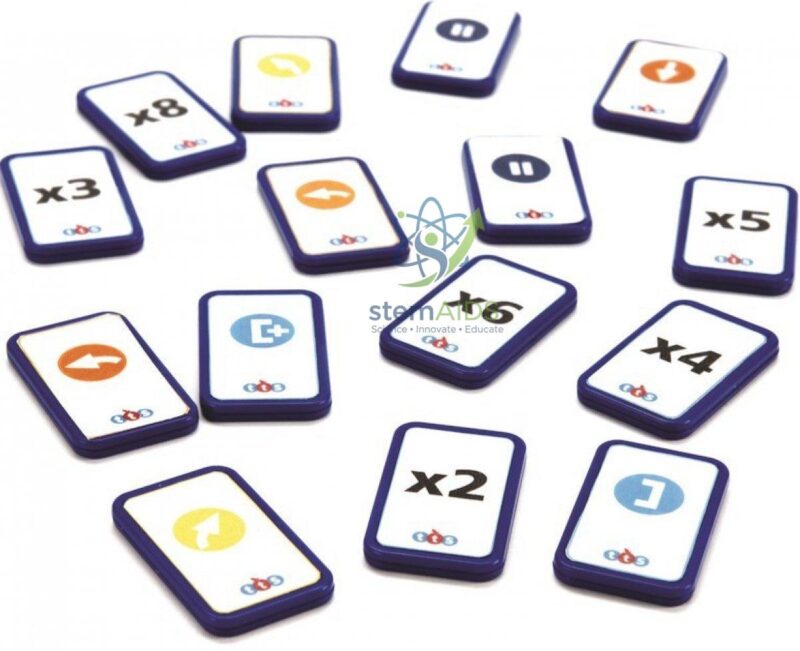
The listing photo shows sturdy dark-edged cards printed with arrow symbols for forward, backward, left turn and right turn, a pause symbol, and number cards marked from x2 to x8. Laid in a line, the cards form a written program: a visual record of what the robot should do, which children can read back step by step.
The multiplier cards are the interesting part. A forward card followed by x4 means four steps forward, so a long route can be written with fewer cards. This introduces the idea behind a loop, repeating an instruction a set number of times, long before pupils meet the word in a programming language.
The cards are not read by the robot. They are a planning and recording tool used beside the Bee-Bot robot or Blue-Bot. For a set where the physical sequence itself sends the program, see the Blue-Bot with programming bar, which uses tiles in a reader.
Lesson Ideas
- Unplugged coding: one pupil lays out cards and a partner acts as the robot, walking the route
- Planning a route on a mat before programming, then comparing the cards with what happened
- Introducing repetition by rewriting a long program with multiplier cards
- Displaying the class program on a board so everyone can check it during debugging
Specifications
| Contents | 25 command cards (as titled) |
| Symbols pictured | Forward, back, left turn, right turn, pause; multipliers x2 to x8 |
| Use with | Bee-Bot and Blue-Bot, as planning aids |
| Read by the robot | No; the cards are for planning and recording |
| Card size and material | Confirm at enquiry |
Care & Handling
- Keep the pack in a box with the card count written on the lid, and check the count after each lesson.
- Wipe cards with a barely damp cloth; do not soak them.
- Store the cards flat to stop them curling, which makes them hard to lay in a straight line.
Why Choose LabEquip
Teachers buy sequence cards when they want pupils to plan before pressing keys and to leave a record that can be marked. LabEquip lists this pack in General Lab Products; send quantities for several groups through the contact page.
Frequently Asked Questions
What are sequence cards used for?
They let pupils plan a robot program on the table before entering it, and they keep a record of the program afterwards. Comparing the cards with the robot’s actual route is how children find and fix errors.
What do the x2 to x8 cards mean?
They repeat the command placed before them. A forward arrow followed by x3 means three steps forward. The same idea appears later in programming as a loop.
Can the robot read these cards?
No. The robot is still programmed with its keys or app. The cards are a planning and recording aid, while a reader bar with tiles is needed if you want the sequence itself to send the program.
Are the cards useful without a robot?
Yes. In unplugged activities one child reads the cards aloud and another follows them as the robot, stepping and turning on a grid of floor tiles or a chalk grid. It makes a good warm-up before the robots come out.
How many cards does a group need?
A short route needs only a handful, so one set of 25 can be split between two or three groups for simple tasks. Longer challenges use more cards, and multipliers help keep programs short.
Is ‘sequential cards’ the same as ‘sequence cards’?
Yes. The listing uses the word sequential, but these are what classroom robot suppliers usually call sequence cards or command cards.
Last Updated: September 2026
You must be logged in to post a review.
Bestsellers




Reviews
There are no reviews yet.