
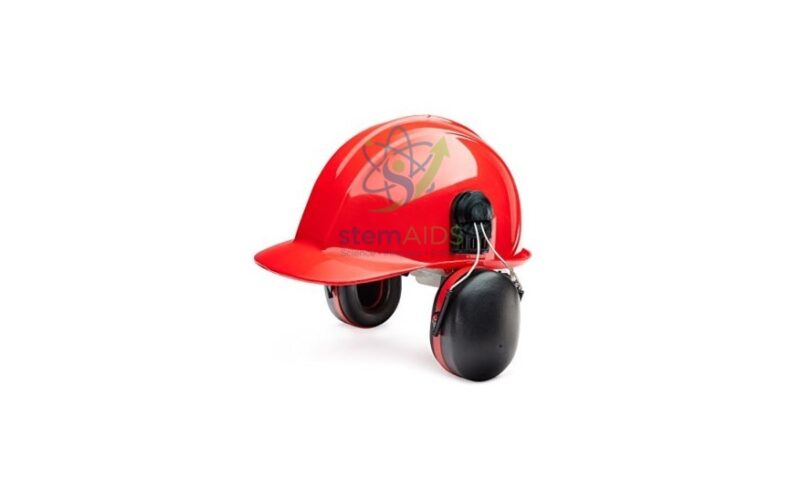
Quick Answer: The Helmet with Slot Fix Ear Muffs is a safety helmet with helmet mounted ear muffs clipped into accessory slots on each side of the shell, shown in the listing photograph as a red helmet with black cups. It protects the head and reduces noise at the same time, without a headband competing with the helmet harness.
Why Mount the Muffs on the Helmet
Headband ear muffs and a hard hat do not sit well together: the band has to pass over or behind the helmet and often lifts the cups off the ears, breaking the seal that makes them work. Mounting the muffs on the helmet avoids that problem. Each cup is carried on a sprung arm whose plug slides into a slot at the side of the shell, and the spring presses the cushion against the head around the ear.
Most slot-mounted muffs have a working position, pressed against the ears, and a parked position, swung up against the shell when the area is quiet; some add an intermediate venting position. Being able to park them quickly means workers keep them on the helmet instead of taking them off, which is often when they get lost or damaged.
How much the muffs reduce noise is given by their attenuation rating, which should be printed on the cups or packaging. The listing does not state it, so compare that marking with the noise levels at your site. The same helmet with a visor is the Helmet with Slot Fix Face Shield, while headband Ear Muffs suit work where no hard hat is required.
Specifications
| Type | Safety helmet with slot-mounted ear muffs |
| Helmet colour in photograph | Red |
| Ear cups | Black cups on sprung arms plugged into side slots |
| Positions | Working and parked, as usual for slot-mounted muffs |
| Attenuation rating | Confirm at enquiry |
Noisy Places With Overhead Risk
- Workshops with lathes, grinders and power saws beneath overhead cranes.
- Plant rooms, generator rooms and boiler houses during maintenance.
- Construction work with breakers, compressors and cutting tools.
- Grounds work near mowers, blowers and chippers where falling branches are a risk.
Care of Cups and Cushions
- Wipe the cushions with a damp cloth after use; sweat and dust harden them and spoil the seal.
- Replace cushions and foam inserts when they crack or flatten; replacement hygiene kits exist for many cup designs.
- Never bend the arms outward to ease the pressure, since this weakens the spring and reduces protection.
- Park the cups against the shell for storage rather than leaving them pressed shut.
Why Choose LabEquip
Engineering workshops, estates teams and contractors buy helmet mounted muffs when staff need head and hearing protection on the same job. LabEquip lists this helmet in General Lab Products, and quantities can be arranged through the contact page.
Frequently Asked Questions
Do slot-mounted ear muffs fit any helmet?
No. The arm plug has to match the size and shape of the helmet’s slot, and different makes use different fittings. Buying the helmet with its muffs, as here, avoids a mismatch.
Can I wear glasses with helmet mounted ear muffs?
Yes, but spectacle arms passing under the cushions break the seal slightly and let some noise in. Safety spectacles with thin arms cause less leakage than thick frames.
Why do the muffs press quite firmly?
The spring force holds each cushion tight against the head so sound cannot leak around the edge. Some pressure is normal; a cup that feels loose is giving less protection than its rating suggests.
What is the parked position for?
Swinging the cups up against the shell keeps them clear of the ears when the area is quiet, so the wearer can talk or listen for warnings. Return them to the working position before going back into a noisy area.
Can the ear muffs be removed from the helmet?
Slot-mounted muffs usually pull out of their slots, so the helmet can be used alone and a damaged muff can be replaced. Check that each plug clicks fully home when refitting.
Are ear muffs or ear plugs more suitable with a helmet?
Helmet mounted muffs are easy to check at a glance and quick to use on and off. Ear plugs suit hot conditions and long shifts, and the two can be combined for very loud work.
Last Updated: September 2026




Reviews
There are no reviews yet.