













In Stock
Heating dry bath microtube with lid
$401.59
Quick Answer: The Heating dry bath microtube with lid is a compact microtube heating dry bath: a small heated block for microcentrifuge tubes under a tall, clear cover that encloses the tubes during incubation.
Small Footprint, Enclosed Tubes
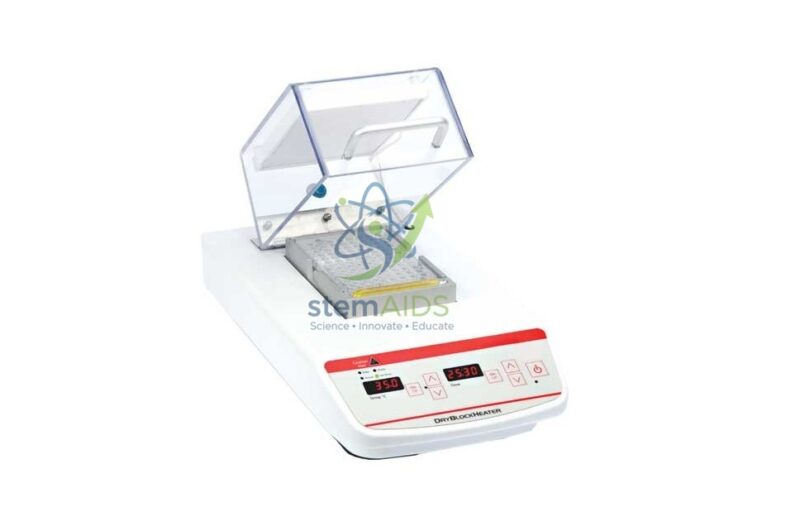
The photo shows a small white base with a compact block and a tall transparent cover standing over it, roomy enough to clear the caps of microtubes. This is a unit for small batches: one practical group’s handful of tubes, a single set of reactions, or a bench where space is short.
Covering the tubes matters more for microtubes than for larger vessels. Their small volumes lose heat quickly from the cap end, and droplets condense under the tube lid when the air above the block is cool. Enclosing the tubes keeps that air warm, so small reactions stay closer to the set temperature, and it shields them from draughts near windows and fume hood airflow.
Compared with the open Digital dry bath for microtubes, this unit trades quick access for enclosure; compared with the larger Heated dry bath with lid HB120-S, it is smaller and holds fewer tubes. Block size and temperature range are not in the title.
Well-Suited Tasks
- Colony PCR preparation by heating small cell samples in water, with lid locks on the tubes
- Small-scale enzyme reactions for individual student groups
- Heating RNA or DNA samples briefly before gel loading
- Incubating a few tubes at 37 °C near a draughty window or hood
Specifications
| Type | Compact dry block heater for microtubes |
| Lid | Tall clear cover, as pictured |
| Base | Small white housing with display, as pictured |
| Tubes | Microcentrifuge tubes, as titled |
| Number of wells and temperature range | Confirm at enquiry |
Care & Handling
- Keep the cover closed while tubes incubate and open it only to load or unload.
- Seat tubes fully in the wells; a tube that sits proud heats slowly.
- Clean the cover with a soft cloth and neutral detergent, and wipe the block only when cool.
Why Choose LabEquip
Schools and small research groups choose this microtube heating dry bath when they need an enclosed heater for a few tubes rather than a full-size block. More dry baths and blocks are in General Lab Products.
Frequently Asked Questions
Why does a microtube dry bath need a lid?
Microtubes hold small volumes that lose heat quickly from the cap end, and condensation forms under their caps. A lid keeps warm air around the tubes so the reaction stays near the set temperature.
Is this model suitable for a whole class?
It is a compact unit for a few tubes at a time. For a whole class running reactions together, a larger block heater or several small units is more practical.
Can samples be boiled for colony PCR in it?
If its range reaches the temperature needed, yes. Use tubes with secure caps or lid locks, since steam pressure can open tubes near boiling.
Where should the unit be placed on the bench?
On a level surface away from windows, fume hood airflow and heating vents, with space around it for ventilation. Draughts make small blocks drift.
Can larger tubes be used?
The block is made for microtubes. Larger tubes will not seat in the wells; use a dry bath with a block made for that tube size instead.
How is the clear cover cleaned?
Wipe it with a soft cloth and a neutral detergent, then dry it. Avoid solvents and abrasive pads, which scratch and cloud clear plastic.
Last Updated: September 2026
You must be logged in to post a review.
Bestsellers




Reviews
There are no reviews yet.