








In Stock
Heating Blanket
Nappe de chauffage Engineered with high-flexibility internal wiring encapsulated in dual-layered PVC to provide uniform infrared thermal emission across the entire surface area, eliminating localized hotspots that can damage sensitive root tissues.
IP67-Rated Waterproof Construction Features a hermetically sealed, moisture-resistant exterior designed to withstand high-humidity nursery environments and continuous irrigation runoff, ensuring electrical safety and long-term industrial durability during high-cadence operation.
₹1,010.00
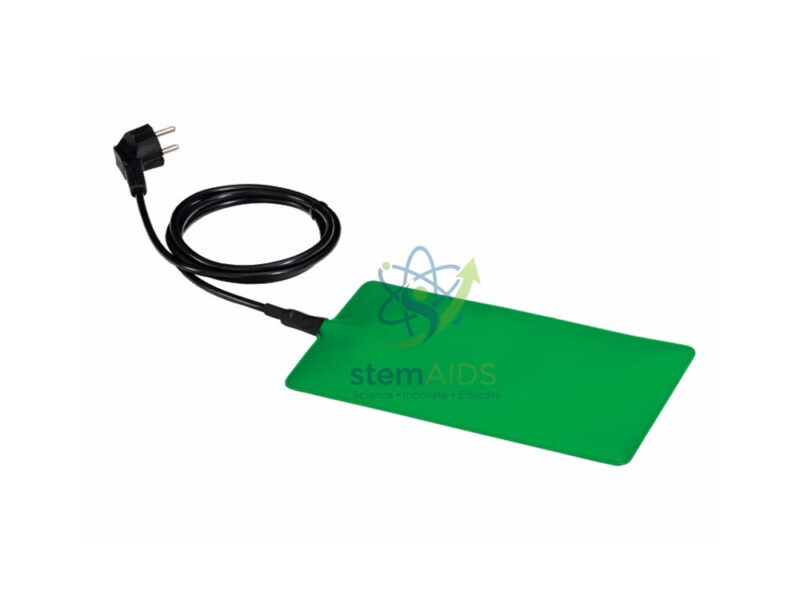
Quick Answer: The Heating Blanket is a flexible heating mat, pictured as a flat green pad with a mains lead and plug, placed under seed trays and propagators to warm the growing medium from below. As a seedling heat mat it speeds and evens germination and helps cuttings root in cool rooms.
How Bottom Heat Helps Germination
Seeds of many plants germinate faster and more evenly when the compost is warm, and root growth is often more sensitive to soil temperature than to air temperature. A mat underneath the tray warms the root zone directly, so seedlings can be started in a cool classroom or early in the growing season without heating the whole room.
A heating mat on its own simply adds heat, so the compost temperature depends on the room and on how the tray is insulated. Pairing it with a thermostat that has a probe in the compost, such as the Hortiswitch Programmable Thermostat, holds a set temperature and prevents overheating. A clear cover or a mini greenhouse keeps warmth and moisture in.
Heat mats also make good fair tests. Two identical trays sown on the same day, one on the mat and one beside it, show the effect of temperature on germination time and seedling growth. The mat’s power rating and size are not given in the title, so check that it matches the trays you plan to use.
Uses in the Classroom and Greenhouse
- Germination experiments comparing warm and room-temperature compost
- Starting warm-season crops such as tomato, pepper and chilli early in the season
- Rooting cuttings in a propagator
- Keeping a small culture or seedling tray warm in a cool prep room
Electrical Safety and Care
- Lay the mat flat on a level, heat-tolerant surface; do not fold, crease or pierce it.
- Keep the plug and connections dry, and wipe spilled water off the mat before switching on.
- Stand trays with drainage holes in a drip tray, not directly in puddles on the mat.
- Unplug before cleaning, and inspect the lead for damage before each use.
Specifications
| Type | Flexible heating mat for propagation |
| Pictured | Flat green mat with mains lead and plug |
| Placement | Under seed trays, pots or propagators |
| Temperature control | Use with a separate thermostat for set temperatures |
| Power rating, size and plug type | Confirm at enquiry |
Why Choose LabEquip
School gardens, agriculture colleges and biology departments use a heat mat to start plants on a timetable that suits the curriculum rather than the season. LabEquip lists this heating blanket in the General Lab Products range.
Frequently Asked Questions
What compost temperature suits most seeds?
Many common vegetable and flower seeds germinate well in warm compost around 20 to 25 °C, while some cool-season crops prefer less. Check the seed packet and use a thermometer in the compost rather than guessing from the room.
Should the mat be used with a thermostat?
Yes, if you want a set temperature or plan to leave it on for long periods. A thermostat with a probe in the compost switches the mat on and off to hold the chosen temperature and avoids drying or cooking the seeds.
Can the heating blanket stay on overnight?
Propagation mats are generally designed for continuous use under trays, but follow the supplied instructions, keep them dry and use a thermostat. Switch off once seedlings have emerged if the room is warm enough.
Why do seedlings need less heat after germination?
Warmth speeds germination, but once shoots appear, too much bottom heat with too little light makes seedlings tall and weak. Move them into good light and reduce the heat gradually.
Does the mat dry out the compost?
Warm compost loses water faster, especially near the base of the tray. Check moisture daily, water from below or mist lightly, and keep a clear cover on to hold humidity.
Is the mat waterproof?
Propagation mats are generally designed to sit under damp trays, but that does not make the plug or connections safe to wet. Keep them dry, use drip trays and follow the instructions supplied with the mat.
Last Updated: September 2026
You must be logged in to post a review.
Bestsellers




Reviews
There are no reviews yet.