




In Stock
Drums for digital drum rotary agitator
$17.37
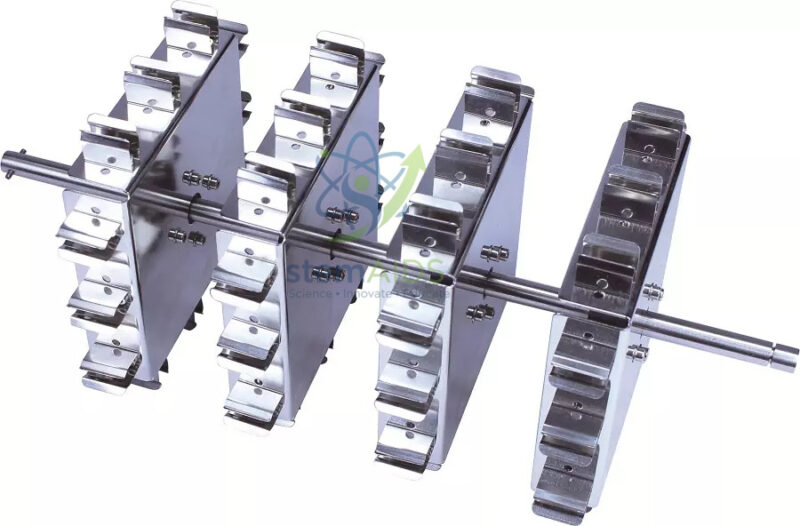
Quick Answer: Drums for digital drum rotary agitator are interchangeable tube holders for a drum-type rotator: as pictured, each drum is a set of slotted plates on a common shaft that grips tubes between them while the agitator turns them end over end.
How a Drum Is Built
The photo shows parallel plates, each with a series of shaped cut-outs around its edge, threaded on a long shaft. Tubes are pushed into matching cut-outs on neighbouring plates, so each tube is held near both ends and lies parallel to the shaft. When the digital drum rotary agitator turns the shaft, every tube tumbles end over end.
Changing the drum changes the tube format. Cut-outs are sized for particular tube diameters and the plate spacing suits a tube length, so one drum might carry microtubes while another carries 15 mL or 50 mL conical tubes. Keeping two or three drums lets one agitator cover the tube sizes a lab actually uses.
The plural in the title suggests the listing covers more than one drum, or a choice of drum types, so the formats and number supplied should be agreed with the order. Name the drive the drums are for, such as the Rotary drum digital shaker, so the shaft fitting can be checked.
Why Labs Add Extra Drums
- Switching one agitator between microtubes and conical tubes without buying a second rotator
- Keeping a spare drum loaded and ready for the next batch
- Dedicating one drum to biological samples and another to chemical mixing
- Replacing a drum whose plates have cracked or whose cut-outs have worn loose
Specifications
| Type | Interchangeable tube drums for a drum rotator |
| Construction | Slotted plates on a common shaft, as pictured |
| Tube position | Held lengthwise between plates, parallel to the shaft |
| Use with | Digital drum rotary agitator, as titled |
| Tube formats and number of drums supplied | Confirm at enquiry |
Care & Handling
- Seat each tube in both plates before starting so it cannot slip sideways.
- Check that the plates stay square on the shaft; a twisted plate grips tubes unevenly.
- Clean plates with mild detergent or a compatible disinfectant and dry them before storage.
Why Choose LabEquip
Research and teaching labs that already own a drum rotator buy extra drums to widen the tube formats it can handle. Drums and drives are listed in General Lab Products, and formats can be agreed through the contact page.
Frequently Asked Questions
What is the difference between a drum and a disc holder?
A drum holds tubes lengthwise between plates on a shaft, so each tube lies parallel to the axis of rotation. A disc holds tubes on its face. Drums suit longer tubes and larger batches of one size.
Can one drum carry different tube sizes?
Normally no, because the cut-outs and plate spacing are made for one diameter and length. That is why labs keep separate drums for each tube format they use.
How are drums swapped?
Switch the agitator off, release the drum from its drive coupling, fit the new drum and secure it. Turn it by hand once to make sure it clears the housing before restarting.
How should tubes be arranged on the drum?
Fill positions evenly around the drum so it turns smoothly. If only a few samples are running, add water-filled tubes opposite them to balance the load.
Can the plates be disinfected?
Yes, wipe them with 70% ethanol or a disinfectant compatible with the plate material, then rinse and dry. Avoid strong solvents, which can craze some plastics.
How do I know a drum will fit my agitator?
Drums are made for a particular drive coupling and shaft length. Give the model of your agitator when ordering so that the drum can be matched to it.
Last Updated: September 2026
You must be logged in to post a review.
Bestsellers




Reviews
There are no reviews yet.