

In Stock
Colony Counter
₹2,305.00
Quick Answer: A colony counter is a bench viewer that holds a Petri dish over a ruled grid, usually lit from below, so the colonies on an agar plate stand out and can be counted square by square. It is used for plate counts and colony-forming unit (CFU) calculations in microbiology practicals.
What the Colony Counter Does
Counting colonies on a plate held up to the window is slow and unreliable: small colonies are missed and it is easy to count the same one twice. A dedicated counter fixes both problems. The Petri dish sits in one position above a ruled plate, the grid splits the agar into squares that are counted one at a time, and light from beneath makes pale colonies show clearly against the medium.
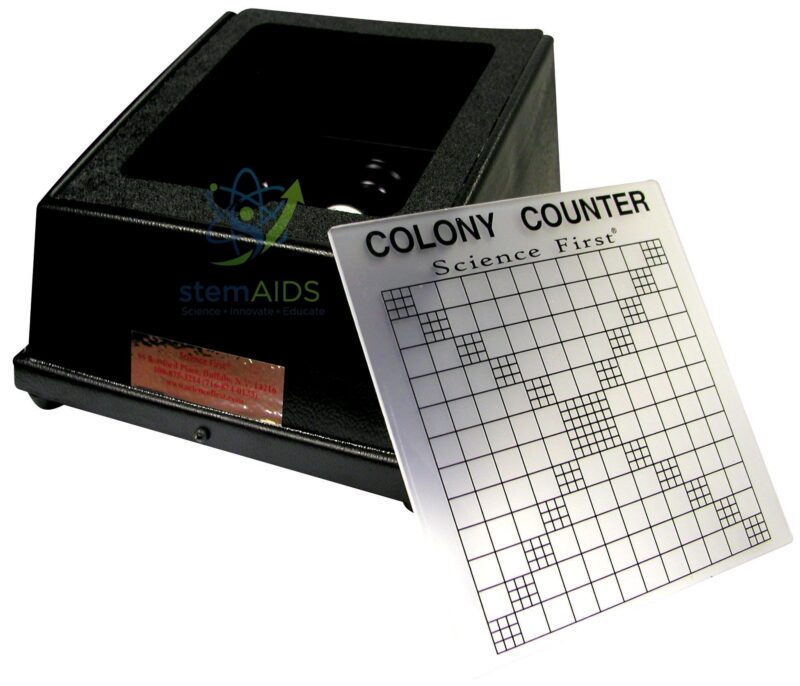
The listing photograph shows a dark housing with a sloped viewing window and a lamp inside, together with a frosted counting plate printed with a square grid in which some squares are divided into smaller ones. Those subdivided squares are there for crowded plates, where students count a sample of small squares and scale up to the whole dish. The title does not state the power supply, the lamp type or whether a magnifier is fitted, so these should be confirmed with the order.
Specifications
| Item | Colony counter for Petri dishes |
| Counting aid | Frosted plate with a ruled grid and subdivided squares (as pictured) |
| Housing | Enclosed base with a sloped viewing window (as pictured) |
| Plates | Standard round glass or plastic Petri dishes |
| Counting method | Manual tally, each colony marked on the dish base |
| Power supply, lamp and magnifier | Confirm at enquiry |
From Colony Count to CFU per mL
A count only becomes a result when it is linked to the dilution. In a standard plate count, the sample is diluted in steps, a known volume of each dilution is spread or poured onto agar, and after incubation the plate with a countable number of colonies is chosen. CFU per mL is the colony count divided by the volume plated, multiplied by the dilution factor. As a worked case, 150 colonies on a plate that received 0.1 mL of a 10⁻⁴ dilution correspond to 1.5 × 10⁷ CFU per mL in the original sample.
Applications
- Standard plate counts of bacteria in milk, water or food samples during microbiology practicals
- Comparing swab plates taken from hands or benches before and after washing or disinfecting
- Counting surviving colonies on plates exposed to UV light or antibiotics for different times
- Comparing settle plates left open for a set time in different rooms
Care & Handling
- Count through the base with the lid taped shut; cultured plates should never be opened to count them, and they are autoclaved before disposal under school microbiology rules.
- Clean the counting plate and viewing surface with a mild disinfectant suitable for plastics, since strong solvents can cloud or craze clear plastic.
- Switch off and unplug an illuminated counter before cleaning it, and let the lamp cool first.
- Keep the grid plate flat and covered when not in use so the printed lines are not scratched away.
Why Choose LabEquip
Colony counters are ordered by school biology labs starting microbiology work and by college departments that run plate counts every term. LabEquip supplies the counter with the consumables that come before it, such as Petri Dish (Culture), Plastic and Inoculating Loops, Metal. Browse General Lab Products for more bench aids, or send your list through our contact page.
Frequently Asked Questions
What is the ideal number of colonies on a plate for counting?
Plates carrying roughly 30 to 300 colonies are normally used. Below 30 the result is statistically unreliable, and above 300 colonies merge and are undercounted, so pick the dilution whose plate falls inside that range.
How do I avoid counting the same colony twice?
Turn the plate upside down on the counter and put a small dot with a fine marker on the base over each colony as you count it. Work across the grid square by square in a fixed order and keep a running tally.
How is a crowded plate counted using the grid?
Count the colonies in several of the small subdivided squares chosen at random, work out the average per square, then multiply by the number of such squares needed to cover the dish. This gives an estimate; counting a plate from a higher dilution is better where one is available.
Can I count colonies without opening the Petri dish?
Yes, and you should. Colonies are counted through the base or the closed lid with the plate taped shut, which protects students from cultured microorganisms and keeps the plate free of contamination.
Does the counter work with both glass and plastic Petri dishes?
Yes. Glass dishes and disposable polystyrene dishes both sit on the counting plate, provided the base is clean and not badly scratched. Condensation on the lid can hide small colonies, so incubate plates upside down and count through the base.
How long should plates be incubated before counting?
School protocols commonly incubate bacterial plates at 25 to 30 degrees Celsius for one to two days before counting, which avoids favouring organisms adapted to body temperature. Count all plates in a set at the same time, because colonies that keep growing can merge.
Last Updated: September 2026
You must be logged in to post a review.
Bestsellers





Reviews
There are no reviews yet.