





In Stock
Burette Clamp, Rotatable 1
360° Rotational Joint: Features a central locking swivel mechanism that allows the clamp head to rotate fully, enabling vertical, horizontal, or angled positioning.
Precision Locking System: Equipped with a heavy-duty wing nut or thumb screw that locks the desired angle firmly into place, preventing "drift" during use.
$2.71
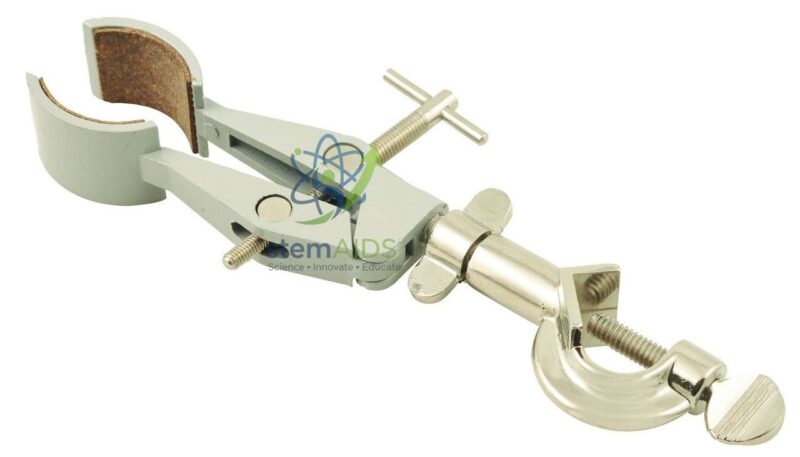
Quick Answer: The Burette Clamp, Rotatable 1 is a rotatable burette clamp whose jaws turn on a swivel and lock at any angle to the stand. The listing image shows a light grey cast body, curved cork-lined jaws closed by a T-screw, and a clamp-type fixing with its own screw.
Turning the Grip to Any Angle
A fixed clamp holds its jaws in one orientation, so tilting a tube means twisting the rod in the boss head. The Burette Clamp, Rotatable 1 has a swivel between the jaws and the fixing: loosen it, turn the jaws, and lock them again. The same clamp can hold a burette vertical in one lesson and a condenser sloping downward in the next.
Cork lining is a traditional choice for clamp jaws. Cork grips glass without slipping, cushions it, and tolerates warm glass better than many plastic coatings, although it chars in a flame and wears with use. Curved jaws, as pictured, wrap round a cylinder rather than pinching it along two lines, which spreads the force on thin glass.
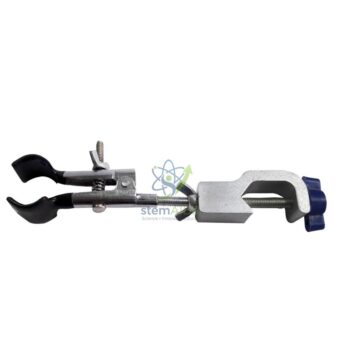
This is the first of two rotatable patterns in the range; the Burette Clamp, Rotatable 2 photograph shows a blue body with long arms. The title does not list jaw range, material or finish.
Specifications
| Type | Rotatable (swivel) clamp |
| Jaws | Curved, cork-lined (as pictured) |
| Closure | T-screw |
| Rotation | Swivel joint, locked by screw |
| Body | Light grey cast body in the listing image |
| Jaw range | Confirm at enquiry |
Applications
- Holding a Liebig condenser at a downward slope for simple distillation
- Bringing a burette back to vertical at the swivel when the stand upright is slightly out of true
- Holding a boiling tube at a slant while a solid is heated
- Supporting a gas delivery tube at the angle needed to reach a trough
Care & Handling
- Lock the swivel screw firmly before loading; a loose swivel lets the item rotate downward under its own weight.
- Replace the cork lining of the rotatable burette clamp when it becomes hard, crumbly or charred.
- Keep cork jaws dry after cleaning, as damp cork loses grip and can grow mould.
Why Choose LabEquip
Teaching labs that want one clamp to cover titration, distillation and heating work favour rotatable designs, since fewer clamp types need stocking. LabEquip lists this pattern in the General Lab Products range; ask us about quantities and jaw range.
Frequently Asked Questions
What does rotatable mean on a burette clamp?
It means the jaws are mounted on a swivel, so they can be turned and locked at any angle without moving the rod in the boss head. One clamp can then hold glassware upright or sloping.
Why are the jaws lined with cork?
Cork grips smooth glass well, cushions it, and copes with warm glass better than many plastic coatings. It does wear and can char in a flame, so linings need occasional replacement.
Can it hold a condenser for distillation?
Yes, provided the condenser jacket fits within the jaw range. Set the swivel to the slope you need, lock it, and then close the jaws around the jacket.
Is a rotatable clamp less stable than a fixed one?
Only if the swivel is not locked. With the lock screw tight, the joint holds like a fixed clamp; check it before each use, particularly under heavier loads.
How do I replace worn cork lining?
Remove the old cork and any adhesive, cut new cork sheet to the jaw shape, and fix it with an adhesive suited to cork and metal. Let it cure fully before clamping glass.
What is the difference between Rotatable 1 and Rotatable 2?
Both are pictured with a swivel and cork-lined jaws. Number 1 is shown with a compact light grey cast body, while number 2 is shown with a blue body and longer arms.
Last Updated: September 2026
You must be logged in to post a review.
Bestsellers





Reviews
There are no reviews yet.