
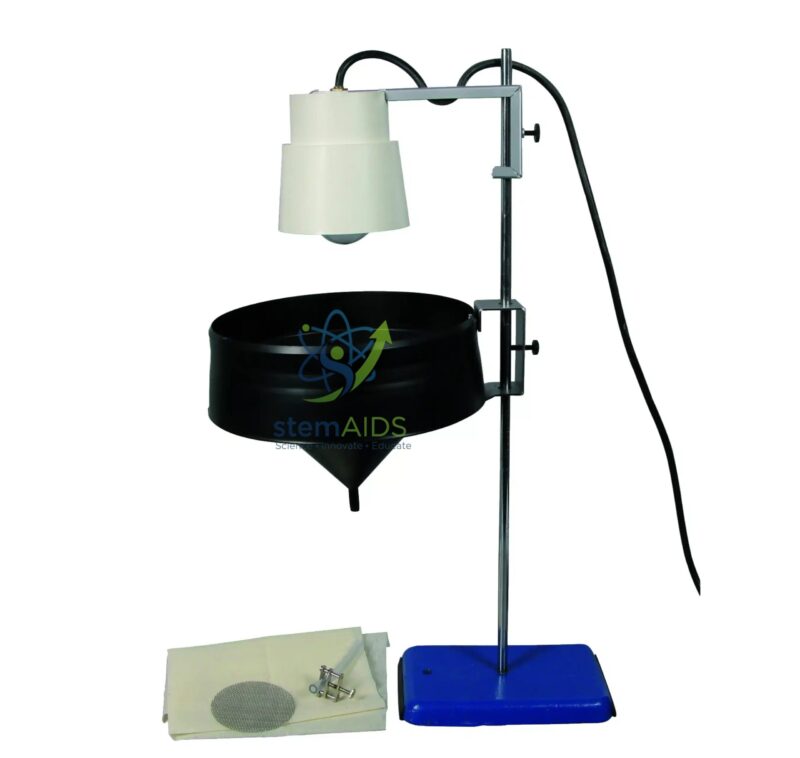
Quick Answer: The Berlèse and Baermann Apparatus is a stand-mounted extraction set for soil fauna, pictured with a lamp in a white shade held above a black funnel on a retort stand. Run dry under the lamp it works as a Berlese funnel for mites and springtails; run with water as a Baermann funnel it extracts nematodes and other small worms.
Two Extraction Methods on One Stand
The two methods target different animals. Arthropods move away from heat and drying, so in the dry Berlese method the lamp slowly dries a litter sample on a mesh until the animals drop through the funnel into a collecting vessel. The method is named after Antonio Berlese, who described a heated funnel in 1905; Tullgren later adapted it with an electric lamp as the heat source, which is why the set-up is also called a Tullgren funnel.
Nematodes cannot crawl out of drying soil; they need water. In the wet method, described by Baermann in 1917, the funnel stem is closed with a length of rubber tubing and a pinch clip and the funnel is filled with water. The soil sample, wrapped in tissue or muslin on a mesh, sits in the water. Nematodes wriggle out, sink down the stem and collect above the clip, and after a day or two a few millilitres are run off into a dish for counting under a stereo microscope.
Whether the tubing and clip for the wet method come with the set should be confirmed. The plastic Berlese Funnel kit covers only the dry method and suits large classes; this stand-mounted version suits college soil biology and nematology practicals where both groups of animals are studied from the same site.
Specifications
| Type | Combined dry (Berlese) and wet (Baermann) extraction set |
| Pictured parts | Retort stand, lamp with shade, funnel, mesh sample holder |
| Dry method | Lamp above litter on a mesh; arthropods drop into a collecting vessel |
| Wet method | Water-filled funnel closed by tubing and clip; nematodes sink to the stem |
| Tubing, clip and lamp rating | Confirm at enquiry |
Practical Applications
- Soil biology practicals comparing arthropods and nematodes from the same site
- Agriculture and plant-protection courses introducing plant-parasitic nematodes
- Comparing soil fauna under different crops, tillage or compost treatments
- Project work linking soil animals to decomposition and nutrient cycling
Care & Handling
- Keep the lamp clear of paper and dry litter, and do not leave it running unattended without a risk assessment.
- Clamp the funnel and lamp firmly and keep the stand on a level bench where it cannot be knocked.
- For the wet method, keep water away from the lamp and cable, and unplug the lamp while filling or draining.
- Wash the funnel, mesh and tubing after each run so animals from one sample are not carried into the next.
Why Choose LabEquip
College soil science and agriculture departments choose a stand-mounted set when students need both extraction methods on one bench. LabEquip lists this apparatus in the General Lab Products range; an Infrared Lamp 75W is another heat source for the dry method.
Frequently Asked Questions
What is the difference between the Berlese and Baermann methods?
The Berlese method is dry: a lamp drives heat-avoiding arthropods such as mites and springtails down through a mesh. The Baermann method is wet: nematodes swim out of a soil sample held in water and sink to the bottom of the funnel stem.
How long does a Baermann funnel extraction take?
Commonly 24 to 48 hours. Most active nematodes leave the sample in the first day, and running off a small volume from the stem at set times shows how the catch builds up.
How are nematodes counted?
Run a few millilitres from the stem into a counting dish or a Petri dish marked with a grid, and count them under a stereo microscope. Larger numbers can be estimated by counting a measured part of the sample.
Can both methods be run at the same time?
Not on a single funnel, since one needs the sample dry and the other needs it in water. Split the soil sample, run the two extractions one after the other or on a second funnel, and record which part went to each method.
Why wrap the soil in tissue for the Baermann method?
The tissue or muslin holds back soil particles so the water in the stem stays clear, while nematodes can still wriggle through. A cloudy collection makes counting under the microscope difficult.
Which lamp should be used for the dry method?
One that warms the top of the sample gently, such as a low-wattage bulb or small heat lamp positioned a few centimetres above the litter. Check the sample surface regularly and raise the lamp if the litter starts to scorch.
Last Updated: September 2026




Reviews
There are no reviews yet.