






In Stock
Air and Water Analysis Kit for the Environment
Kit d’analyse de l'air et de l'eau dans l'environnement. Precision-engineered syringe-based collectors and specialized reagents for the volumetric determination of CO2 and O2 concentrations within local microclimates and industrial exhaust streams.
Multimodal Aqueous Reagent Suite features high-stability colorimetric indicators and titrants calibrated for the forensic detection of dissolved ions and pH fluctuations across diverse hydrological horizons and wastewater profiles.
₹1,289.00
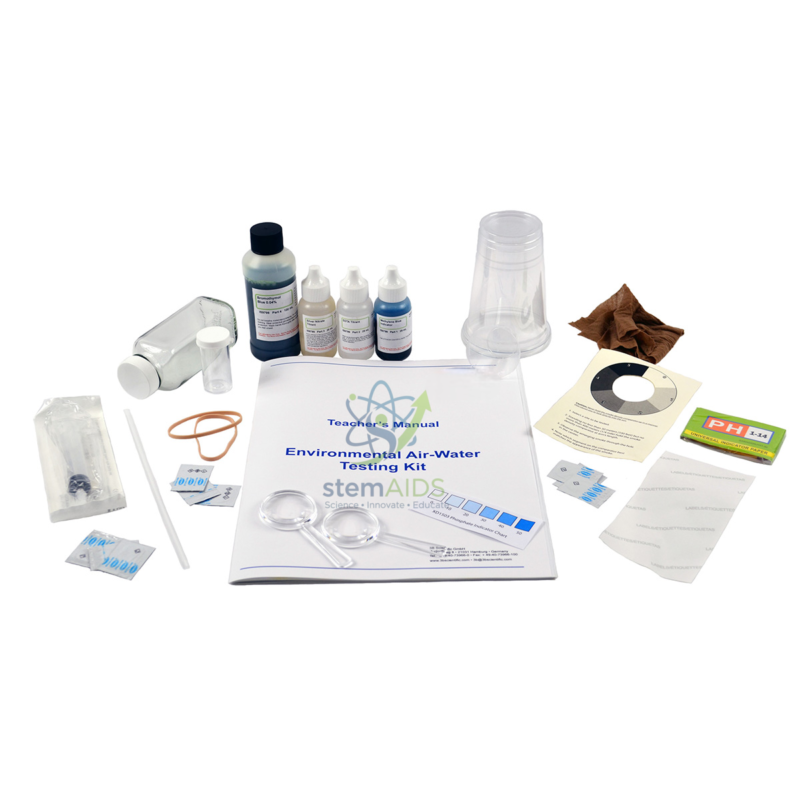
Quick Answer: The Air and Water Analysis Kit for the Environment is a classroom kit for testing water samples and investigating air quality; the listing photo shows reagent bottles, pH test paper, a syringe, sample containers, magnifiers and a teacher’s manual for environmental air and water testing. It is used in environmental science and geography lessons to turn local pollution questions into recorded results.
What the Kit Lets Students Investigate
Environmental testing kits of this type bring together two sets of activities. On the water side, students collect samples from taps, ponds, rain gauges or drains and test them with reagents and indicator papers, typically for pH and for dissolved substances such as nitrate or hardness. On the air side, the usual activities are qualitative: catching airborne particles on sticky or coated cards, viewing them under a magnifier, and comparing sites such as a roadside, a classroom and a garden.
The pictured contents fit that pattern: small dropper bottles of reagent, a booklet of pH paper, a plastic syringe for measuring volumes, a clear cup and a vial for samples, hand magnifiers, a black-and-white disc, filter or wipe sheets and a teacher’s manual. The exact list of parameters is not given in the product title, so the manual is the guide to which tests the reagents support and how many runs they allow.
Because the kit favours comparison over laboratory precision, it works well for project-based study. One group might map pH around the school grounds after rain, while another counts particles on cards left near a car park for a week. For a numerical check of total dissolved solids, the TDS/EC water testing meter complements the chemical tests.
Classroom and Field Uses
- Surveying the pH of rainwater, tap water and pond water around a school
- Comparing airborne dust or soot collected beside a busy road with a quiet green area
- Eco-club projects and science-fair investigations on local pollution
- Linking fertiliser run-off to water quality in geography and agriculture lessons
Specifications
| Type | Environmental air and water testing kit for classroom and field use |
| Pictured components | Reagent bottles, pH paper, syringe, sample cup and vial, magnifiers, disc, sheets, teacher’s manual |
| Water tests | Indicator and reagent tests as described in the manual |
| Air activities | Particle collection and observation, as described in the manual |
| Parameters covered and number of tests | Confirm at enquiry |
Care & Handling
- Keep the reagent bottles capped and stored away from sunlight; replace any that are past their date or have changed colour.
- Label every sample container with site, date and time before the class sets out, so results are not mixed up.
- Wear eye protection when handling reagents and wash hands after fieldwork near drains or stagnant water.
- Store the pH paper booklet dry, since damp paper gives false colours.
Why Choose LabEquip
Schools running eco-club projects, environmental science teachers and teacher-training colleges use this air and water analysis kit to give every group a practical role in a local survey. LabEquip lists it in the General Lab Products range; groups adding an oxygen titration can pair it with the Dissolved Oxygen Kit, and refill questions can go through the contact page.
Frequently Asked Questions
Which age groups is the kit suited to?
Environmental kits of this kind are generally used from middle school upwards, with the teacher preparing or supervising the reagent steps. Older students can extend the same tests into structured projects with repeated sampling and graphs.
How should water samples be collected for testing?
Use clean containers rinsed first with the water being sampled, fill them below the surface away from floating debris, and test as soon as possible. Record the site, time and weather, because rain, temperature and time of day all change the results.
How do students assess air quality without an electronic sensor?
The common method is to expose a sticky or coated card at each site for a set time and then examine the trapped particles with a magnifier, counting them in a marked area. It gives a comparison between places rather than a concentration in micrograms per cubic metre.
Can the results be used to decide if water is safe to drink?
No. Classroom kits show trends and differences between samples, but drinking-water safety depends on microbiological and chemical tests carried out by an accredited laboratory. Treat the kit as a teaching and screening tool only.
Why is pH paper used instead of a pH meter?
pH paper needs no calibration, electricity or maintenance, so a whole class can test many samples quickly outdoors. It reads in steps rather than to decimal places, which is enough to compare rainwater, tap water and pond water.
What should be done with used reagents and samples?
Follow the disposal notes in the manual and your school’s waste rules. Small volumes of dilute, non-hazardous test solutions are often poured to a laboratory sink with running water, but anything the safety data sheet marks as hazardous must be collected for proper disposal.
Last Updated: September 2026
You must be logged in to post a review.
Bestsellers




Reviews
There are no reviews yet.