








Sale
In Stock
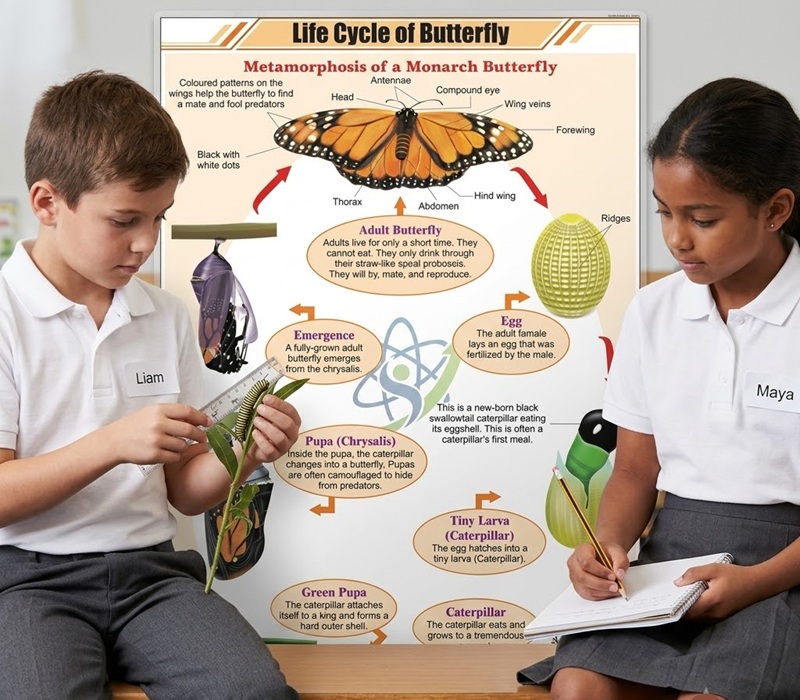
Life Cycle of a Butterfly Educational Chart
Original price was: ₹340.00.₹160.00Current price is: ₹160.00.
Quick Answer: The Life Cycle of a Butterfly Educational Chart is a biology teaching chart showing the four stages of a butterfly’s life, egg, caterpillar (larva), chrysalis (pupa) and adult, arranged as a cycle to explain complete metamorphosis. Teachers use it in primary and middle-school science and alongside caterpillar-rearing projects.
Four Stages, Arranged as a Circle
A butterfly life cycle is usually drawn as a circle because the adult lays the eggs that start the next generation. The first stage is the egg, laid on the particular plant the caterpillar will eat; many species are choosy, so the host plant is often shown. The egg hatches into a caterpillar whose main job is to eat and grow, and because its skin cannot stretch indefinitely it moults several times.
The fully grown caterpillar fixes itself to a stem or leaf and sheds its skin one last time to reveal the chrysalis. Although it looks still, the pupa is where the most dramatic change happens: most larval tissues are broken down and rebuilt into wings, legs, antennae and a coiled proboscis for sipping nectar. The adult then emerges, pumps fluid into its crumpled wings, waits for them to dry and flies off to feed and mate.
Because the young look completely different from the adult and pass through a pupa, the butterfly is the standard example of complete metamorphosis, in contrast to insects such as grasshoppers whose nymphs resemble small adults. The species illustrated varies by edition.
Applications
- Introducing life cycles in primary science with a familiar insect
- Caterpillar-rearing projects, with students recording each stage against the chart
- Comparing complete and incomplete metamorphosis in middle school
- Linking butterflies to pollination in a school garden project
Specifications
| Topic | Butterfly life cycle and complete metamorphosis |
| Stages shown | Egg, caterpillar (larva), chrysalis (pupa), adult (imago) |
| Terms introduced | Host plant, moulting, instar, metamorphosis, proboscis |
| Layout | Circular sequence of stages |
| Level | Primary and middle-school science |
| Species shown, size and finish | Confirm at enquiry |
Care & Handling
- Hang the butterfly chart at child height in primary classrooms so students can point to each stage themselves.
- Keep it near the rearing container during a project, but away from the water spray used to keep leaves fresh.
- Roll it up and store it once the project ends.
Why Choose LabEquip
Primary teachers and science coordinators buy this chart for life-cycle lessons, and it compares well with the Housefly Life Stages Chart, another complete metamorphosis with a very different story. Both are in LabEquip’s Educational Charts range, and orders for several classrooms can be sent via the contact page.
Frequently Asked Questions
What is the difference between a chrysalis and a cocoon?
A chrysalis is the hard outer case of a butterfly pupa, formed from the caterpillar’s own final skin. A cocoon is a silk covering that many moth caterpillars spin around themselves before they pupate. So butterflies usually form a chrysalis and moths a cocoon.
Why does a caterpillar moult?
A caterpillar’s outer skin, the exoskeleton, cannot grow with it. As the caterpillar eats and grows, it periodically sheds the old skin and expands before the new one hardens. The stage between two moults is called an instar.
What happens inside the chrysalis?
Most of the caterpillar’s body is broken down, and groups of cells set aside in the larva, called imaginal discs, grow into the adult’s wings, legs, antennae and other organs. The pupa rebuilds a leaf-eating crawler into a flying, nectar-feeding adult.
How long does the butterfly life cycle take?
It varies widely with species and temperature, from a few weeks in warm weather to many months in species that pass the winter as eggs, caterpillars or pupae. The chart shows the order of the stages rather than their duration.
Why do butterflies lay eggs on particular plants?
Many caterpillars can eat only certain plants. The female uses sensors on her feet and antennae to find the right host plant, such as citrus for lime butterflies or milkweed for monarchs, so the hatching caterpillars have food straight away.
How can a class raise butterflies safely?
Collect a few caterpillars with leaves of the plant they were found on, keep them in a ventilated container out of direct sun, and add fresh leaves of the same plant daily. Release the adults where the caterpillars were found once their wings have dried.
Last Updated: September 2026
Bestsellers


Sale



