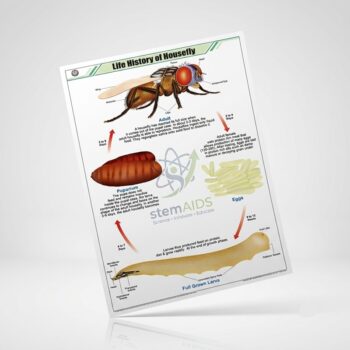
Quick Answer: The Housefly Life Stages Chart is a biology teaching chart showing the housefly life stages of Musca domestica, egg, larva (maggot), pupa and adult, and linking each stage to where it lives. It is used in lessons on insect life cycles, hygiene and the spread of disease.
From Rubbish Heap to Kitchen Table
The housefly’s life cycle explains why flies follow people. Females lay batches of small, white, oval eggs in moist, decaying organic matter: manure, garbage, rotting food. The eggs hatch quickly into legless, cream-coloured maggots that burrow into the material and feed, growing through three larval stages within days when conditions are warm.
When fully grown, the maggot moves to a drier spot, and its last larval skin hardens and darkens into a barrel-shaped case, the puparium, inside which the pupa develops. The adult fly pushes open the end of the case and emerges, soon ready to breed. In warm weather the whole cycle is completed quickly, which is why fly numbers rise so fast in summer.
Charts often show the adult fly’s sponging mouthparts and hairy legs, and this is where biology meets health. Flies feed on waste and on our food, and they carry germs of diseases such as typhoid, cholera and dysentery from one to the other. Breaking the cycle at the breeding stage is the most effective control.
Care & Handling
- Take the housefly chart to a canteen hygiene session if needed, then return it to the science room, away from kitchen steam.
- Dust it with a dry cloth and keep it away from moisture.
- Store it rolled with the other insect charts.
Specifications
| Organism | Housefly (Musca domestica) |
| Stages shown | Egg, larva (maggot), pupa in puparium, adult |
| Type of development | Complete metamorphosis |
| Health link | Breeding in waste; mechanical carrier of germs |
| Level | Primary to secondary science and health education |
| Size and finish | Confirm at enquiry |
Applications
- Life-cycle lessons comparing the housefly with the butterfly and the mosquito
- Hygiene and sanitation lessons on covering food, waste disposal and clean toilets
- Explaining the mechanical transmission of disease-causing organisms
- Environmental projects on waste management around the school
Why Choose LabEquip
Science and health teachers order this chart for the life-cycle and hygiene units, often alongside the Life Cycle of a Butterfly Educational Chart to show two very different insects with the same four stages. For wider pest topics, the Harmful Insects Learning Chart groups the housefly with other vectors, and LabEquip supplies all three in the Educational Charts range.
Frequently Asked Questions
How does a housefly spread disease?
A housefly does not inject germs as a mosquito does. It picks them up on its hairy legs, body and mouthparts while feeding on faeces and garbage, then transfers them to food. It also releases saliva onto solid food to dissolve it and leaves droppings, adding further contamination.
Why is the pupa of a housefly brown and barrel-shaped?
The housefly pupa forms inside the last larval skin, which hardens and darkens into a protective case called the puparium. That is why it looks like a smooth brown barrel rather than a shaped chrysalis.
Where do houseflies lay their eggs?
In moist, warm, decaying organic matter such as manure, garbage bins, compost and rotting food. These materials give the maggots food and moisture, so removing or covering them is the most effective way to cut fly numbers.
How does a housefly feed?
Its mouthparts end in a sponge-like pad, the labellum, that soaks up liquid food. For solids such as sugar, the fly first releases saliva to dissolve the food and then sucks up the liquid.
Is the housefly’s development complete or incomplete metamorphosis?
Complete. The housefly passes through four distinct stages, egg, larva, pupa and adult, and the legless maggot looks nothing like the winged adult, just as a caterpillar differs from a butterfly.
How can schools reduce houseflies?
Keep waste bins covered and emptied regularly, clean toilets and drains, keep food covered, and do not let food scraps or animal dung pile up near buildings. Fly screens on kitchen windows help, and removing breeding sites works better than spraying adult flies.
Last Updated: September 2026