Quick Answer: The Harmful Insects Learning Chart is a biology teaching chart that introduces insects which harm people, crops, stored food or buildings, typically including mosquitoes, houseflies, cockroaches, locusts, termites and grain pests, grouped by the kind of harm they cause. This harmful insects chart supports lessons on insects, health and agriculture.
Why Some Insects Are Called Harmful
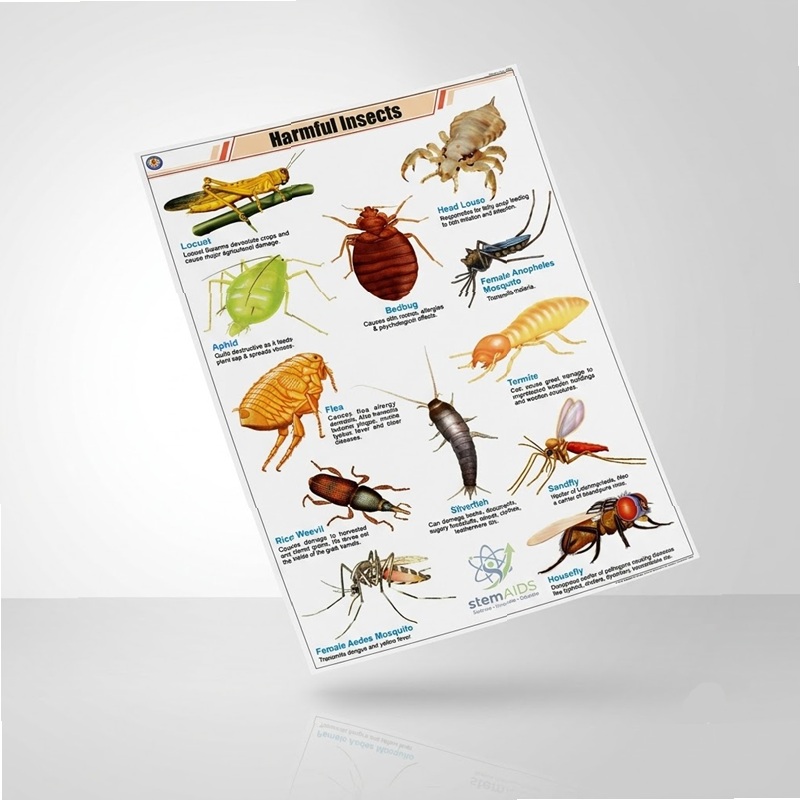
No insect is harmful in itself; it is harmful to someone, in some setting. A chart of this kind makes that point by grouping insects according to the damage they do. Disease vectors usually come first: the Anopheles mosquito that spreads malaria, Aedes that spreads dengue, and the housefly that carries germs of diarrhoeal diseases on its legs and mouthparts. Household pests such as cockroaches, bed bugs and head lice sit nearby.
Agricultural pests form the second group. Locusts in swarms, aphids sucking plant sap, and caterpillars such as stem borers and bollworms feeding inside crops show different ways of harming a plant. Stored-grain pests, like the rice weevil and pulse beetle, damage food after harvest, and termites attack wood and buildings. Each is typically shown with its name and the damage it causes.
The lesson is most useful when it ends with control rather than fear: removing breeding sites, covering food, crop rotation, natural enemies and careful use of insecticides. The examples in a given edition vary, so check which species it shows if your syllabus names particular pests.
Specifications
| Theme | Insects harmful to health, crops, stored food and buildings |
| Typical examples | Mosquito, housefly, cockroach, locust, aphid, termite, rice weevil |
| Grouping | Disease vectors, crop pests, stored-grain pests, household pests |
| Learning goals | Identify pests, describe the harm, discuss control |
| Level | Primary and middle-school science, basic agriculture |
| Size, finish and language | Confirm at enquiry |
Applications
- Health lessons linking mosquitoes and flies to the diseases they spread
- Agriculture units on crop protection and pest control
- Home-science lessons on keeping stored food free of pests
- A class survey of insects found around the school, compared with the chart
Care & Handling
- Pair the harmful insects chart on the wall with a chart of useful insects, so students do not come away thinking all insects are pests.
- Hang it in a dry area; silverfish and termites damage stored paper, which is a practical lesson in itself.
- Store it rolled in a closed tube.
Why Choose LabEquip
This chart is bought by science and health-education teachers, often as a pair with the Beneficial Insects Study Chart to give a balanced view, while the broader Insects Charts cover structure and life cycles. LabEquip supplies all of them through the Educational Charts range.
Frequently Asked Questions
What makes an insect a disease vector?
A vector is an animal that carries a disease-causing organism from one host to another. Some insects, such as mosquitoes, carry the parasite inside their bodies and pass it on when they bite; others, such as houseflies, carry germs on their body surface and contaminate food.
Why are locusts more dangerous than grasshoppers?
Locusts are grasshoppers that change behaviour when crowded, forming huge swarms that fly long distances and strip crops and vegetation as they go. Solitary grasshoppers feed in small numbers and rarely cause more than local damage.
How do termites damage buildings?
Termites feed on cellulose, the main material in wood and paper. Colonies tunnel through timber, furniture, books and door frames, often from the inside, so the damage may not be visible until the wood is hollow.
Which insects damage stored grain?
Common stored-grain pests include the rice weevil, the lesser grain borer, the pulse beetle and the red flour beetle. Their larvae feed inside or among the grains, causing weight loss and contamination. Drying grain well and storing it in clean, airtight containers reduces infestation.
What is integrated pest management?
It is an approach that combines several methods to keep pests below damaging levels, using insecticides only when needed. Methods include crop rotation, resistant varieties, traps, and natural enemies such as ladybirds and parasitic wasps.
Should students kill every harmful insect they see?
No. Most insects, including many that are pests in one setting, are food for birds, frogs and other animals. The aim is to control pests where they cause harm, for example by removing stagnant water and covering food, not to eliminate insects altogether.
Last Updated: September 2026