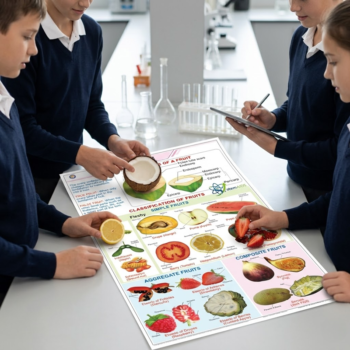
Quick Answer: The Fruit Categories Learning Chart is a botany teaching chart that sorts fruits into their main groups, simple fleshy, simple dry, aggregate and multiple, with familiar examples for each type. This fruit categories chart helps students classify the fruits they eat and link each type to the flower it came from.
Sorting Fruits the Botanical Way
Botanists classify a fruit by how it develops, not by taste. A chart of fruit categories usually starts with the big split: simple fruits come from one ovary of one flower, aggregate fruits from several separate carpels of one flower, and multiple fruits from a whole cluster of flowers. Simple fruits are then divided into fleshy ones, such as berries, drupes and pomes, and dry ones, which either split open to release their seeds (dehiscent) or stay closed (indehiscent).
Everyday examples make the scheme stick. A mango or coconut is a drupe, with a stony inner layer around the seed; a tomato, grape or guava is a berry; an apple is a pome; an orange is a hesperidium; and a cucumber or watermelon is a pepo. Among dry fruits, pea and bean pods are legumes, mustard produces a siliqua, cotton and lady’s finger form capsules, and a grain of wheat or rice is a caryopsis. Strawberry and custard apple represent aggregate fruits, while jackfruit, pineapple and mulberry are multiple fruits.
Which examples appear, and how many subtypes are shown, depends on the edition. Some courses stop at simple, aggregate and multiple fruits, while others expect the dry-fruit subtypes too, so compare the chart’s categories with your syllabus.
Specifications
| Classification shown | Simple (fleshy and dry), aggregate and multiple fruits |
| Fleshy types | Berry, drupe, pome, hesperidium, pepo |
| Dry types | Legume, siliqua, capsule (dehiscent); caryopsis, achene, nut (indehiscent) |
| Example fruits | Mango, tomato, apple, orange, pea, wheat, strawberry, jackfruit |
| Level | Middle school to senior secondary botany |
| Size and finish | Confirm at enquiry |
Care & Handling
- Hang the fruit categories chart well away from the bench used for cutting fruit; juice and seeds stain paper.
- Work through the classification tree with a pointer so the most-used branches do not get smudged.
- Store the chart rolled in a cool, dry place between uses.
Applications
- Fruit-sorting practicals where groups classify a tray of market fruits and justify each placement
- Cutting fruits open to count carpels and find where the seeds are attached
- Linking flower structure to fruit type after the pollination unit
- Quick identification rounds to revise fruit-type terms
Why Choose LabEquip
Science teachers usually buy this chart for the fruit-classification practical, and it pairs with the Botanical Flower Structure Chart, since every fruit type traces back to the ovary. For fruit structure and dispersal, the Fruits Charts set covers related ground. Both sit in LabEquip’s Educational Charts range, and orders can go through the contact page.
Frequently Asked Questions
What is the difference between a drupe and a berry?
Both are fleshy simple fruits, but a drupe has a hard, stony inner layer, the endocarp, around its seed, as in mango, plum and coconut. In a berry the whole fruit wall is soft or fleshy and usually holds several seeds, as in tomato, grape and guava.
Is a coconut really a drupe?
Yes. The smooth outer skin, the thick fibrous husk and the hard shell correspond to the outer, middle and stony inner layers of a mango. The difference is that the coconut’s middle layer is fibrous and dry rather than juicy.
What type of fruit is a grain of wheat or rice?
It is a caryopsis, a small dry fruit that does not split open, in which the thin fruit wall is fused to the seed coat. That is why a cereal grain is botanically a whole fruit, even though it is sown and eaten like a seed.
What is a hesperidium?
It is the berry-like fruit of citrus plants such as orange, lemon and lime. It has a leathery rind dotted with oil glands, a white spongy layer beneath, and segments filled with juice sacs, which are hairs grown from the inner wall of the ovary.
How is a legume different from a siliqua?
Both are dry pods that split open. A legume, such as pea or bean, develops from a single carpel and splits along two seams. A siliqua, as in mustard, develops from two fused carpels and opens from the bottom upward, leaving a papery central partition, the replum, with the seeds attached.
Why is a pineapple called a multiple fruit?
A pineapple develops from a whole inflorescence. Each small flower on the stalk forms a fruitlet, and these fuse with the bracts and the central axis into a single fleshy structure. Jackfruit and mulberry form in the same way.
Last Updated: September 2026