











Sale
In Stock
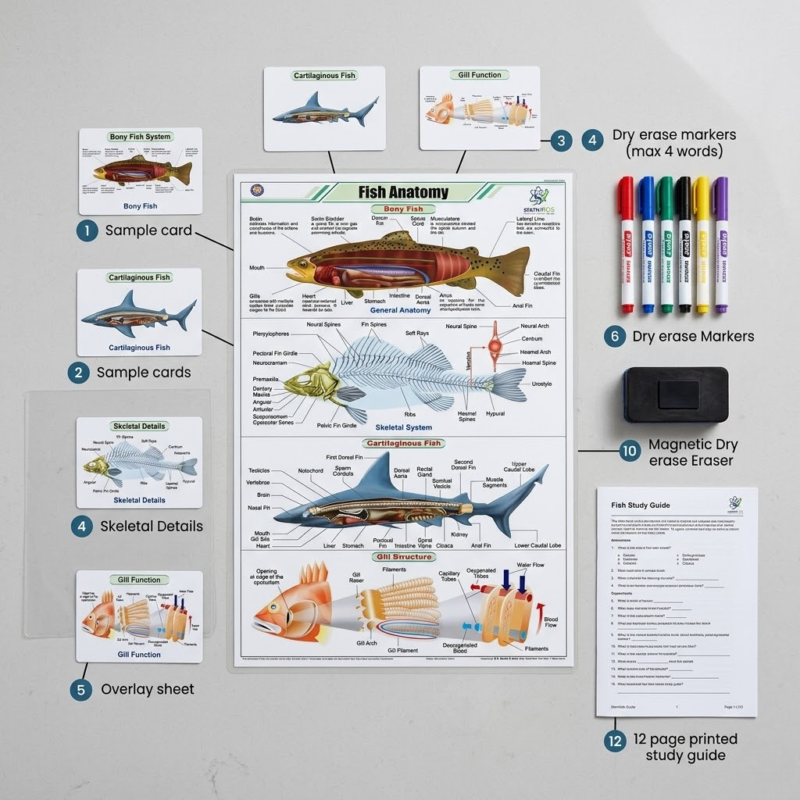
Fish Internal Anatomy Chart
Original price was: ₹340.00.₹160.00Current price is: ₹160.00.
Quick Answer: The Fish Internal Anatomy Chart is a zoology wall chart showing the internal organs of a bony fish as seen in a dissection, including the gills, heart, liver, digestive tract, swim bladder, kidneys and gonads. It is used in vertebrate biology and comparative anatomy lessons and to prepare students for fish dissections.
What Lies Beneath the Scales
Where a general fish chart gives equal space to fins and scales, an internal anatomy chart opens the body cavity. The standard view is a bony fish seen from the side with the body wall removed, so the organs appear in their natural positions: the gills under the operculum, the small heart just behind and below them, a large liver with its gall bladder, and the digestive tract running back from the stomach to the vent. Many charts label the finger-like pyloric caeca where stomach meets intestine.
Above the gut lies the swim bladder, and above that, pressed against the backbone, the dark kidneys run almost the full length of the body cavity. The gonads, ovaries or testes, sit alongside the gut and change greatly in size with the breeding season, something students notice when they dissect fish bought at different times of year. Brain and spinal cord are often drawn in outline to complete the picture.
The chart suits comparative anatomy well. A fish heart pumps blood that passes through it only once per circuit, and the kidneys do very different work in freshwater and marine species. These are exactly the contrasts students are asked to draw with frog, bird and mammal.
Specifications
| Animal represented | Bony fish (teleost) with the body cavity opened |
| Organs usually labelled | Gills, heart, liver, gall bladder, stomach, pyloric caeca, intestine |
| Other structures | Swim bladder, kidneys, gonads, brain and spinal cord in outline |
| Teaching focus | Internal organs and dissection guidance |
| Level | Secondary zoology to first-year college |
| Size and finish | Confirm at enquiry |
Applications
- Preparing students for a fish dissection, so they know where each organ should lie before the first cut
- Comparing single circulation in fish with double circulation in mammals
- Teaching osmoregulation by contrasting freshwater and marine fish
- Revision for vertebrate comparative anatomy
Care & Handling
- Hang the fish anatomy chart where it can be seen from the dissection trays but well clear of splashes, which stain and weaken paper.
- Ask students to wash and dry their hands before touching the chart after a dissection.
- Store it rolled in a closed tube over the holidays so insects and damp cannot reach it.
Why Choose LabEquip
Zoology teachers ordering for dissection practicals often take this chart together with the Fish Anatomy Chart, which covers external features and adaptations, so one sheet shows the outside and the other the inside. LabEquip supplies both in its Educational Charts range, and dissection-lab lists can be sent through the contact page.
Frequently Asked Questions
What are pyloric caeca?
They are finger-like pouches that branch off the gut where the stomach joins the intestine in many bony fish. They increase the surface area for digesting and absorbing food. Their number varies widely between species, from a few to hundreds.
Why are the kidneys of a fish so long and dark?
Fish kidneys lie along the whole length of the body cavity, just beneath the backbone, and are rich in blood, which gives them their dark red colour. As well as removing waste, they help regulate the balance of water and salts.
How does a freshwater fish deal with water entering its body?
Water constantly enters a freshwater fish by osmosis through the gills, because its body fluids are saltier than the surrounding water. Its kidneys therefore produce large amounts of dilute urine, and the gills actively take up salts. Marine fish face the opposite problem and drink seawater.
What is single circulation?
In a fish, blood leaves the heart, passes through the gills to pick up oxygen and then flows on to the rest of the body before returning to the heart. It passes through the heart only once per complete circuit, whereas in mammals it passes through twice.
Which organs should students look for first in a fish dissection?
After opening the body cavity, look for the liver, usually the largest organ and reddish-brown, then follow the gut from the stomach to the vent. The swim bladder is a silvery sac above the gut, and the gills can be seen by lifting the operculum.
Do cartilaginous fish such as sharks have the same organs?
Mostly, but with key differences. Sharks have no swim bladder and rely on a very large, oily liver and their fins to avoid sinking. Their intestine contains a spiral valve that increases the absorbing surface, and they have gill slits without an operculum.
Last Updated: September 2026
Bestsellers



Sale

