
Quick Answer: A plastic separatory funnel is a pear-shaped funnel moulded from plastic, with a closable neck at the top and a stopcock on the stem, used to shake two immiscible liquids together and then drain them off as separate layers. It is chosen where a glass funnel could break.
A Pear-Shaped Plastic Body and What It Changes
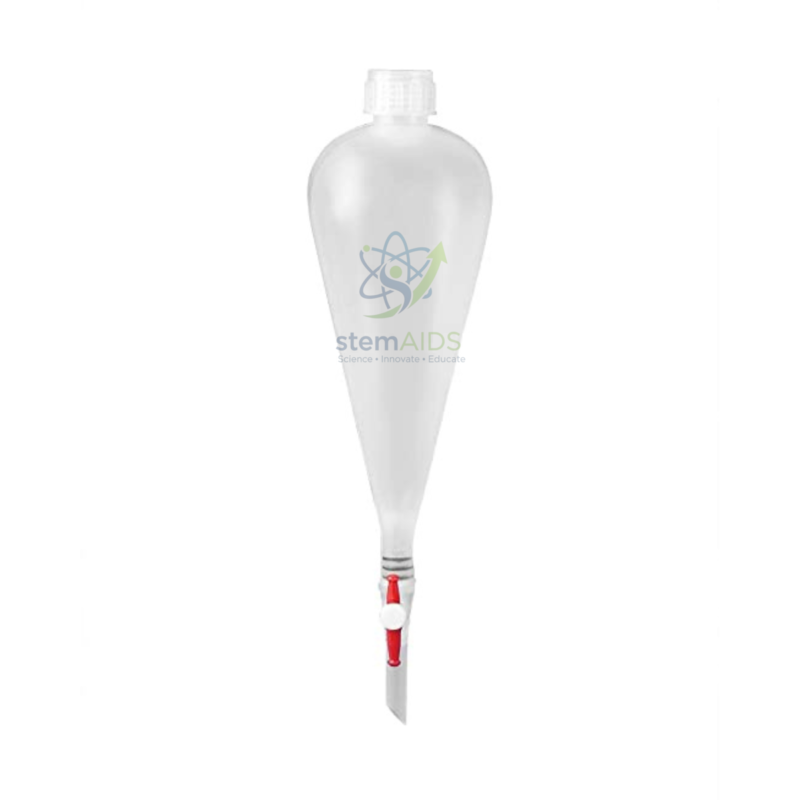
The listing photo shows a translucent, pear-shaped (Squibb-style) body with a threaded neck and a red-handled stopcock on the stem. The tapering cone matters in use: as the lower layer drains, the interface narrows into the stem, so the moment to close the tap is easy to judge by eye.
Plastic changes the chemistry rather than the technique. Polypropylene, a common resin for these funnels, resists aqueous acids, alkalis and salt solutions well and survives knocks that would crack glass. Many organic extraction solvents are a different matter: chlorinated solvents such as dichloromethane and chloroform, and aromatic ones such as toluene, can swell or soften polyolefins. The title does not name the resin, so compare its resistance chart with the solvent before a first extraction.
For chlorinated solvents, or for any work that needs a clear view of a faint interface, the glass separating funnel remains the standard choice. The plastic version suits aqueous work, oil and water demonstrations with younger classes, and outreach or field kits where glass is unwelcome.
Specifications
| Type | Separatory funnel, pear (Squibb) shape, as shown in the listing photo |
| Material | Plastic, as titled; resin not named |
| Outlet | Stopcock on the stem with a coloured key, as shown in the photo |
| Neck | Threaded neck, as seen in the photo |
Applications
- Demonstrating immiscibility with vegetable oil and coloured water in middle-school science
- Separating an aqueous layer from a compatible organic layer in simple extraction practicals
- Washing an organic product with water or sodium hydrogen carbonate solution before drying, where the solvent suits the plastic
- Recovering oil from a water sample in environmental or food-science classes
Care & Handling
- Mount the funnel in a ring or a separatory funnel holder and place a beaker beneath before opening the stopcock.
- Vent through the open stopcock after every few shakes, with the stem pointing up and away from people, because vapour pressure builds quickly with volatile solvents.
- Remove the top closure before draining; otherwise a partial vacuum forms and the flow stops.
- Wash with warm water and mild detergent, and dismantle the stopcock now and then to rinse out trapped residue.
- Keep the funnel away from flames and hot plates, since plastics soften with heat.
Why Choose LabEquip
Schools that want students to practise layer separation without breakage, and teams who pack kits for fieldwork, are the usual buyers of a plastic funnel of this kind. LabEquip lists it with other chemistry lab equipment; send the capacities and numbers you need through the contact page.
Related Products
- Separatory Funnel Holder, Plastic: A plastic holder that keeps the funnel upright while the layers settle and drain.
- Glass Separatory Funnel: A glass separatory funnel for chlorinated or aromatic solvents that can soften plastic.
- Funnel Holder, Plastic: A plastic funnel holder that clamps to a stand rod for supporting the funnel at a chosen height.
- Flavor Synthesis and Purification kit: A flavour synthesis kit whose purification steps include washing and layer separation in a separating funnel.
Frequently Asked Questions
Which solvents can be used in a plastic separatory funnel?
A plastic separatory funnel suits aqueous acids, alkalis and salt solutions, and polypropylene resists many alcohols. Chlorinated solvents such as dichloromethane and chloroform, and aromatic ones such as toluene, can swell or soften polyolefins, so extractions with those solvents belong in a glass funnel.
How is a separatory funnel vented while shaking?
Stopper the funnel, turn it upside down holding the stopper in place, point the stem away from people and open the stopcock briefly to release pressure. Shake a few times, vent again, and repeat until venting no longer gives a hiss.
Why does the funnel stop draining even though the stopcock is open?
The stopper is still in the neck, so liquid leaving creates a partial vacuum above it and the flow stops. Remove the stopper, or twist it so its groove lines up with the vent if it has one, and the liquid will run again.
How can I tell which layer in the funnel is aqueous?
The denser liquid forms the lower layer. If unsure, add a few drops of water and watch which layer they join. Keep both layers until the experiment is finished, so a mistake can still be corrected.
Is the boundary between layers easy to see in a plastic funnel?
The listing photo shows a translucent body, which is less clear than glass. Holding a light or a white card behind the funnel helps the boundary show, and the pear-shaped cone narrows the boundary near the tap, so the moment to close it is still easy to judge.
Can a plastic separatory funnel be autoclaved?
Only if the body and stopcock are made of an autoclavable resin such as polypropylene; check the moulded resin code. Remove the stopper and open the stopcock during the cycle so steam can reach every part.
Last Updated: November 2026




Reviews
There are no reviews yet.