
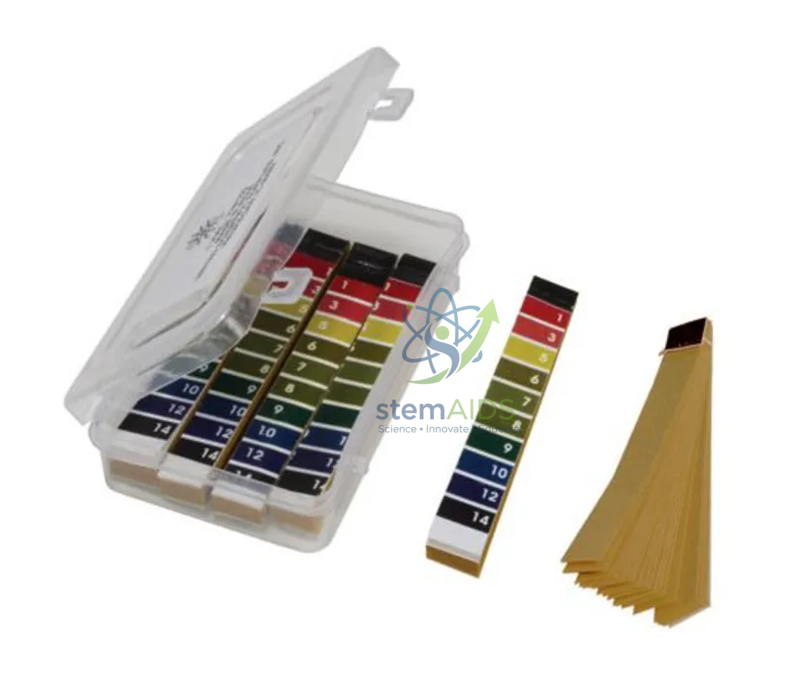
Quick Answer: Wide range pH paper is indicator-impregnated paper that changes colour according to the pH of a solution, read against a printed colour chart. The listing photo shows booklets of strips in a clear plastic box, each with a chart running from red at the acidic end through yellow and green to deep blue, plus loose tear-off strips.
Estimating pH in a Few Seconds
The paper carries a blend of indicators, each changing colour over a different part of the pH scale, so together they produce a graded run of colours instead of the single switch of litmus. The chart printed on each booklet in the photo is numbered from 1 to 14, which is what ‘wide range’ means here: one strip gives a rough value anywhere across the usual scale.
To use it, tear off a short strip, touch it with a drop of the test solution on a glass rod or dip just the end briefly, and compare the colour with the chart straight away. Readings are to about one pH unit. That is enough to tell a strong acid from a weak one or to show that a soap solution is alkaline, but not enough to plot a titration curve or check a buffer.
For readings to one or two decimal places a laboratory pH meter is needed, such as the wireless pH meter sensor, which also logs readings over time. Paper stays quicker for surveys of many samples, needs no calibration and can be handed to every student at once.
Specifications
| Item | Wide range pH indicator paper |
| Format | Booklets of tear-off strips with printed colour chart (photo) |
| Chart scale | Numbered 1 to 14 (photo) |
| Packaging | Clear plastic box holding several booklets (photo) |
Applications
- Classifying household substances such as vinegar, soap, baking soda and lemon juice as acidic, neutral or alkaline
- Checking the pH of water samples, soil extracts or rainwater in environmental projects
- Following a neutralisation roughly as acid is added to alkali
- Confirming that waste solutions are near neutral before disposal, as lab rules require
Care & Handling
- Keep the wide range pH paper booklets closed in their box and away from acid or ammonia fumes, which change the colour of unused paper.
- Handle strips by one end with dry hands; moisture and sweat on fingers can affect the colour.
- Read the colour immediately after wetting, since colours can drift as the strip dries.
- Never dip a strip into a stock reagent bottle; test a drop taken out on a glass rod instead.
Why Choose LabEquip
Schools, colleges and environmental science groups buy wide range pH paper for quick classification work where a meter would be slower. LabEquip lists it among its chemistry lab equipment; ask on the contact page about quantities for a year of classes.
Related Products
- pH Indicator Paper Narrow Range – Packs and Rolls: Narrow range pH paper with finer colour steps for reading pH more precisely once the rough value is known.
- Neutral Litmus Paper: Neutral litmus paper for a simple acid-or-alkali check before younger classes move to graded pH.
- Spotting Plate / Cavity Tile: A white cavity tile for testing drops of several solutions with pH strips side by side.
- Laboratory Glass Stirrer: A glass stirrer for transferring a single drop of test solution onto the pH strip.
Frequently Asked Questions
How accurate is wide range pH paper?
Wide range pH paper estimates pH to about one unit, because one strip has to cover the whole scale from 1 to 14 in a limited number of colour steps. That is ideal for sorting solutions into strongly acidic, weakly acidic, neutral and alkaline. For finer values, use narrow range paper or a pH meter.
How is wide range pH paper different from litmus paper?
Litmus changes only from red in acid to blue in alkali, so it tells you which side of neutral a solution is on. Wide range paper contains a blend of indicators that gives a graded series of colours, which are matched to the printed chart on the booklet to read an approximate pH value.
How should a strip of pH paper be used for a reading?
Tear off a short strip, touch it with a drop of the solution on a clean glass rod or dip just the tip briefly, and compare the colour with the chart straight away in good light. Waiting too long lets the colour change as the strip dries.
Why should pH paper not be dipped into the stock bottle?
Dyes from the paper can leach into the liquid and contaminate the whole bottle. Transfer a drop to the strip with a glass rod, or pour a small sample into a separate container first and test that.
Can pH paper test strongly coloured solutions?
A coloured solution can mask the indicator colours and give a misleading reading. Diluting the sample may help if the colour is faint, but for strongly coloured liquids such as dark juices or dyes, a pH meter gives a more reliable value.
How should pH indicator paper booklets be stored?
Keep them in their closed box, away from acid or ammonia fumes, damp and direct light, which can change the paper before use. Handle strips with dry fingers and close the box after each use.
Last Updated: November 2026






Reviews
There are no reviews yet.