
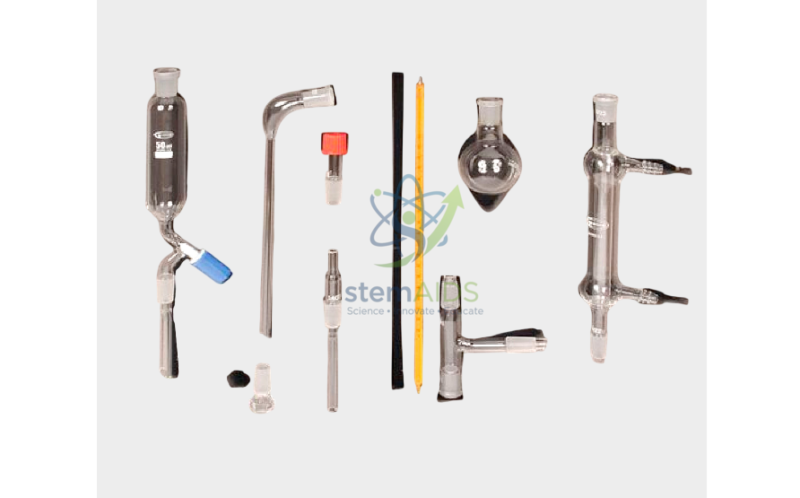
Quick Answer: The organic chemistry glassware kit is a 9-piece set of ground-glass jointed apparatus for small-scale synthesis. The listing photo shows a round-bottom flask, a condenser with hose connections, a dropping funnel with stopcock, bent and side-arm adapters, stoppers and a joint clip, parts that assemble into reflux and distillation set-ups.
Jointed Glassware for Reflux and Distillation
Organic practicals rarely use a single vessel. Heating a reaction under reflux, distilling off a product or adding a reagent slowly all need several pieces of glass joined gas-tight. In jointed glassware every piece ends in a tapered ground-glass cone or socket of matching size, so the parts push together without corks or rubber bungs and can be rearranged for each experiment.
The photo shows the main building blocks: a small round bottom flask, a condenser with an inner tube and two hose barbs for cooling water, a dropping funnel with a stopcock, a bent adapter for leading vapour down to a receiver, an adapter with a side arm, stoppers and a plastic joint clip.
With these parts a student can build a reflux assembly by standing the condenser upright on the flask, then turn the condenser sideways with the bent adapter to distil the product off, as in a simple distillation assembly. The dropping funnel sits on the flask when a reagent must be added drop by drop to control an exothermic reaction.
Specifications
| Item | Jointed glassware set for organic chemistry practicals |
| Pieces | 9, as stated in the listing title |
| Main items shown | Round-bottom flask, condenser, dropping funnel, adapters, stoppers (photo) |
| Connections | Ground-glass cone and socket joints (photo) |
Applications
- Preparing an ester under reflux, then rearranging the same glass to distil off the product
- Adding a reagent drop by drop from the dropping funnel to keep a reaction under control
- Teaching students to assemble, clamp and check jointed apparatus before heating
- Small-scale preparations in sixth-form, college and first-year university labs
Care & Handling
- Grease the joints of the organic chemistry glassware kit very lightly, or fit joint sleeves, wherever they will be heated, so they do not seize.
- Clamp the flask and the condenser separately; the joints are not meant to carry the weight of the glass below them.
- Separate joints after each practical, before they cool and stick, and store the pieces apart.
- Connect cooling water to the lower hose barb of the condenser and let it leave from the upper one.
Why Choose LabEquip
Teachers introducing jointed glassware at advanced school or first-year college level buy this 9-piece kit so that each group has a complete, compatible set. LabEquip lists it in its chemistry lab equipment; ask about joint size and spare flasks through the contact page.
Related Products
- Reflux Assembly: A reflux assembly showing the flask and vertical condenser arrangement this kit can be built into.
- Quick Fit Kits: Quick fit kits of ground-joint glassware for fractional distillation and larger organic set-ups.
- Filtering Kit: A vacuum filtration kit with Buchner funnel and hand pump for collecting the solid product after reflux.
- Chemistry Hardware Assortment: A hardware assortment with stand, clamps and boss heads to support the flask and condenser.
- Flask, Boiling, Two/Three Neck (Round/Flat Bottom): Two- and three-neck boiling flasks for fitting a condenser, dropping funnel and thermometer at the same time.
Frequently Asked Questions
What can be assembled with the 9-piece organic chemistry glassware kit?
The listing photo shows a round-bottom flask, a condenser with hose connections, a dropping funnel with stopcock, bent and side-arm adapters, stoppers and a joint clip. Together these make a reflux set-up, a simple distillation and a reaction with slow addition of a reagent, which cover most introductory organic practicals.
Which way should cooling water flow through the condenser?
Water enters at the lower hose connection and leaves at the upper one. Flowing upwards keeps the jacket completely full, so the whole inner tube stays cold. If water enters at the top it drains through without filling the jacket and much of the vapour escapes.
Why are ground-glass joints greased or fitted with sleeves?
A thin film of joint grease or a PTFE sleeve seals the joint and stops it seizing, especially with alkaline mixtures or under vacuum. Apply grease sparingly to the upper part of the cone only, so none reaches the reaction mixture, and clean it off after use.
Why must a reflux or distillation apparatus never be closed?
Heating a sealed system builds up pressure that can blow joints apart or shatter the glass. In reflux the top of the condenser stays open to the air, or connected to a drying tube, and in distillation the receiver adapter is vented, so vapour that does not condense can escape safely.
Can the round-bottom flask from the kit be heated on a hot plate?
A round-bottom flask touches a flat hot plate at a single point, which heats unevenly. Use a heating mantle, a water bath or an oil bath around the flask instead, clamp it at the neck, and add anti-bumping granules before heating.
Will the kit pieces fit other ground-joint glassware?
Ground joints are interchangeable only between pieces of the same joint size, which is marked as two numbers such as 19/26. Check the size on the kit’s joints and add flasks, thermometer adapters or condensers of that size; a reduction or expansion adapter can join different sizes.
Last Updated: November 2026




Reviews
There are no reviews yet.