





In Stock
Micro-TRI-gloss Brillancemeter
$740.19
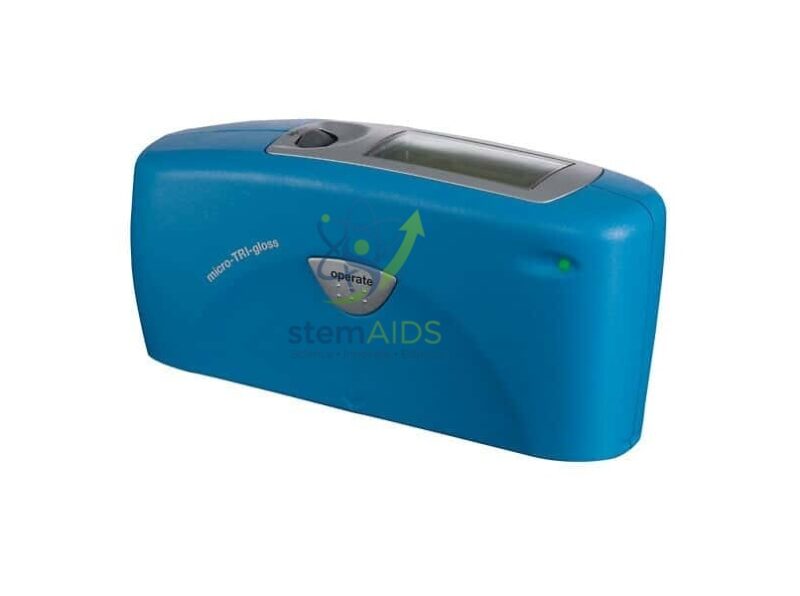
Quick Answer: The Micro-TRI-gloss gloss meter, listed as ‘Micro-TRI-gloss Brillancemeter’, is a handheld instrument that shines light onto a surface at a fixed angle and measures how much is reflected in the mirror direction. The listing photo shows a compact blue unit with a display window and an ‘operate’ button, used to compare the shine of paints, coatings and plastics.
How a Gloss Meter Puts a Number on Shine
‘Brillancemeter’ comes from the French ‘brillancemètre’, meaning gloss meter. Gloss is how mirror-like a surface looks, and the eye judges it inconsistently under different lighting. A gloss meter removes the guesswork: a light source inside the unit sends a beam onto the surface at a set angle, a detector positioned at the mirror angle measures the reflected light, and the result is expressed in gloss units (GU) relative to a calibrated reference.
Gloss measurement uses standard geometries: 60° as the general-purpose angle, 20° to separate high-gloss finishes, and 85° for matt surfaces, where reflection at the other angles is too weak to tell samples apart. The ‘TRI’ in this model’s name points to a three-angle meter, so one instrument can cover matt, satin and high-gloss samples; the angles and range should be confirmed for the unit supplied.
In teaching and research labs a gloss meter makes surface finish measurable. Students can follow how the gloss of a paint film changes as it dries, compare coatings applied at different thicknesses, or record how abrasion and weathering dull a plastic surface. The photo shows a blue housing with the display window on top, an ‘operate’ button on the front and a small indicator lamp.
Specifications
| Item | Handheld gloss meter |
| Listed as | Micro-TRI-gloss Brillancemeter |
| Measures | Specular reflection, reported in gloss units (GU) |
| Form | Compact blue housing with display window and ‘operate’ button (photo) |
| Measuring angles and range | Confirm at enquiry |
Applications
- Following the gloss of paint films as they dry or cure
- Quantifying scratch and abrasion damage on plastic or lacquered test panels
- Materials projects on surface finish, such as polishing metal coupons to increasing smoothness
- Checking that sample panels in a coatings practical start with a consistent finish
Care & Handling
- Calibrate the Micro-TRI-gloss against its reference tile at the start of each measuring session, following its instructions.
- Keep the measuring aperture and the reference tile clean; a fingerprint on either changes the readings.
- Place the meter flat on the sample and lift it off rather than sliding it, so the aperture is not scratched.
- Store it in its case away from dust, and remove the batteries if it will not be used for a long period.
Why Choose LabEquip
University and college labs teaching paints, polymers and surface coatings, along with quality-control training courses, are the typical buyers of a gloss meter like this. It is listed among LabEquip’s chemistry lab equipment; ask about angles and accessories through the contact page.
Frequently Asked Questions
What is a gloss unit?
It is the scale gloss meters report on. A polished black glass reference is defined as 100 GU at the chosen angle, and other surfaces are measured relative to it, so a matt wall paint reads low and a polished lacquer reads high.
Which measuring angle should I use?
Start at 60 degrees. If the reading is above about 70 GU, a 20 degree measurement separates high-gloss samples better; if it is below about 10 GU, 85 degrees gives more useful results on matt surfaces.
Why is it called a brillancemeter?
The name comes from the French brillancemètre, which means gloss meter. It is the same type of instrument that English-speaking labs call a glossmeter.
Can it measure curved or textured surfaces?
Gloss meters give their most reliable results on flat, smooth samples larger than the measuring aperture. Curved or heavily textured surfaces scatter light unevenly, so treat readings on them as comparative only.
How often does the meter need calibrating?
Check it against its reference tile at the start of every session, and again if the room temperature changes or after a long series of readings. A dirty or scratched tile gives a false calibration.
Does gloss relate to surface roughness?
Yes. A smoother surface reflects more light in the mirror direction and gives a higher gloss reading, while a rough one scatters light in many directions. That is why polishing raises gloss and abrasion lowers it.
Last Updated: September 2026
You must be logged in to post a review.
Bestsellers




Reviews
There are no reviews yet.