
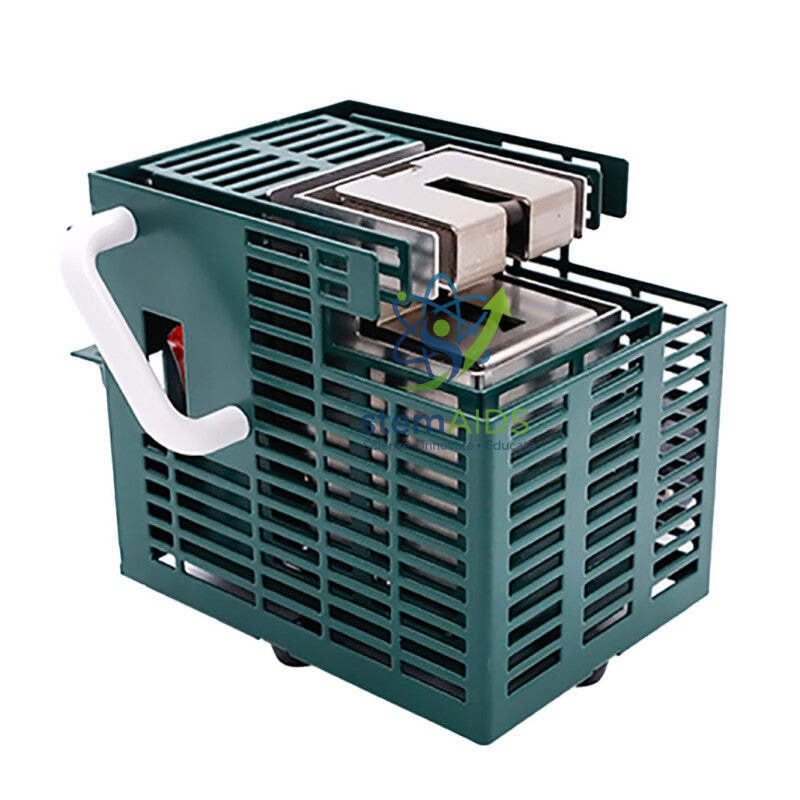
Quick Answer: The LAB Microbiology Electric Bunsen Burner is an electric heater used in place of a gas Bunsen burner for aseptic technique. The listing photo shows a heating unit inside a dark green perforated cage with a carrying handle, into which wire loops and the mouths of culture tubes are brought for sterilising heat.
Built Around Aseptic Technique
Microbiology practicals use a burner for two reasons: to sterilise wire loops and tube mouths, and to set up the rising column of warm air that teachers rely on to carry airborne contaminants away from open plates. This microbiology electric Bunsen burner is aimed at the first job and supports the second, without an open flame beside students’ sleeves and alcohol wash bottles.
In the photo the heater sits inside a tall, dark green cage of vertical bars with a white carrying handle on one side, and a heating block is visible within. The cage lets a loop or the neck of a culture tube be brought into the heat while keeping knuckles at a safe distance. A loop held in the hot zone until the whole wire glows red has been sterilised; if a unit does not bring the wire to a glow, a longer dwell time is needed, following the maker’s instructions.
For general heating, the squat LAB 2 electric Bunsen burner is the simpler choice. For this microbiology model, the glassware support listed for the LAB Microbio burner adds a perforated plate on which a small vessel can be warmed above the heat.
Microbiology Tasks
- Sterilising nichrome or platinum inoculating loops between streaks when plating bacteria or yeast
- Passing the mouths of culture tubes and flasks through the heat before and after transfers
- Keeping an aseptic zone at a teaching bench in a lab that has no gas supply
- Supervised microbiology open days where an open flame near visitors is undesirable
Care & Handling
- Place the burner so the loop hand reaches it without crossing open plates, and keep ethanol bottles well away from the cage.
- Heat a loop that carries culture gradually, starting from the shaft end, so the material dries before it reaches the hottest zone and does not spit.
- Let loops cool for a few seconds before touching colonies; a hot loop kills cells on contact and can spatter them into the air.
- Unplug the unit after the session and wait until the cage is fully cool before storing it.
Specifications
| Item | Electric Bunsen burner for microbiology work |
| Housing | Perforated cage with a side carrying handle, as photographed |
| Heat source | Electric; no gas and no open flame |
| Typical tasks | Loop sterilisation, heating tube and flask necks, gentle warming |
Why Choose LabEquip
Microbiology teaching labs, school biology departments and training centres without piped gas are the natural buyers of this burner. It sits in LabEquip’s chemistry lab equipment range; for a class set, send the number of benches through the contact page.
Related Products
- Glassware support for LAB Microbio electric burner: The glassware support named for this burner, with a perforated plate to hold small vessels over the heat.
- Inoculating Loops, Metal: Reusable metal inoculating loops whose wire is sterilised by heating to red heat in the burner.
- Electric Bunsen Burner LAB 2: The LAB 2 electric burner with a control knob and indicator lamps, for general bench heating.
- Laboratory Bunsen Burner Set of 2: A pair of gas Bunsen burners for labs that prefer a conventional flame for aseptic work.
Frequently Asked Questions
Can an electric burner sterilise an inoculating loop?
Yes. Hold the loop in the hot zone inside the cage until the whole wire glows red, then let it cool for a few seconds before touching any culture. Start with the wire near the handle and move to the tip, so material on the loop is heated gradually and does not spatter.
Does an electric burner create a sterile working area like a gas flame?
A gas flame sets up a rising column of warm air that helps carry airborne contaminants away from open plates. An electric burner produces some rising warm air too, but less visibly, so good aseptic technique matters even more: work close to the burner, keep lids on plates and open tubes only briefly.
Why use an electric burner instead of a gas flame for microbiology?
There is no open flame beside students’ sleeves, hair and alcohol wash bottles, and no gas supply is needed, so the burner can be used on any bench with a socket. The cage of the LAB Microbiology burner also keeps knuckles away from the heating block while loops and tube mouths are heated.
Can I heat the neck of a culture tube with this electric burner?
Yes, passing the mouth of a culture tube or flask briefly into the hot zone after removing the cap is a standard aseptic step. Keep the movement quick so the glass warms without overheating, and hold the tube at an angle to reduce the chance of airborne particles falling in.
What should I do if culture spatters onto the electric burner?
Switch off and let the burner cool, then treat the area as contaminated: wipe it with a suitable disinfectant and dispose of the wipes as biological waste. Spattering usually comes from putting a loaded loop straight into the hottest zone, so heat from the base of the wire first.
What accessories go with the LAB microbiology electric burner?
A glassware support is listed for this burner to hold a small vessel above the heat. Inoculating loops, a test tube rack and a disinfectant spray complete a basic aseptic station, and a heat-resistant mat under the burner protects the bench.
Last Updated: November 2026




Reviews
There are no reviews yet.