

Quick Answer: The flavor synthesis and purification kit is an organic chemistry practical in which students make a flavour compound, typically a fruity-smelling ester, and then purify it. The purification stage, using washes, a separating funnel and a drying agent, is what sets it apart from a simple smell-the-product ester demonstration.
Synthesis First, Then Purification
Esters give many fruits their smell: isoamyl acetate recalls bananas and pear drops, ethyl butanoate pineapple, and methyl salicylate wintergreen. They are made by heating a carboxylic acid with an alcohol and a few drops of concentrated sulfuric acid as catalyst, usually under reflux so that nothing boils away. The reaction is an equilibrium, so the crude product still contains unreacted acid, alcohol and catalyst.
Purification removes them. The cooled mixture is washed in a separating funnel with sodium hydrogencarbonate solution, which neutralises the acids and releases carbon dioxide, and then with water. The ester layer is separated, dried over an anhydrous salt and, in fuller versions, distilled. Each step teaches a technique that recurs throughout organic chemistry.
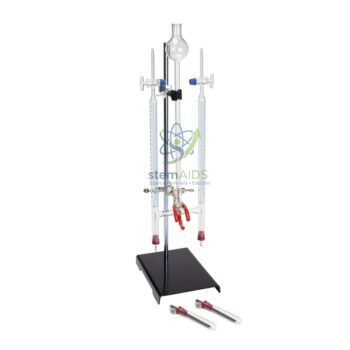
A reflux assembly and a separating funnel are the core glassware for the method described here.
Specifications
| Item | Flavour compound synthesis and purification kit |
| Typical reaction | Esterification of an acid and an alcohol with an acid catalyst |
| Purification steps | Washing, layer separation, drying, optionally distillation |
| Level | Upper-secondary, vocational and introductory college chemistry |
Applications
- Teaching esterification, reversible reactions and the role of a catalyst
- Practising separating funnel technique, including venting carbon dioxide during a hydrogencarbonate wash
- Calculating percentage yield from a weighed, purified product
- Linking organic chemistry to the food and fragrance industries
Care & Handling
- Dispense concentrated sulfuric acid only in a fume cupboard with goggles and gloves, adding it slowly to the mixture of acid and alcohol.
- Keep esters and alcohols away from open flames; many are flammable.
- Vent the separating funnel often during the hydrogencarbonate wash, pointing the stem away from people.
- Smell products only by wafting, never by sniffing directly from the container.
Why Choose LabEquip
Chemistry teachers who want students to carry an organic synthesis through to a purified product, not just a smell, are the buyers of this kit. LabEquip lists it under chemistry lab equipment; send your glassware list through the contact page to check what else is needed.
Related Products
- Funnel, Separating: A glass separating funnel for the washing and layer-separation stages that set this kit apart from a smell-only ester test.
- Organic Chemistry Glassware Kit, 9 pieces: A 9-piece jointed glassware kit with flask and condenser for refluxing the acid and alcohol before purification.
- Reflux Assembly: A reflux assembly that heats the reaction mixture for longer without losing volatile alcohol or ester.
- Nylon Synthesis kit for Students: A nylon rope-trick kit for a second organic practical, this time showing condensation polymerisation.
Frequently Asked Questions
What flavour compounds can students make with an ester synthesis kit?
Esters give many fruits their smell. Isoamyl acetate smells of bananas and pear drops, ethyl butanoate of pineapple and methyl salicylate of wintergreen. Each is made by heating a carboxylic acid with an alcohol and an acid catalyst, and the purification steps in this kit then turn the crude product into a cleaner sample.
Why is concentrated sulfuric acid added when making an ester?
The acid is a catalyst: it speeds up the reaction between the carboxylic acid and the alcohol, which is very slow on its own. It also takes up some of the water formed, which helps push the equilibrium towards the ester. Only a few drops are needed, and they must be added carefully with eye protection.
Why is the crude ester washed with sodium hydrogencarbonate solution?
The crude product still contains unreacted carboxylic acid and the acid catalyst. Sodium hydrogencarbonate neutralises them, releasing carbon dioxide, so the funnel must be swirled gently and vented often. The neutralised acids move into the water layer, which is then drained away from the ester layer.
How can I tell which layer in the separating funnel is the ester?
Most simple esters are less dense than water and form the upper layer, but check rather than assume. Add a few drops of water and watch which layer they join: that is the aqueous layer. Keep both layers labelled until the end of the practical, so nothing is thrown away by mistake.
Why is the yield of an esterification practical usually low?
Esterification is a reversible reaction that reaches equilibrium before all the acid and alcohol are used up. Further product is lost in every transfer, wash, separation and drying step, and some volatile ester evaporates. Students can calculate percentage yield and suggest which step lost most, which is a useful evaluation exercise.
Is it safe to taste or sniff the ester made in class?
Never taste a product made in a laboratory: it may contain acid catalyst, unreacted alcohol or other impurities. Smell it only by wafting the vapour gently towards the nose from a small sample on a watch glass or in a test tube of water, and keep it away from flames because esters are flammable.
Last Updated: November 2026




Reviews
There are no reviews yet.