

Quick Answer: A round bottom flask is a spherical glass boiling flask with a neck, used for heating, boiling, distilling and refluxing liquids. The spherical body spreads heat and stress evenly, so it generally copes with strong heating and vacuum better than a flat-based vessel.
Why the Sphere Is the Shape for Heating
A sphere has no corners and no flat panels, so heat applied from below spreads evenly through the glass, and a pressure difference, as in vacuum distillation, is carried evenly by the whole wall. That is why the round bottom flask is the standard reaction and boiling vessel of organic chemistry and the default flask in distillation and reflux set-ups.
Because it cannot stand by itself, it is always supported: clamped at the neck to a retort stand, rested in a cork ring on the bench, or seated in a heating mantle shaped to its curve. Mantles, oil baths and water baths suit it better than a direct flame, which can create a hot spot on the glass.
In a typical distillation the flask carries a still head and thermometer and leads to a Liebig condenser; for reflux it carries a vertical condenser such as the Allihn condenser. Its size is normally chosen so that the liquid fills between a third and a half of the bulb.
Specifications
| Item | Boiling flask with a spherical body |
| Body | Spherical, for even heating and resistance to pressure difference |
| Support | Clamp at the neck, cork ring or heating mantle |
| Heating methods | Heating mantle, oil or water bath, or gauze and burner |
Applications
- Simple and fractional distillation
- Heating under reflux in organic preparations
- Vacuum or reduced-pressure distillation, where a flat-based vessel would be unsafe
- Removing solvent from a solution under reduced pressure
Care & Handling
- Fill no more than about half full for distillation, so boiling liquid cannot splash into the still head.
- Add anti-bumping granules to the cold liquid, never to a hot one, which could boil over suddenly.
- Inspect for star cracks and scratches before vacuum use, as a flawed flask can implode.
- Rest the flask in a cork ring whenever it is put down, never directly on a flat bench.
Why Choose LabEquip
College laboratories and research groups use more of these flasks than almost any other vessel, in sizes matched to their condensers and mantles. LabEquip supplies them in its chemistry lab equipment range; send sizes and neck requirements through the LabEquip contact page.
Related Products
- Flask, Boiling, Flat Bottom: A flat bottom boiling flask that stands unsupported for gas preparation and gentle heating.
- Flask Stand, Plastic: A stepped plastic ring stand that holds round bottom flasks of several sizes upright.
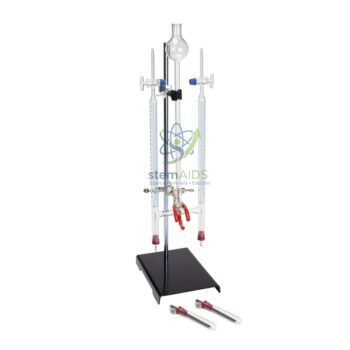
- Reflux Assembly: A reflux assembly that pairs a round bottom flask with a vertical condenser for prolonged heating.
- Round Bottom Flask 250ml: A 250ml glass round bottom flask for reflux, distillation and general synthesis heating.
- Brush, Erlenmeyer (Conical)/ Round Bottom/ Flat Bottom Flask: A bendable flask brush that reaches inside the curved body of a round bottom flask.
Frequently Asked Questions
Why are boiling flasks made with a round bottom?
A sphere has no corners or flat panels, so heat from below spreads evenly through the glass and any pressure difference is carried by the whole wall. That makes a round bottom flask the standard boiling and reaction vessel for distillation, reflux and organic synthesis, and the safest flask shape for work under vacuum.
How is a round bottom flask supported on the bench?
It cannot stand on its own, so it is clamped by the neck to a retort stand, rested in a cork ring or stepped flask stand, or seated in a heating mantle shaped to fit it. When the flask holds liquid, clamp it at the neck even if it sits in a ring, so a knock cannot tip it over.
Is a round bottom flask safe for vacuum distillation?
It is the right flask shape for vacuum work, because the even curvature resists the pressure difference better than any flat-based vessel. Before evacuating, check the glass for star cracks, chips and scratches, which weaken it, and use a safety screen. A damaged flask should be taken out of service rather than used under vacuum.
Which heat sources suit a round bottom flask?
A heating mantle of the matching size is the usual choice because it wraps the curved base and heats evenly without a flame. Water and oil baths also work well and allow close temperature control. A Bunsen burner with gauze can be used for aqueous mixtures, but keep the flame moderate and away from flammable liquids.
Why do liquids bump when boiled in a round bottom flask, and how is it prevented?
The smooth inner surface gives few places for bubbles to form, so the liquid can overheat and then boil in sudden bursts. Adding two or three anti-bumping granules before heating, or stirring with a magnetic stirrer bar, provides steady points for bubbles to start and keeps boiling smooth.
How should a round bottom flask be cleaned?
Rinse out residues with a suitable solvent, then wash with warm detergent water using a bent flask brush that reaches the whole curved surface. Rinse with tap water and then distilled water, and dry upside down on a rack. Stubborn deposits can be soaked overnight; avoid scouring powders, which scratch the glass.
Last Updated: November 2026






Reviews
There are no reviews yet.