
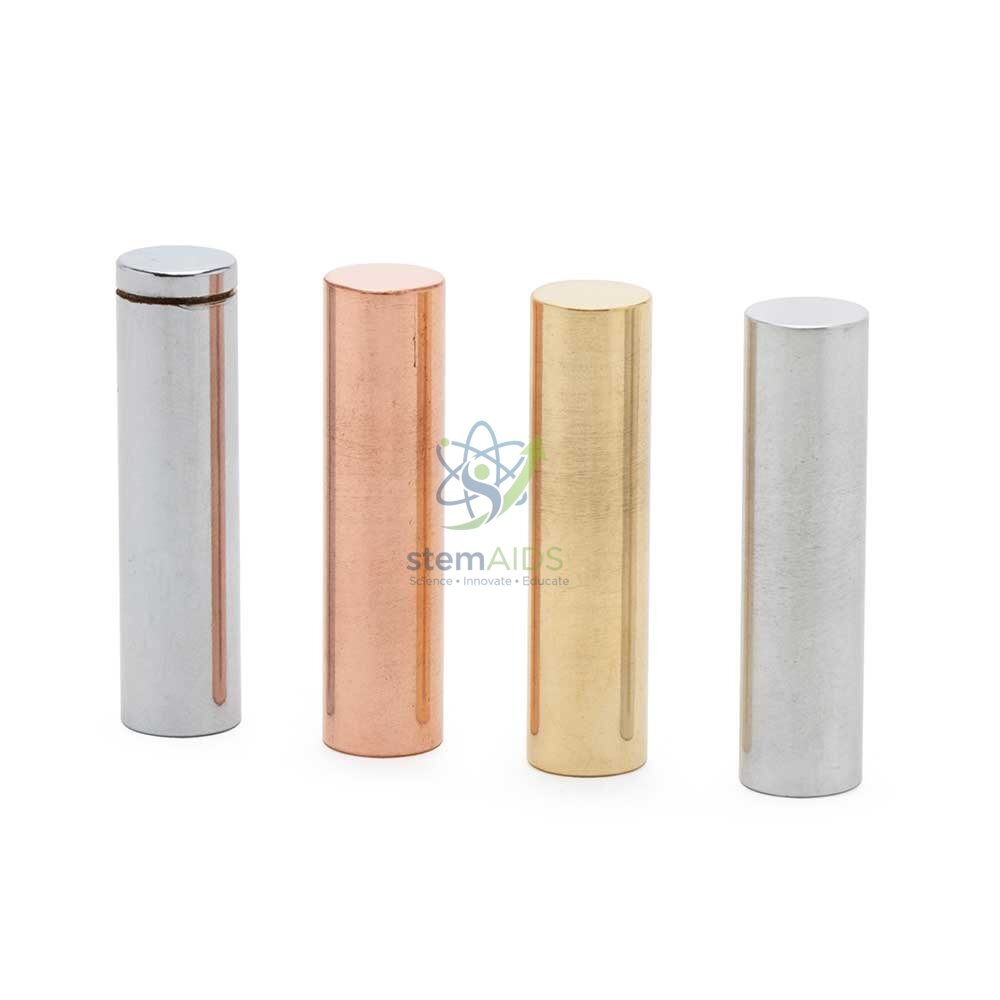
Quick Answer: Equal volume metal cylinders are a set of four cylinders made to the same volume but from different metals. The listing photo shows silver-grey, copper-coloured and brass-coloured cylinders standing side by side, used to compare mass, density and upthrust.
Four Metals, One Volume
Held one after another, cylinders of the same size but different metals give an immediate surprise: the copper-coloured one is noticeably heavier than the pale grey one. Because the volumes match, weighing the four cylinders on a balance ranks their densities directly, and dividing each mass by the common volume turns the ranking into numbers.
The same set shows a less obvious result in buoyancy. Hang each cylinder from a spring balance and lower it completely into water: the reading drops by the same amount for all four. Upthrust depends on the volume of water displaced, not on what the object is made of, so equal volumes receive equal upthrust. With an overflow can and bucket, students can confirm that each cylinder pushes out the same amount of water.
In the photo the four cylinders are two silver-grey metals, one copper-coloured and one brass-coloured, and one has a darker band near its top. The exact metals are not named in the listing. For a wider comparison that includes woods and plastics, pair this set with the density cube set.
Specifications
| Item | Set of four metal cylinders of equal volume |
| Quantity | 4, as stated in the title |
| Metals shown | Two silver-grey, one copper-coloured, one brass-coloured (photo) |
| Key feature | Same volume, different mass |
Care & Handling
- Weigh the equal volume metal cylinders on a balance with enough capacity; dense metals can exceed the range of small pocket balances.
- Dry the cylinders fully after immersion to prevent tarnish, particularly on the copper and brass pieces.
- Stand the cylinders upright in a tray when not in use so they cannot roll off the bench.
- Remove tarnish with a soft cloth only, since abrasives take off metal and change the mass slightly.
Applications
- Ranking metals by density using equal-volume samples and a balance
- Showing that equal volumes experience equal upthrust in water, whatever the metal
- Calculating density from measured diameter and length, then comparing with data tables
- Identifying the metals from calculated densities as a problem-solving task
Why Choose LabEquip
Teachers who want one set to serve both density and buoyancy lessons choose equal volume cylinders. LabEquip lists the set in its chemistry lab equipment; ask through the contact page which metals are included and about class-set numbers.
Related Products
- Density Cube Set of 10: Ten same-size cubes of metal, wood and plastic for ranking a wider range of materials by density.
- Metal Cylinders: Solid metal cylinders for density, upthrust and specific heat capacity experiments.
- Overflow Can and Bucket Set: An overflow can and catch bucket for collecting and weighing the water each cylinder displaces.
- Metal Set, Collection of 12 Metals: A labelled collection of 12 metals for linking density to other properties such as lustre.
Frequently Asked Questions
What does a set of equal-volume metal cylinders show?
The four cylinders have the same volume but are made of different metals, so they have different masses. Weighing them ranks their densities directly, and dividing each mass by the shared volume gives the densities as numbers. The listing photo shows two silver-grey cylinders, one copper-coloured and one brass-coloured.
Why do equal-volume cylinders get the same upthrust in water?
Upthrust equals the weight of water displaced, and each cylinder displaces the same volume of water when fully submerged. Hanging each one from a spring balance and lowering it into water shows the same drop in reading for all four, even though their weights in air are very different. This surprises many students who expect heavier objects to get more upthrust.
How do students find the volume of a metal cylinder?
Measure the diameter with a vernier caliper, halve it for the radius, measure the length, and calculate the volume with V = πr²h. For a check, lower the cylinder into a measuring cylinder of water and read the rise in level. The two methods should agree closely, and the comparison shows which method is more precise.
How can the cylinders be used to identify the metals?
Find the density of each cylinder and compare it with a table of metal densities. Colour gives a first clue for the copper- and brass-coloured cylinders, while the two silver-grey cylinders can look alike but usually differ clearly in mass, so density separates them where appearance cannot.
Why compare equal volumes rather than equal masses of metals?
With equal volumes, the material is the only thing that changes, so mass differences are density differences, and the effect on upthrust can be tested directly. Equal masses of different metals would have different sizes, which is useful for a different lesson, but mixes up two variables when the aim is to understand density.
How do the cylinders demonstrate Archimedes’ principle?
Weigh a cylinder in air on a spring balance, then again fully submerged in water; the loss in weight is the upthrust. Collect the displaced water in an overflow can and weigh it. The upthrust matches the weight of displaced water, and because the volumes are equal the result is the same for all four metals.
Last Updated: November 2026




Reviews
There are no reviews yet.