



In Stock
Ensemble Interactives Exploring Entropy
₹500.00
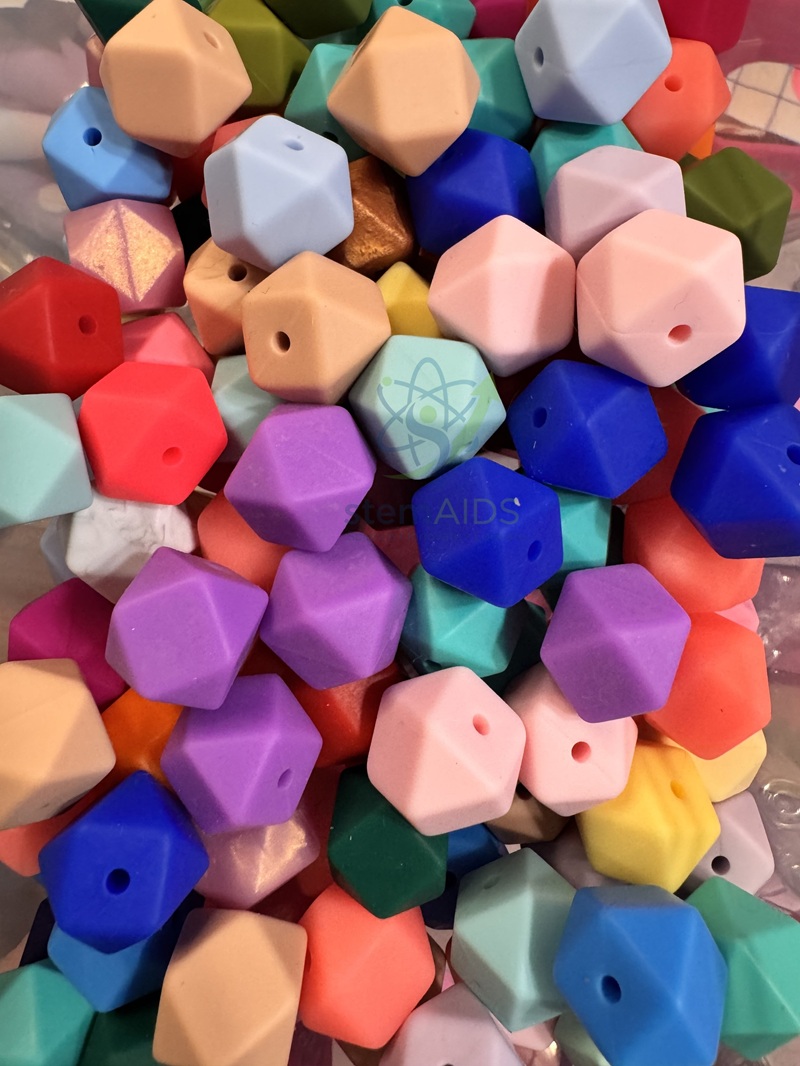
Quick Answer: Ensemble Interactives Exploring Entropy is an interactive classroom set for teaching entropy through hands-on models of how particles and energy spread out. The listing photo shows a large number of loose, coloured faceted beads; the full contents are not listed.
Entropy as Counting Arrangements
Entropy is often described as disorder, a word that misleads students. A more useful picture, and the one hands-on activities build, is counting: entropy measures how many different arrangements of particles and energy are consistent with what we observe. A state that can be reached in many ways is overwhelmingly more likely than one that can be reached in only a few.
Coloured counters make the idea concrete. Start with beads of two colours separated in a tray, shake it, and they mix; shake again and they practically never unmix, because mixed arrangements vastly outnumber separated ones. Counting the ways a few units of energy can be shared among a small number of particles, and then a larger number, shows how quickly the count grows with size, which is the root of the second law of thermodynamics.
The listing photo shows only loose beads in many colours, so the full contents, instructions and any worksheets included with the set should be confirmed before lessons are planned around it. The activities above can be run with beads and a tray alone.
Specifications
| Item | Interactive classroom set on entropy |
| Listed as | Ensemble Interactives Exploring Entropy |
| Shown in photo | Loose coloured faceted beads (photo) |
| Topic | Entropy, probability and the spreading of particles and energy |
| Full contents and teacher notes | Confirm at enquiry |
Applications
- Modelling the mixing of two gases with two colours of beads in a shaken tray
- Counting the arrangements of energy units among particles to introduce microstates
- Linking probability to the direction of spontaneous change in pre-university chemistry and physics
- Discussing why dissolving and diffusion happen without being driven
Care & Handling
- Count the beads of the Exploring Entropy set back into their container after each lesson, since losses change the numbers in counting activities.
- Keep small beads away from young children, as they are a choking hazard.
- Wash beads in warm soapy water if they get dirty, and dry them fully before storing.
Why Choose LabEquip
Chemistry and physics teachers at pre-university level, who need to teach entropy beyond the word disorder, are the likely buyers of this set. LabEquip lists it with its chemistry lab equipment; request the contents list through the contact page before ordering.
Frequently Asked Questions
What is entropy in simple terms?
Entropy measures how many ways the particles and energy of a system can be arranged while it looks the same overall. States that can be arranged in more ways have higher entropy and are more likely to occur.
Why is disorder a misleading description of entropy?
Some changes that look more ordered, such as crystals forming in a cooling solution, still increase the total entropy once the heat released to the surroundings is counted. Thinking in terms of the number of arrangements avoids that confusion.
How do beads model entropy?
Two colours of beads start separated and are shaken together. They quickly mix and almost never return to separate groups, because mixed arrangements vastly outnumber separated ones.
Which age group is the set suited to?
The ideas suit upper-secondary and pre-university chemistry or physics, where entropy and the second law are introduced. The bead activities can be used more simply with younger classes to discuss mixing and diffusion.
What is included in the set?
The listing photo shows loose coloured faceted beads, but the full contents are not listed. Ask for the contents and any teacher notes when you enquire.
How does entropy relate to the second law of thermodynamics?
The second law states that the total entropy of an isolated system does not decrease. Systems move towards the arrangements that can happen in the most ways, which is why heat flows from hot to cold.
Last Updated: September 2026
You must be logged in to post a review.
Bestsellers




Reviews
There are no reviews yet.