





In Stock
Teasing Needles
₹1,000.00
Quick Answer: Teasing needles are fine, straight, sharp-pointed needles set in handles, used to pull tissues apart into thin strands and to arrange small specimens on a microscope slide. Biology and histology students use them during slide preparation and dissection.
What Teasing Means in Slide Preparation
Many specimens are too thick or tangled to see through under a microscope. Teasing is the technique of pulling them apart with two needles, working in a drop of liquid on a slide until the material is spread into strands or single cells. A piece of muscle, for example, can be separated along its grain until individual fibres with their stripes are visible; a clump of filamentous algae can be spread so each thread lies separately.
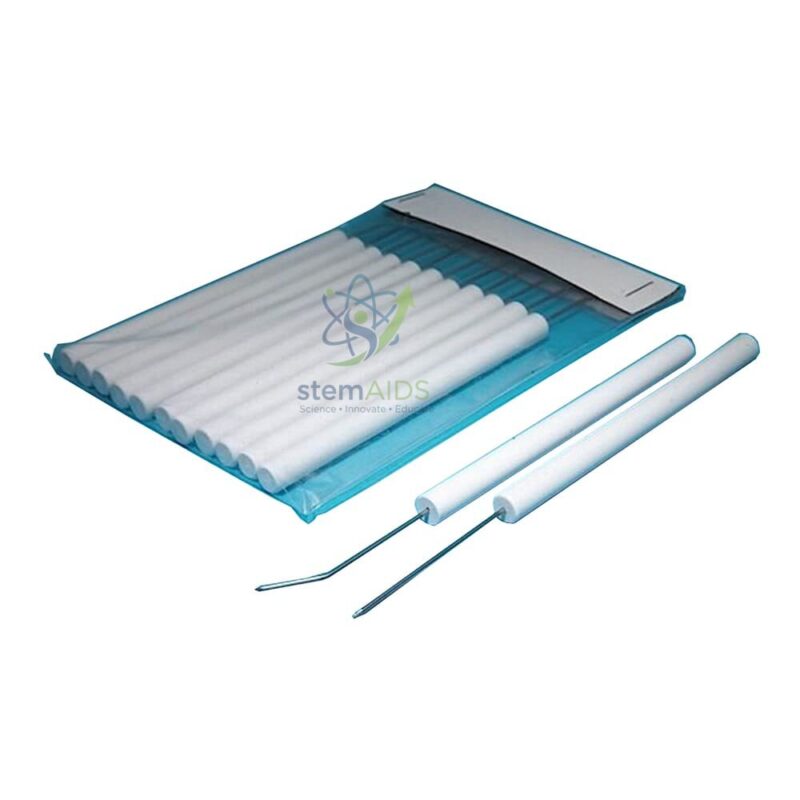
The product photo shows two needles with white handles on a card. They are normally used in pairs, one to hold the material and the other to pull, and a straight, fine point gives the control needed for this work. The handle material, needle length and number supplied are not stated in the listing.
These needles differ from their near relatives in the dissecting kit. A seeker has a blunt, often angled tip for tracing vessels and nerves without damaging them, while a teasing needle is pointed and meant to separate. LabEquip also lists a single needle with handle as a general-purpose mounted needle; a pair of teasing needles is the choice when fine separation work on slides is the main task.
Tasks at the Bench
- Separating skeletal muscle fibres to show striations
- Spreading Spirogyra, moss leaves or fungal hyphae on a slide
- Breaking up root tip tissue in a squash preparation for mitosis
- Lowering coverslips slowly onto wet mounts to avoid bubbles
- Picking up small seeds, insects or anthers during dissection
Specifications
| Item | Pointed dissecting needles set in handles |
| Tip | Fine, straight, sharp point for separating tissue |
| Typical use | In pairs, on a slide or in a dish of liquid |
| Handles (from product photo) | White handles |
| Needle length, handle material and quantity | Confirm at enquiry |
Care and Safe Storage
- Wipe teasing needles clean and dry after each use; wet steel points rust quickly.
- Push a small cork or cap onto each point before storing to protect the tip and fingers.
- Do not flame needles with plastic handles; heat can melt the handle and loosen the needle.
- Replace needles with bent or blunted points, which tear tissue instead of separating it.
Why Choose LabEquip
Biology teachers order teasing needles in pairs for every student, since they are used in nearly every slide-making practical. LabEquip supplies them within its biology lab products, alongside the blunt-tipped steel seeker for dissection.
Frequently Asked Questions
What is the difference between a teasing needle and a seeker?
A teasing needle has a straight, sharp point for pulling tissue apart and handling small objects on slides. A seeker has a blunt, usually bent tip for tracing and lifting structures such as nerves and vessels without cutting or piercing them.
How do I tease muscle fibres for the microscope?
Place a very small piece of muscle in a drop of saline or water on a slide. Hold it down with one needle and draw the other needle along the grain to split it into thinner strands, repeating until fibres lie separately. Add a coverslip and a stain such as methylene blue if needed.
Why are the needles used in pairs?
One needle anchors the material while the other pulls. With a single needle, the specimen simply slides across the slide instead of separating.
Can the needles be sterilised in a flame?
Metal needles in metal handles can be flamed briefly. Needles in plastic handles should be wiped with 70 percent alcohol instead, since a flame can melt or loosen the handle.
How do the needles help when adding a coverslip?
Rest one edge of the coverslip on the slide beside the drop, support the other edge with the needle tip and lower it slowly. Air is pushed out as the liquid spreads, leaving a mount free of bubbles.
How should the needles be stored safely?
Protect each point with a cork or cap and keep the needles in a box or a dissecting case, never loose in a drawer where fingers reach in. Count them in and out during class practicals.
Last Updated: September 2026
You must be logged in to post a review.
Bestsellers




Reviews
There are no reviews yet.