





In Stock
Real Animal Bone Skeleton
Squelette d'animal en os véritable. Specimens undergo a multi-stage chemical degreasing and hydrogen peroxide bleaching process, ensuring long-term lipid-free preservation and high-contrast surface visibility of intricate cortical bone structures.
Anatomical Wire Articulation utilizes surgical-grade stainless steel hardware for semi-flexible articulation, preserving natural postural dynamics and precise joint spacing for advanced biomechanical and comparative morphology evaluations.
$129.16
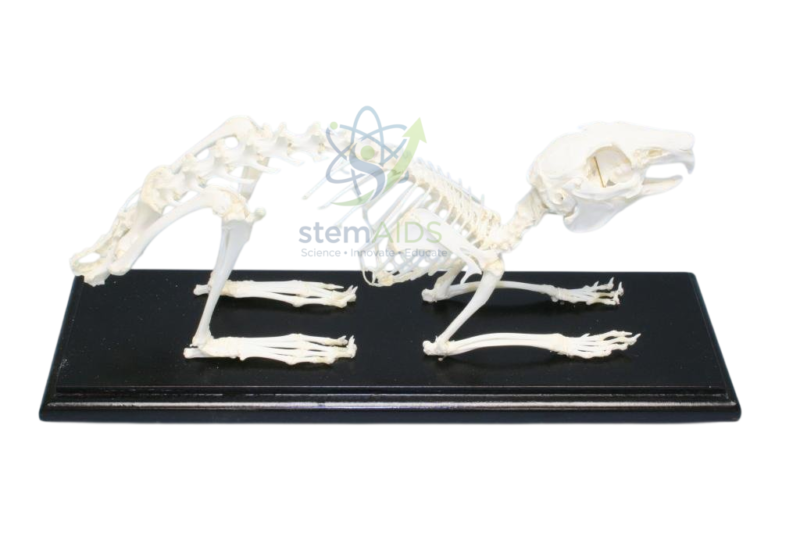
Quick Answer: The Real Animal Bone Skeleton is an articulated skeleton prepared from genuine animal bone and mounted on a base; the product photo shows a small mammal that appears to be a rabbit. It is used in zoology and comparative anatomy to study how a mammal’s skeleton is built for its way of life.
A Genuine Skeleton for Comparative Anatomy
A real bone skeleton shows what a cast cannot: the natural texture of bone, fine processes, sutures in the skull and the small variations between individuals. The product photo shows the skeleton standing on a black base, with a long skull bearing large front teeth, a flexible spine, long hind limbs folded beneath the body and shorter forelimbs. These features match a rabbit, but the listing names no species, so confirm which animal is supplied before planning a lesson around it.
If the specimen is a rabbit, it is a clear example of a herbivore built for grazing and escape. Its incisors grow continuously and are separated from the cheek teeth by a wide gap, the diastema, and there are no canines. The long hind legs and feet power hopping, and the eye sockets sit on the sides of the skull, giving a wide field of view for spotting predators. Beside a human skeleton such as the economy human skeleton model, the same bones, skull, vertebrae, scapula, pelvis and limb bones, can be matched one by one, which is the core idea of homologous structures.
Because the bones are real, the specimen is more delicate than a plastic model, and its joints are usually held by wire or fine rods. Species, size, the method of articulation and whether a cover is supplied are not stated in the listing.
Uses in Zoology Lessons
- Comparing a mammal skeleton with a human one to identify homologous bones
- Relating dentition to diet: continuously growing incisors and the diastema in a herbivore
- Studying limb proportions and how they suit hopping, running or climbing
- Practising bone identification in zoology and veterinary foundation courses
Specifications
| Specimen | Articulated skeleton of genuine animal bone, on a base |
| Animal in the product photo | A small mammal that appears to be a rabbit |
| Features to study | Skull and dentition, vertebral column, limb girdles, fore and hind limbs |
| Subjects | Zoology, comparative anatomy, evolution |
| Species, size and mounting details | Confirm at enquiry |
Care & Handling
- Handle the real animal bone skeleton by its base only; thin bones such as the ribs, lower jaw and toes break easily.
- Keep it in a dry room away from direct sunlight and damp, which cause yellowing, cracking and mould on natural bone.
- Dust with a soft, dry brush; never wash it, and check it now and then for insect damage if it is stored for long periods.
Why Choose LabEquip
Zoology departments, veterinary foundation courses and school biology labs choose a real bone specimen when students need to see genuine bone rather than a cast. LabEquip lists it among its biology lab products; to confirm the species and size, use the contact page.
Frequently Asked Questions
Is this skeleton made of real bone or plastic?
The listing names it a real animal bone skeleton, meaning it is prepared from genuine bone rather than cast in plastic. Real bone shows natural texture and variation but is more fragile than a replica.
Which animal is the skeleton from?
The product photo shows a small mammal with long hind limbs and large incisors that appears to be a rabbit. The species is not named in the listing, so it should be confirmed at enquiry.
What is a diastema?
It is a gap between teeth. In rabbits and many other plant-eating mammals there is a wide gap between the incisors and the cheek teeth, which helps the tongue and lips move food back for grinding.
How does a mammal skeleton show homologous structures?
The forelimb of a rabbit, a human arm, a bat wing and a whale flipper contain the same set of bones: one upper arm bone, two forearm bones, wrist bones and digits. The shapes differ with use, but the shared plan points to a common ancestor.
How are real bone skeletons prepared?
The soft tissue is removed, often with the help of dermestid beetles or by slow maceration in water, and the bones are then cleaned, degreased and whitened. They are reassembled on wires or rods in a natural posture.
How should a real bone specimen be stored?
Keep it dry, dust-free and out of direct sunlight, ideally under a cover. Avoid damp rooms, which encourage mould, and check it occasionally for small insects, which can damage stored natural material.
Last Updated: September 2026
You must be logged in to post a review.
Bestsellers




Reviews
There are no reviews yet.