
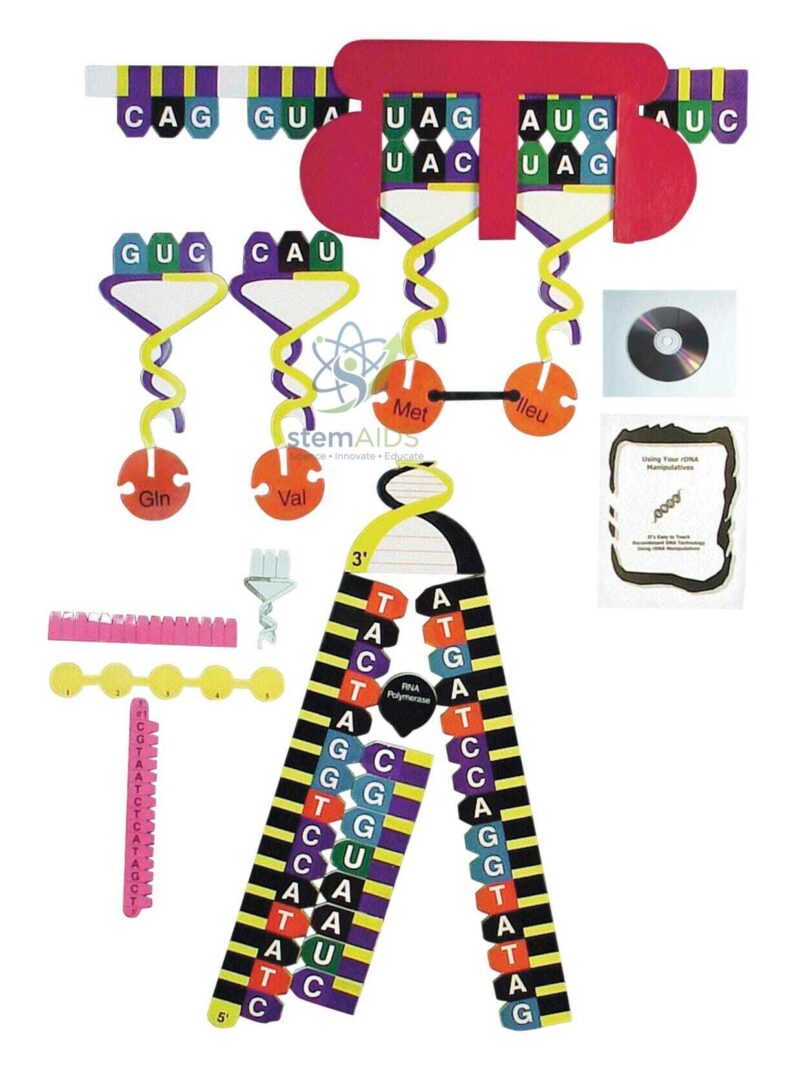
Quick Answer: The Protein Synthesis Manipulatives Kit is a hands-on teaching set for modelling how a gene is transcribed into messenger RNA and translated into a chain of amino acids. The listing photograph shows lettered DNA and RNA strands, tRNA-shaped pieces carrying anticodons, amino-acid pieces and a printed guide.
From Gene to Polypeptide on the Desk
Protein synthesis has two stages, and students often confuse them. In transcription, one strand of DNA is used as a template to make messenger RNA, with uracil taking the place of thymine. In translation, the mRNA is read three bases at a time, each codon is matched by a transfer RNA carrying the complementary anticodon, and the amino acids those tRNAs bring are joined into a chain. Doing each step with separate pieces keeps the two stages, and the molecules involved in each, clearly apart.
A typical activity gives a group a short DNA sequence. They build the complementary mRNA, move it to a ribosome area on the desk, and read it from the start codon AUG, which codes for methionine. For each codon they find the tRNA whose anticodon pairs with it, attach its amino acid to the growing chain, and continue until they reach one of the stop codons UAA, UAG or UGA. The finished chain can then be compared with a genetic code table.
The kit also shows why mutations matter. Changing one base in the DNA may change one codon and so one amino acid, or it may change nothing at all; deleting a base shifts every codon after it. Exact contents, the number of amino-acid pieces and how many groups one kit supports are not stated in the title.
Applications
- Transcribing a given DNA sequence into mRNA with uracil in place of thymine
- Translating mRNA into a short polypeptide using codon and anticodon pairing
- Modelling substitution and frameshift mutations and predicting their effect
- Revision of the genetic code with a codon table
Specifications
| Item | Manipulative set for modelling transcription and translation |
| Pieces shown | DNA and mRNA strands, tRNA with anticodons, amino acids, guide (listing photograph) |
| Concepts | Codons, anticodons, start and stop codons, peptide chain, mutations |
| Level | Upper secondary and introductory college biology |
| Exact contents and group numbers | Confirm at enquiry |
Care & Handling
- Store tRNA and amino-acid pieces in separate labelled bags so the next group can find matching pieces quickly.
- Keep the printed guide with the kit; it holds the sequences and answers the activities rely on.
- Clean pieces with a barely damp cloth and let them dry before packing them away.
Why Choose LabEquip
This kit is usually bought for the lesson after DNA structure, so many schools order it with the DNA Manipulatives Kit. LabEquip lists both in Biology Lab Products, and the RNA molecular model gives a finished three-dimensional reference. Send your group numbers through the LabEquip contact page.
Frequently Asked Questions
How does the kit model transcription?
Students take a DNA template strand and build a complementary mRNA strand beside it, using uracil wherever DNA would have thymine. The mRNA is then separated and moved away from the DNA, just as it leaves the nucleus in a eukaryotic cell.
How is translation shown with the pieces?
The mRNA is read in groups of three bases. For each codon students find the tRNA with the matching anticodon, attach its amino acid to the chain and move on to the next codon until a stop codon ends the chain.
What are start and stop codons?
AUG is the start codon, which also codes for methionine, so most chains begin with it. UAA, UAG and UGA are stop codons: no tRNA matches them, and translation ends there.
How can students use the kit to model a mutation?
Change one base in the DNA and repeat both steps. A substitution may change one amino acid or none, because several codons code for the same amino acid. Deleting a base shifts the reading frame and changes every amino acid after it.
Where does the ribosome come into the activity?
The ribosome is where translation happens, holding the mRNA while tRNAs are matched to it. If the kit has no ribosome piece, a marked area of the desk or a card can stand for it.
How is this kit different from the DNA manipulatives kit?
The DNA kit focuses on the structure and copying of DNA itself. This kit starts from a DNA sequence and follows it through mRNA to a chain of amino acids, so the two are often taught one after the other.
Last Updated: September 2026




Reviews
There are no reviews yet.