













In Stock
Prism Microscope, 40x
₹1,586.00
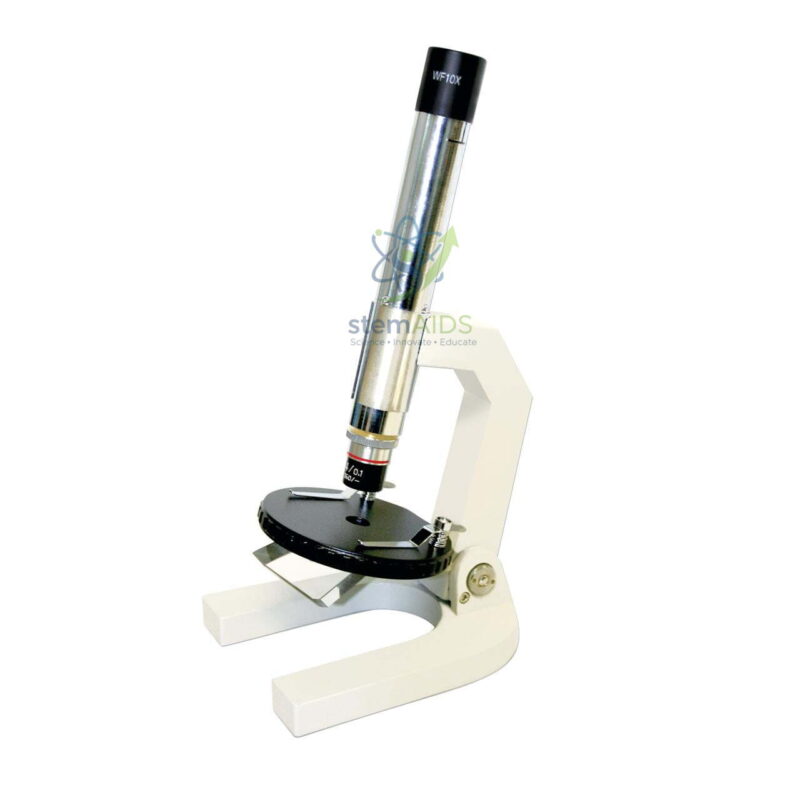
Quick Answer: The Prism Microscope, 40x is a simple student microscope with a single magnification of 40x, as stated in its title. The listing photograph shows a compact instrument with one vertical tube, a round stage with clips and a U-shaped base, suited to first microscope lessons in primary and middle school.
What 40x Magnification Shows
At 40x, an object looks forty times larger than to the naked eye. That is enough to turn a strip of onion skin into a wall of brick-shaped cells, a housefly’s leg into a spiky jointed limb, and a pinch of salt into a scatter of tiny cubes. It also reveals the fibres in paper and cloth, the scales on a butterfly wing and the larger organisms in a drop of pond water. It is not enough for bacteria, which need several hundred to a thousand times magnification and an oil-immersion objective.
A single fixed magnification suits beginners. There are no objectives to change, no risk of driving a high-power lens into a slide, and every student in a class sees the specimen at the same scale, which makes drawings and comparisons easier. Specimens are mounted on standard slides, thin enough for light to pass through, and held in place by the stage clips.
The title names a prism but does not describe its role, and the light source is not stated. In simple microscopes a prism or mirror is often used to direct light up through the specimen or to fold the light path; confirm how this model is lit before planning lessons in rooms without good daylight. For magnification that can be stepped up to higher powers, see the economy student microscope.
Applications
- First lessons on plant and animal cells using onion skin and similar specimens
- Looking at insect parts, feathers, hair and fibres
- Observing crystals of salt and sugar
- Science clubs and home-school programmes introducing the microscope
Care & Handling
- Clean the eyepiece and lens only with lens tissue; clothing and paper towels scratch coatings.
- Carry the microscope with one hand under the base and the other on the body.
- Cover it or return it to its box after use so dust does not settle on the optics.
Specifications
| Item | Student microscope with single magnification |
| Magnification | 40x, per the title |
| Form | Single vertical tube, round stage with clips, U-shaped base (listing photograph) |
| Specimens | Standard prepared slides and simple wet mounts |
| Prism role and light source | Confirm at enquiry |
Why Choose LabEquip
Primary and middle schools often buy simple microscopes in class sets so every pair of students has one. LabEquip lists this model in Biology Lab Products, and prepared specimens from the prepared slides range give students something to look at from the first lesson. Use the LabEquip contact page to confirm lighting and quantities.
Frequently Asked Questions
What can students see at 40x?
Onion and cheek cells as outlines, insect parts, hair, fibres, pollen masses, salt crystals and larger pond organisms. Details inside cells, such as organelles, need higher magnification.
Can this microscope show bacteria?
No. Bacteria are far too small to see at 40x. They need several hundred to a thousand times magnification, normally with an oil-immersion objective and stained slides.
What does the prism do in this microscope?
The title does not describe it, so confirm at enquiry. In simple microscopes a prism is commonly used to redirect light or to fold the light path, which affects where the light should come from.
How should a beginner focus the microscope?
Look from the side and bring the tube close to the slide without touching it. Then look through the eyepiece and move the tube slowly away from the slide until the specimen becomes sharp.
How should a specimen be prepared for viewing?
It must be thin and flat so light passes through it. Place it on a slide in a drop of water, lower a cover glass at an angle to avoid air bubbles, and clip the slide to the stage.
Who is a 40x microscope suitable for?
It suits young students and first-time users who need a simple instrument with one setting. Older students studying cell structure in detail need a compound microscope with several objectives.
Last Updated: September 2026
You must be logged in to post a review.
Bestsellers




Reviews
There are no reviews yet.