






In Stock
Monocotyledon Stem Model
$5.30
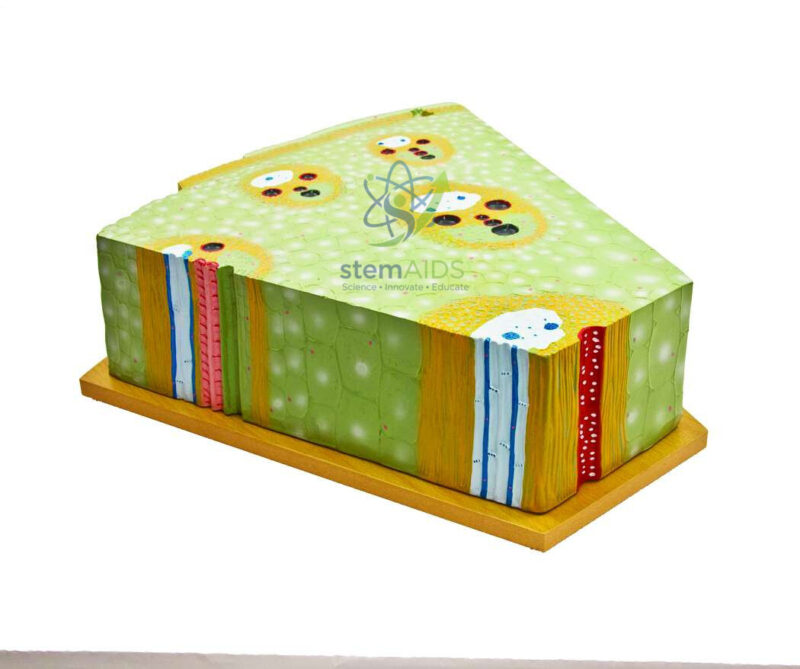
Quick Answer: The Monocotyledon Stem Model is an enlarged teaching model of the internal structure of a monocot stem. The listing photograph shows a block-style piece on a wooden base, with the top face cut as a transverse section and the sides showing the tissues running lengthwise.
Seeing the Monocot Stem in Three Dimensions
Most students first meet the monocot stem as a flat circle on a textbook page: many small vascular bundles scattered through soft ground tissue, with no ring and no clear pith. A block model adds depth. On the top face of the Monocotyledon Stem Model the bundles appear as the familiar scattered spots; on the side faces the same bundles run as long, parallel strands up the stem. Seeing both views together makes it clear that each spot in a cross-section is a strand cut across, not an isolated island of tissue.
The features to point out start at the outside. A single-layered epidermis is covered by cuticle, and under it lies a band of thick-walled supporting cells. Inside is ground tissue made of large, thin-walled parenchyma cells. The bundles are smaller and crowded near the edge and larger and more widely spaced towards the centre. In each one the xylem faces inwards and the phloem outwards, a sheath of fibres surrounds the whole bundle, and no cambium lies between xylem and phloem. That missing cambium explains why most monocot stems do not grow thicker year after year the way a tree trunk does.
The plant the model is based on, its scale and the number of cut faces are not stated in the title. Many teaching models follow the maize stem, where a large air or water space appears in older bundles. LabEquip also lists a flat T.S. monocot stem model that shows the cross-section alone.
Specifications
| Model of | Internal structure of a monocotyledon stem |
| Format | Block section on a wooden base, per the listing photograph |
| Views | Transverse face on top; lengthwise tissues on the sides |
| Key features | Epidermis, supporting layer, ground tissue, scattered closed vascular bundles |
| Plant basis, scale and material | Confirm at enquiry |
Care & Handling
- Lift the model by its base with both hands; painted edges of the block chip if it is knocked against a bench.
- Dust with a soft brush or dry cloth, and avoid solvents that can lift the paint and labels.
- Store away from direct sunlight, which fades the colours used to separate tissue types.
Classroom Uses
- Comparing monocot and dicot stems side by side before students draw labelled diagrams
- Explaining why most monocots lack secondary thickening
- Preparing students to identify bundles in a stained section of maize stem under the microscope
- Revision of plant tissue names ahead of practical examinations
Why Choose LabEquip
Botany teachers usually buy a monocot stem model alongside its dicot counterpart for comparison lessons. LabEquip lists this block model in Biology Lab Products with the matching monocot stem chart. Use the LabEquip contact page to confirm size and base before ordering.
Frequently Asked Questions
How can students tell a monocot stem from a dicot stem?
In a monocot stem the vascular bundles are scattered through the ground tissue. In a dicot stem they sit in a single ring, with a distinct cortex outside and a pith inside. Monocot bundles also lack cambium.
Why do most monocot stems not thicken each year?
Their vascular bundles have no cambium, the layer that produces new xylem and phloem in dicots and conifers. Without it there is no ring of new wood each season. Palms become thick in other ways.
What does the block format show that a flat cross-section model does not?
The side faces show the vascular bundles as long strands running along the stem. That makes it clear the spots in a cross-section are strands cut across, and helps students connect transverse and longitudinal sections.
Which part of a vascular bundle faces the centre of the stem?
The xylem faces inwards, towards the centre, and the phloem faces outwards. A sheath of thick-walled fibres surrounds the bundle and gives the stem much of its strength.
Which plant is a monocot stem model usually based on?
Maize is the most common example in textbooks and models, with its large bundles and a clear space in older xylem. The plant used for this model is not named in the title, so confirm it at enquiry if it matters for your syllabus.
How can students compare the model with a real stem?
Cut a thin cross-section of a maize or grass stem with a sharp blade, stain it, and view it under low power. Students can then match the scattered bundles and fibre sheaths they see with the model.
Last Updated: September 2026
You must be logged in to post a review.
Bestsellers




Reviews
There are no reviews yet.