



In Stock
Molecular Model of DNA PCR Principle
Modèle moléculaire de l’ADN Principe de la PCR Features precision-engineered snap-fit connectors that simulate specific base-pairing affinity, allowing for the physical separation and re-annealing of double-stranded DNA during simulated thermal cycles.
Color-Coded Nucleotide Matrix incorporates high-density, chemically-resistant polymer components representing deoxyribose sugars, phosphate groups, and nitrogenous bases calibrated to standard molecular geometry for accurate double-helix torsion.
$24.03
Quick Answer: The Molecular Model of DNA PCR Principle is a DNA model for teaching the polymerase chain reaction: how the strands are separated, primers attach and new strands are built, so that one DNA sequence is copied millions of times. Biology and biotechnology classes use it to follow the DNA PCR principle step by step.
Three Steps, Repeated
PCR copies a chosen stretch of DNA in cycles, each with three temperature steps. In denaturation, at around 94 to 98 °C, the hydrogen bonds between base pairs break and the double helix separates into two single strands. In annealing, at a lower temperature typically between about 50 and 65 °C, short single-stranded primers bind to matching sequences at each end of the target. In extension, at around 72 °C, a heat-stable DNA polymerase such as Taq polymerase adds nucleotides to each primer and builds a new complementary strand.
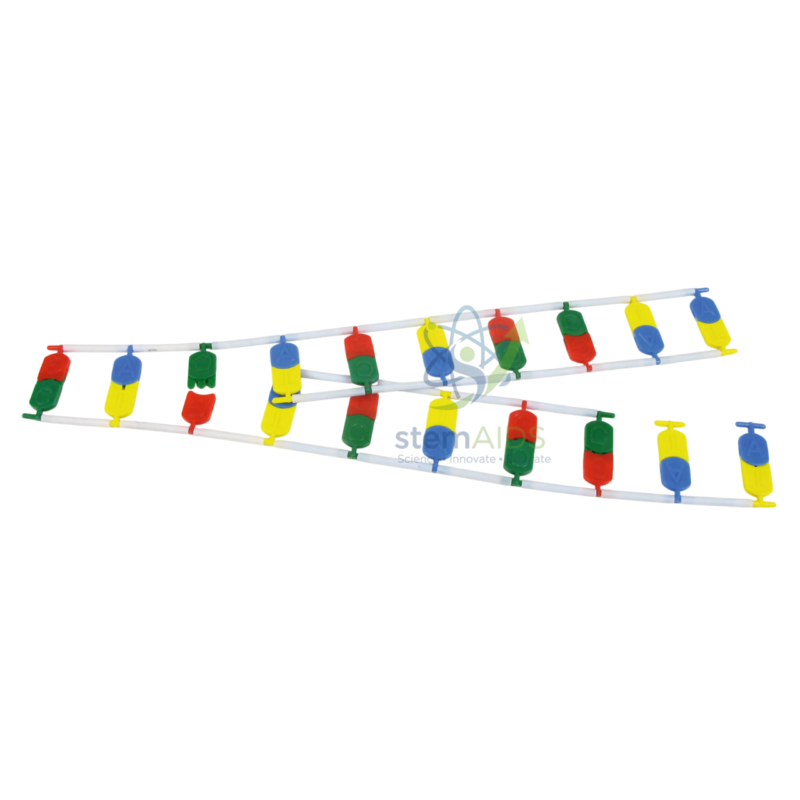
The product photo shows two DNA strands with coloured base pieces held apart, the starting point of a cycle, which a class can close and reopen by hand. Physically separating the strands, placing a primer on each and adding bases in the 5′ to 3′ direction makes it clear why two primers are needed, one for each strand, and why the copies made in later cycles start and stop exactly at the primers.
Doubling is the point of the method. Each cycle can double the number of target copies, so after 30 cycles one molecule can in principle become about a billion. The listing does not give the parts list or say whether primers and polymerase are represented. The model follows naturally from a basic DNA structure model, and PCR products are later cloned into vectors like the one in the plasmid model kit.
Specifications
| Model of | DNA during the polymerase chain reaction |
| Steps shown | Denaturation, primer annealing, extension |
| Shown in the product photo | Two separated DNA strands with coloured base pieces |
| Key ideas | Complementary base pairing, primers, 5′ to 3′ synthesis, doubling per cycle |
| Parts list, primer and enzyme pieces | Confirm at enquiry |
Teaching Uses
- Explaining how PCR amplifies a target sequence in molecular biology and biotechnology courses
- Linking PCR to DNA profiling, forensic analysis and diagnostic testing for infections
- Comparing PCR with DNA replication in the cell: heat instead of helicase, one target instead of the whole genome
- Calculating copy numbers after a given number of cycles
Care & Handling
- Keep the strands and base pieces sorted in their storage box so both strands can be rebuilt quickly.
- Open and close the strands gently at the base-pair joints, since forcing them loosens the connectors over time.
- Wipe with a dry or slightly damp cloth and store away from heat.
Why Choose LabEquip
Biotechnology and biology teachers use a PCR model because the temperature cycle is easy to recite but hard to picture at the level of molecules. It is part of LabEquip’s biology lab products; ask about the parts through the contact page.
Frequently Asked Questions
What does PCR stand for?
Polymerase chain reaction. It is a laboratory method for making many copies of a specific DNA sequence using a heat-stable DNA polymerase, two primers, nucleotides and repeated heating and cooling.
Why is DNA heated to about 95 °C in PCR?
The heat breaks the hydrogen bonds between complementary bases and separates the double helix into single strands. Each single strand can then act as a template for a new strand.
What are primers and why are two needed?
Primers are short, single-stranded DNA sequences that bind at the start of the target region. DNA polymerase can only extend an existing strand, so a primer is needed on each of the two template strands, one at each end of the target.
Why is Taq polymerase used?
It comes from Thermus aquaticus, a bacterium that lives in hot springs, so it is not destroyed by repeated heating to around 95 °C. Earlier methods needed fresh enzyme after every cycle.
How many copies does PCR make?
Each cycle can double the number of copies of the target. After 30 cycles one starting molecule can in principle give about a billion copies, although efficiency drops in later cycles as reagents run low.
Where is PCR used in real life?
In diagnosing infections by detecting a pathogen’s DNA or RNA, in forensic DNA profiling and paternity testing, in detecting genetic disorders, and in research for cloning and sequencing genes.
Last Updated: September 2026
You must be logged in to post a review.
Bestsellers




Reviews
There are no reviews yet.