













In Stock
Large Diameter Magnifying Glass
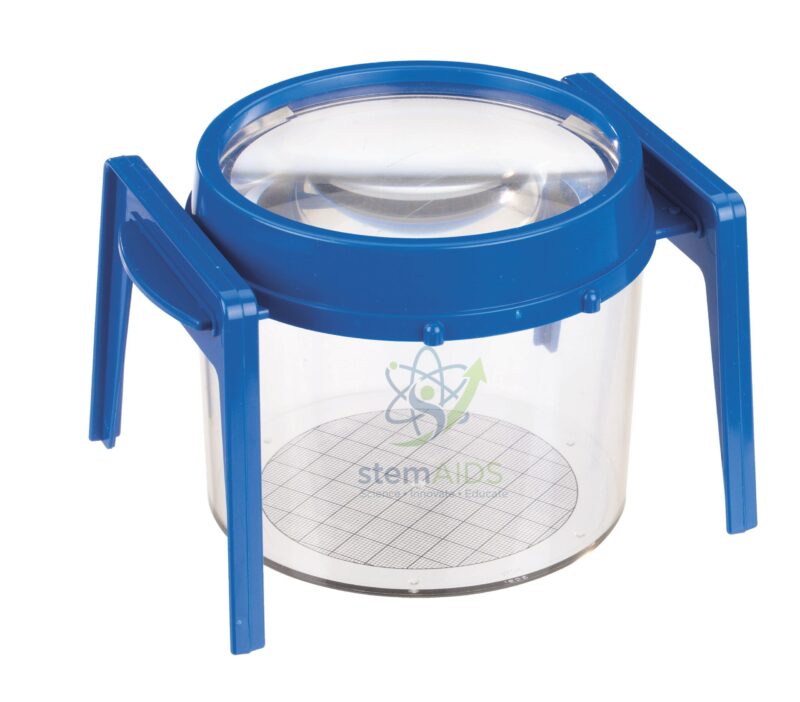
Boîte-loupe grand diamètre Features a wide-diameter plano-convex optical element integrated into the viewing lid, providing a stabilized focal plane that minimizes spherical aberration for high-resolution macroscopic specimen inspection.
Metric-Calibrated Measurement Grid The base of the observation chamber includes a precision-molded 5mm/10mm grid, enabling real-time quantitative size assessment and morphological data recording directly within the controlled environment.
₹1,148.00
Quick Answer: The Large Diameter Magnifying Glass is a magnifier with a wide lens, so a whole insect, leaf or rock sample can be seen enlarged at once and by more than one pair of eyes. It is used in primary science, biology and nature study for close observation without a microscope.
Why Lens Diameter Matters
A magnifier’s lens diameter decides how much of the object is seen at once and how comfortable it is to use. A small, strong hand lens gives high magnification over a tiny field and must be held close to the eye; a wide lens gives lower magnification but a broad, bright view that children can use without squinting, and two or three pupils can look through it together. For whole animals, flowers and rock surfaces, that wide field is usually more useful than extra power.
The version shown in the product photo holds the lens in a lid above a clear container raised on legs, so a beetle, spider or woodlouse can be placed inside and watched while it moves, without being handled. The base in the photo appears to carry a printed grid, which lets pupils estimate size. The listing does not give the lens diameter or magnification.
Magnifier work is often the first step before the microscope. Pupils draw what they see, count legs and body sections, trace leaf veins or crystal faces, and then move to a stereo microscope for finer detail. A cage terrarium keeps animals comfortable between viewing sessions.
Observation Activities
- Minibeast hunts: watching insects and woodlice move without handling them
- Looking at leaf veins, flower parts, seeds and pollen-covered anthers
- Examining rock and mineral surfaces for grains and crystals
- Drawing and labelling specimens as an introduction to scientific observation
Care & Handling
- Clean the lens with a soft lens cloth or tissue; paper towels and sleeves scratch plastic lenses.
- Never leave the magnifying glass in direct sun, because a lens concentrates sunlight and can scorch surfaces or start a fire.
- Return animals to where they were found soon after viewing, and wash the container before the next specimen.
Specifications
| Type | Wide-lens magnifier for observing whole specimens |
| Design shown in the product photo | Lens in a lid above a clear viewing container on legs |
| Suitable subjects | Insects, spiders, snails, leaves, flowers, seeds, rocks |
| Users | Primary and lower-secondary science, nature clubs |
| Lens diameter and magnification | Confirm at enquiry |
Why Choose LabEquip
Primary teachers and outdoor-learning leaders usually buy magnifiers in class sets so each group has its own. This magnifier is in LabEquip’s biology lab products; send the number of groups you need through the contact page.
Frequently Asked Questions
What is the advantage of a large diameter lens?
It shows more of the object at once and is easier to look through, so young children and small groups can use it comfortably. The trade-off is lower magnification than a small, strong hand lens.
Can children safely use the magnifier with live insects?
Yes, if the insect is placed gently inside and returned soon after. Viewing through a container means the animal is not held in fingers, which protects both the animal and the child.
Is a magnifying glass a fire hazard?
It can be in strong sunlight, because the lens focuses the sun’s rays to a hot spot. Store it covered or indoors away from windows, and never use it to focus sunlight on anything.
How does a magnifying glass make things look bigger?
It is a convex lens. When an object sits closer to the lens than its focal length, the lens forms an enlarged, upright virtual image, which the eye sees as a bigger version of the object.
When should students move on to a microscope?
When the detail they need is smaller than the magnifier can show, such as the hairs on an insect’s leg or the cells in a leaf. A stereo microscope is the next step for whole specimens, and a compound microscope for thin sections.
How should the lens be cleaned?
Blow or brush off grit first, then wipe gently with a lens cloth, using a little water or lens cleaner if needed. Avoid solvents on plastic lenses, as they can cloud the surface.
Last Updated: September 2026
You must be logged in to post a review.
Bestsellers




Reviews
There are no reviews yet.