
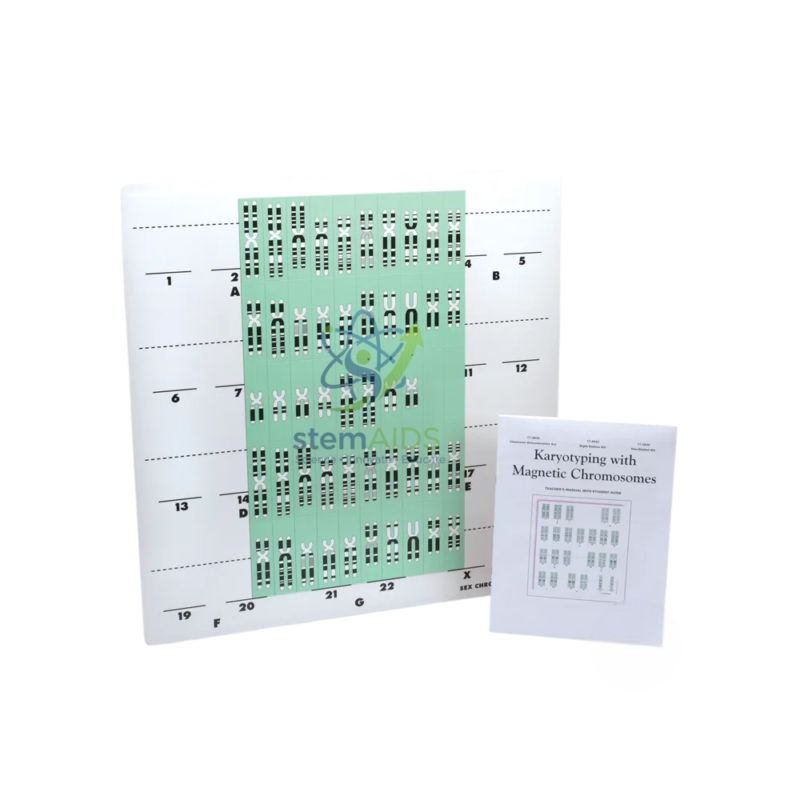
Quick Answer: The Karyotype with Magnetized Chromosomes is a classroom karyotyping activity in which magnetic chromosome pieces are sorted into matched pairs on a board, in order of size and banding. Students use it to learn how a karyotype is built and how conditions such as Down syndrome are recognised from one.
Building a Karyotype on the Board
A karyotype is the complete set of chromosomes in a cell, photographed during cell division and arranged in pairs. A human karyotype has 23 pairs: 22 pairs of autosomes, numbered roughly from largest to smallest, and one pair of sex chromosomes, XX in females and XY in males. Cytogeneticists match chromosomes by length, by the position of the centromere and by their pattern of light and dark bands after staining.
The product photo shows a board marked with numbered positions, black-and-white banded chromosome pieces and a booklet on karyotyping with magnetic chromosomes. Because the pieces are magnetized, as the title says, students can slide them around the board, compare two candidates side by side and correct mistakes, which is how the matching is actually learned.
Once the karyotype is complete, students count. Three copies of chromosome 21 indicate trisomy 21, the cause of Down syndrome; a single X with no second sex chromosome indicates Turner syndrome; XXY indicates Klinefelter syndrome. The chromatid chromosomes set covers what chromosomes do during cell division.
Specifications
| Activity | Arranging chromosomes into a karyotype |
| Pieces | Magnetized chromosome pieces (as named in the title) |
| Shown in the product photo | Numbered board, banded chromosome pieces, instruction booklet |
| Matching criteria | Length, centromere position, banding pattern |
Where It Is Used
- Secondary and pre-university genetics lessons on chromosomes and inheritance
- Identifying numerical abnormalities such as trisomy 21, Turner and Klinefelter syndromes
- Explaining non-disjunction in meiosis as the origin of an extra or missing chromosome
- Introducing prenatal screening and genetic counselling in health and ethics discussions
Care & Handling
- Keep the magnetic pieces away from electronic devices, bank cards and computer drives.
- Return pieces to storage in number order so a missing chromosome is noticed at once.
- Store the board flat and dry, and avoid leaving the pieces stuck together in a heap, which can bend thin magnetic sheet.
Why Choose LabEquip
Genetics teachers use a magnetic karyotype because it can be built on the board in front of the class, then scrambled and rebuilt by students. It is part of LabEquip’s biology lab products; send questions about the karyotypes included through the contact page.
Related Products
- Chromatid Chromosomes Set: Model chromosome pieces showing sister chromatids, centromeres, homologous pairs and an X and Y pair.
- Meiosis Manipulatives Kit: Meiosis manipulatives for modelling how homologous chromosomes separate, the step that goes wrong in non-disjunction.
- Genetic Set Student: A student set for gametes, segregation and fertilisation with bar-shaped chromosomes of different lengths.
- Model of a Cell in Mitosis: Eight model animal cells showing mitosis, the stage at which chromosomes are photographed for a karyotype.
- Animal Meiosis Model, Small: A small model of animal meiosis I and II, showing pairing, crossing over and reduction division.
Frequently Asked Questions
How does a magnetic karyotype activity work?
Banded chromosome pieces are sorted on a numbered board into matched pairs, arranged roughly from largest to smallest with the sex chromosomes last. Because the pieces are magnetized they stay in place when the board is upright, so a teacher can build a karyotype in front of the class or groups can check each other’s arrangements.
How many chromosome pairs should a normal human karyotype show?
A normal human karyotype has 46 chromosomes in 23 pairs. There are 22 pairs of autosomes, numbered 1 to 22 roughly by size, and one pair of sex chromosomes: XX in a female and XY in a male. Counting the pieces on the board is the first check before looking for abnormalities.
How do you tell which two chromosomes are a matching pair?
Homologous chromosomes match in three ways: they are the same length, their centromere is in the same position, and their pattern of light and dark bands is the same. Students compare all three on the pieces. The X and Y are the exception, as they differ in size but still form the sex chromosome pair in a male.
What does Down syndrome look like on a karyotype?
Down syndrome shows as three copies of chromosome 21 instead of two, called trisomy 21, giving a total of 47 chromosomes. Other changes seen in class activities include trisomy 18, trisomy 13, a single X in Turner syndrome (45,X) and an extra X in a male in Klinefelter syndrome (47,XXY).
What causes an extra or missing chromosome?
Most cases come from non-disjunction, when chromosomes or chromatids fail to separate during meiosis. One gamete then gets an extra chromosome and another gets none. If such a gamete is fertilised, the embryo has a trisomy or a monosomy. The chance of non-disjunction in eggs rises with the mother’s age.
Which genetic conditions cannot be seen on a karyotype?
A karyotype shows the number of chromosomes and large structural changes, such as missing or swapped pieces. It cannot show single-gene conditions like cystic fibrosis or sickle cell disease, where the change is too small to see under a microscope. Those need DNA-based tests.
Last Updated: November 2026







Reviews
There are no reviews yet.