













In Stock
Immunology Demonstration Group
Ensemble immunologie de démonstration Features precision-molded components representing diverse antigenic epitopes and antibody paratopes, designed with specific mechanical-fit tolerances to demonstrate lock-and-key molecular recognition.
Magnetic Affinity Simulation Interface. Integrated rare-earth neodymium nodes within the ligand-receptor models provide calibrated haptic feedback, simulating variable binding affinities found in primary and secondary immune system responses.
₹1,130.00
Quick Answer: The Immunology Demonstration Group is an immunology demonstration set: a group of display pieces representing immune cells, antibodies and antigens that a teacher arranges on a board to show how the body recognises and fights infection. It is used in biology lessons on immunity, antibodies and vaccination.
Building an Immune Response on the Board
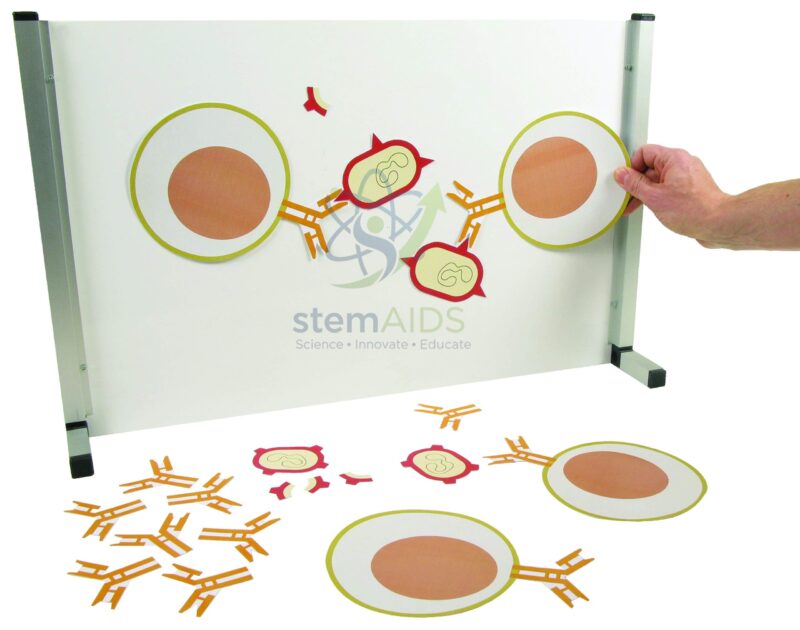
Immunology is full of interactions that are hard to show in a textbook diagram, and movable pieces let the teacher build each step in front of the class. The product photo shows round cells with nuclei, Y-shaped antibodies and smaller antigen-bearing particles arranged on a white board; group in the title most likely means a set of pieces for demonstrating to a group. Whether the pieces are magnetic, and how many of each are supplied, are not stated in the listing.
A typical sequence starts with a pathogen carrying antigens entering the body. Phagocytes engulf and digest it and display its antigens, helper T cells recognise them, and the B cell whose receptors match the antigen is activated. That B cell divides into many plasma cells releasing antibodies, a process called clonal selection, while some of its offspring become memory cells. Each antibody is a Y-shaped protein with two identical binding sites at the tips of its arms, so antibodies can clump pathogens together for phagocytes to remove.
The same pieces explain vaccination. A vaccine presents harmless antigens so memory cells form without illness; on a later infection the secondary response is faster and larger, and the pathogen is cleared before symptoms develop. Many of these cells gather in lymph nodes, shown in detail on the human lymph node model.
Lessons It Supports
- Antigen and antibody specificity: why each antibody fits one antigen
- Primary and secondary immune responses and the role of memory cells
- How vaccines work and why booster doses are given
- Agglutination, and how antibody-antigen reactions are used in blood grouping and rapid tests
Care & Handling
- Store the pieces flat in labelled envelopes or trays by type, so cells, antibodies and antigens can be laid out quickly.
- Clean with a dry or slightly damp cloth, and keep the pieces away from heat and direct sunlight, which can warp or fade them.
- Make sure the board surface is clean before a demonstration so the pieces sit flat and stay in place.
Specifications
| Type | Demonstration pieces for teaching the immune response |
| Pieces shown in the product photo | Cells with nuclei, Y-shaped antibodies, antigen-bearing particles |
| Topics | Antigens, antibodies, phagocytosis, B and T cells, memory, vaccination |
| Use | Teacher-led board demonstration for a whole class |
| Number of pieces and whether magnetic | Confirm at enquiry |
Why Choose LabEquip
Biology teachers use a board set like this when immunity is on the syllabus and the class needs to see the sequence built step by step. It is listed in LabEquip’s biology lab products; to check the piece count and mounting, use the contact page.
Frequently Asked Questions
What is an antigen?
An antigen is a molecule, usually a protein or carbohydrate on the surface of a cell or virus, that the immune system recognises as foreign. Each antigen has a particular shape that only matching antibodies and receptors bind to.
Why are antibodies drawn as a Y shape?
An antibody is made of four protein chains, two heavy and two light, arranged in a Y. The tips of the two arms are the variable regions that bind a specific antigen, while the stem interacts with other parts of the immune system.
What is the difference between B cells and T cells?
B cells produce antibodies once activated. T cells do not: helper T cells coordinate the response by activating B cells and other cells, and cytotoxic T cells kill body cells infected with viruses.
How does vaccination give immunity?
A vaccine exposes the immune system to antigens from a pathogen, or to instructions for making them, without causing the disease. Memory cells are produced, so a later infection triggers a faster and stronger secondary response.
What is agglutination?
Because each antibody has two binding sites, it can link two antigen-bearing particles. Many antibodies together clump pathogens or cells into groups, which makes them easier for phagocytes to remove and is also the basis of blood-group tests.
Why is the secondary immune response faster?
Memory B and T cells from the first exposure remain in the body. When the same antigen appears again, they are activated quickly and in larger numbers, so antibody levels rise sooner and higher than the first time.
Last Updated: September 2026
You must be logged in to post a review.
Bestsellers




Reviews
There are no reviews yet.