



In Stock
High School Genetic Code
Ensemble code génétique lycée features a precision-molded mechanical interface representing hydrogen bonding sites, ensuring that only correct purine-pyrimidine and codon-anticodon pairings are physically compatible during sequence assembly.
Universal Amino Acid Correlation System includes a set of 20 distinct molecular units with integrated color-coded nomenclature, specifically calibrated to match the standard genetic code for high-accuracy polypeptide chain synthesis demonstrations.
₹1,950.00
Quick Answer: High School Genetic Code is a genetic code model set for secondary students: coloured pieces for building nucleic acid strands and reading them as codons that specify amino acids. It is used to teach how the sequence of bases in DNA becomes the sequence of amino acids in a protein.
Reading the Genetic Code with Model Pieces
The genetic code is the set of rules by which a sequence of bases becomes a sequence of amino acids. It is read in triplets: each group of three mRNA bases, a codon, stands for one amino acid or a stop signal. Four bases give 64 possible codons for 20 amino acids, so most amino acids have more than one codon, which is why the code is called degenerate. AUG both codes for methionine and marks where translation starts, while UAA, UAG and UGA mean stop.
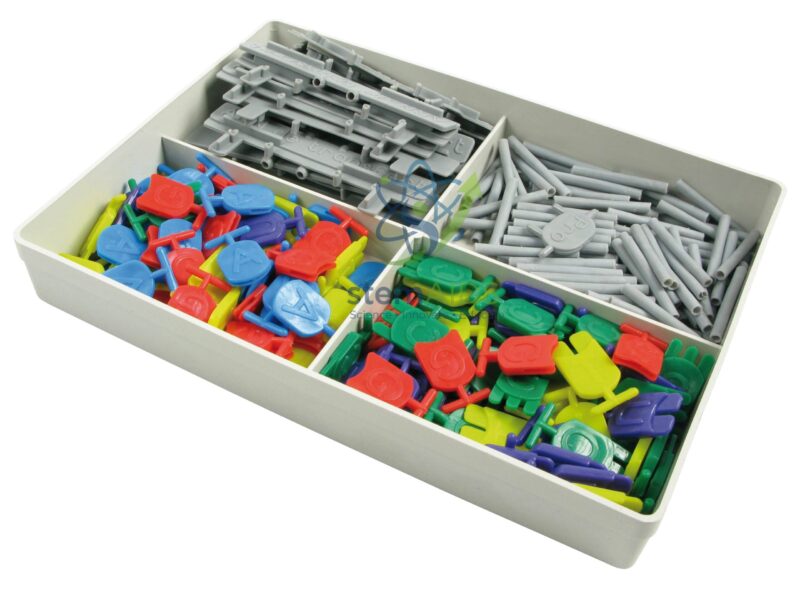
The product photo shows a tray of coloured plastic pieces in several shapes alongside grey backbone parts, the kind of kit in which students assemble a strand, transcribe it into mRNA and then match codons to amino-acid pieces. Building a sequence by hand makes it obvious why the reading frame matters: shift the starting point by one base and every codon after it changes.
That leads straight into mutations. A substitution changes one codon and may change one amino acid, or none if the new codon codes for the same one. An insertion or deletion of a single base causes a frameshift that scrambles everything downstream. The listing gives no parts list, so confirm which molecules can be built; the RNA molecular model concentrates on the RNA molecules themselves.
What Students Do with It
- Transcribing a short DNA template into mRNA using base-pairing rules
- Translating codons into a short chain of amino acids with a codon table
- Modelling substitution, insertion and deletion mutations and comparing their effects
- Showing how sickle-cell anaemia follows from a single base change
Specifications
| Level | High school (secondary) biology |
| Concepts | Codons, reading frame, start and stop codons, amino acids |
| Processes modelled | Transcription and translation |
| Pieces shown in the product photo | Coloured shaped pieces and grey backbone parts in a tray |
| Parts list | Confirm at enquiry |
Care & Handling
- Sort pieces by type into the tray compartments at the end of each lesson so the next class can start quickly.
- Wash grubby pieces in lukewarm soapy water and dry them before packing away.
- Keep the set away from radiators and sunny windowsills, where plastic parts can warp or fade.
Why Choose LabEquip
Biology teachers use a hands-on genetic code set when students can recite three bases for one amino acid but cannot apply it to a sequence. It sits in LabEquip’s biology lab products; ask about the parts included through the contact page.
Frequently Asked Questions
What is a codon?
A codon is a sequence of three bases in messenger RNA that codes for one amino acid or signals the end of translation. The ribosome reads the mRNA codon by codon, and a transfer RNA with the matching anticodon brings the corresponding amino acid.
Why is the genetic code described as degenerate?
There are 64 codons but only 20 amino acids, so most amino acids are coded by more than one codon; glycine, for example, is coded by GGU, GGC, GGA and GGG. This redundancy means some base changes have no effect on the protein.
What are start and stop codons?
AUG is the usual start codon: it sets the reading frame and codes for methionine. UAA, UAG and UGA are stop codons, which no amino acid matches, and translation ends when the ribosome reaches one.
What is a frameshift mutation?
It is caused by inserting or deleting a number of bases that is not a multiple of three. Every codon after the change is read differently, so the protein is usually badly altered or ends early at a new stop codon.
Is the genetic code the same in all organisms?
It is almost universal: the same codons code for the same amino acids in bacteria, plants and animals, with a few small exceptions such as in mitochondria. This is strong evidence that all life shares a common ancestor.
How does sickle-cell anaemia relate to the genetic code?
A single base substitution in the gene for the beta chain of haemoglobin changes one codon, so glutamic acid is replaced by valine. That one amino-acid change makes haemoglobin molecules stick together when oxygen levels are low.
Last Updated: September 2026
You must be logged in to post a review.
Bestsellers




Reviews
There are no reviews yet.